This website uses cookies to ensure you get the best experience on our website.


- Table of Contents
Designing a Western blot for Ephrin type-B receptor 4? The guide has the expected band size, antibodies backed by real blot images, the controls to run alongside, and protocols taken from published papers.
Open the EPHB4 Western Blot GuideDesigning an IHC experiment for Ephrin type-B receptor 4? The guide has the expected staining pattern, antigen retrieval and fixation, antibodies backed by real IHC images, the tissue controls to run alongside, and protocols taken from published papers.
Open the EPHB4 IHC Guide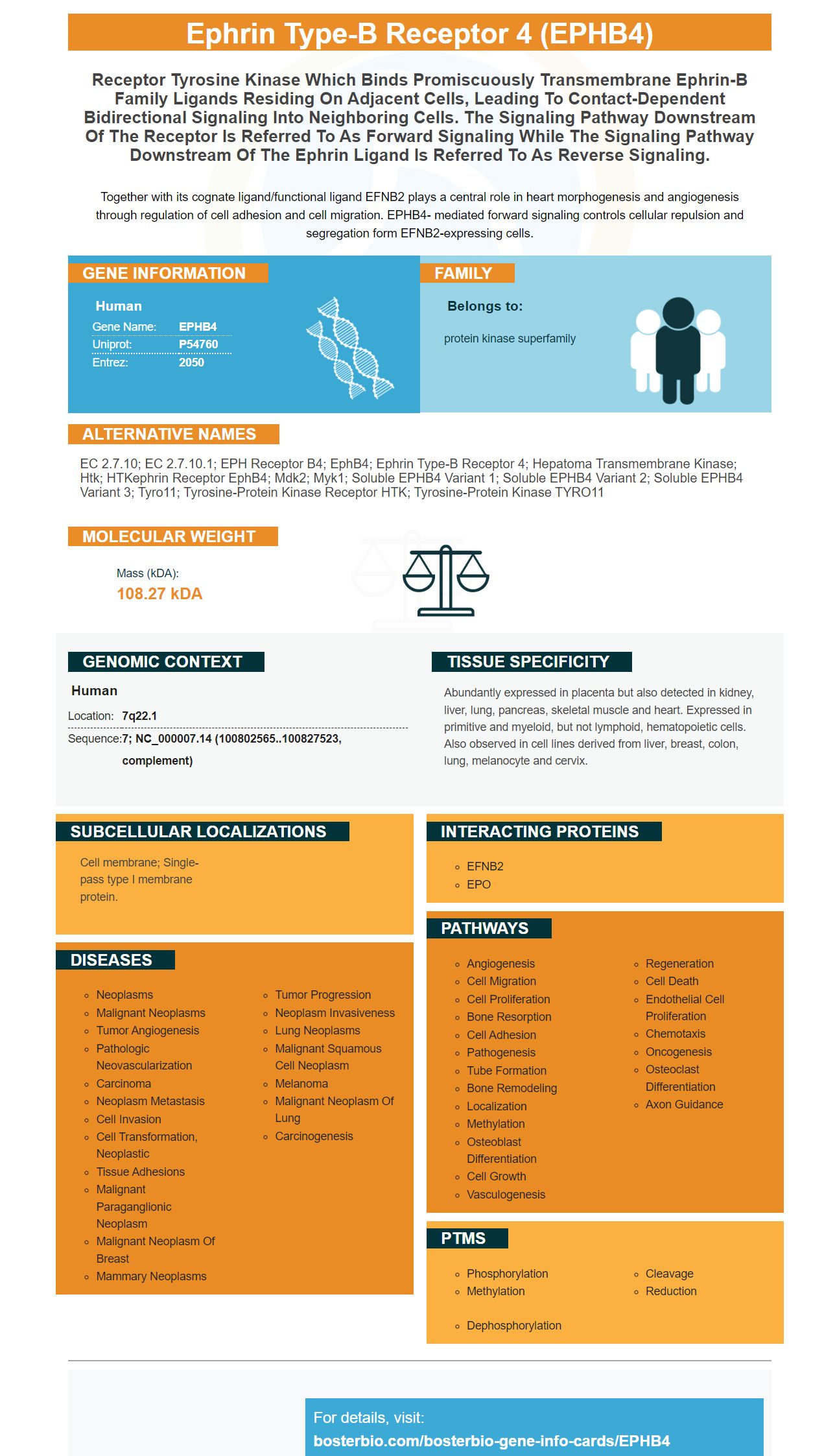
1 Citations
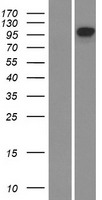
Facts about Ephrin type-B receptor 4.
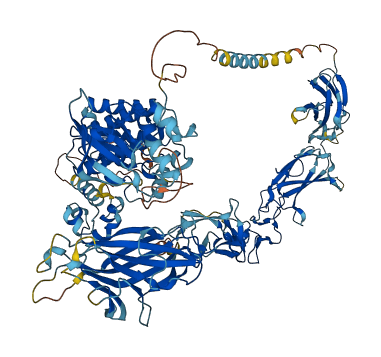
Together with its cognate ligand/functional ligand EFNB2 plays a central role in heart morphogenesis and angiogenesis through regulation of cell adhesion and cell migration. EPHB4- mediated forward signaling controls cellular repulsion and segregation form EFNB2-expressing cells.
| Human | |
|---|---|
| Gene Name: | EPHB4 |
| Uniprot: | P54760 |
| Entrez: | 2050 |

| Belongs to: |
|---|
| protein kinase superfamily |

EC 2.7.10; EC 2.7.10.1; EPH receptor B4; EphB4; ephrin type-B receptor 4; hepatoma transmembrane kinase; Htk; HTKephrin receptor EphB4; Mdk2; Myk1; soluble EPHB4 variant 1; soluble EPHB4 variant 2; soluble EPHB4 variant 3; Tyro11; Tyrosine-protein kinase receptor HTK; Tyrosine-protein kinase TYRO11
Mass (kDA):
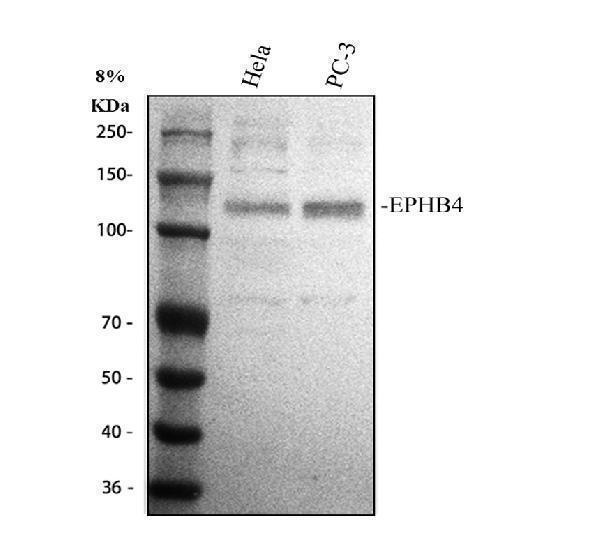
108.27 kDA

| Human | |
|---|---|
| Location: | 7q22.1 |
| Sequence: | 7; NC_000007.14 (100802565..100827523, complement) |
Abundantly expressed in placenta but also detected in kidney, liver, lung, pancreas, skeletal muscle and heart. Expressed in primitive and myeloid, but not lymphoid, hematopoietic cells. Also observed in cell lines derived from liver, breast, colon, lung, melanocyte and cervix.
Cell membrane; Single-pass type I membrane protein.





PMID: 8188704 by Bennett B.D., et al. Cloning and characterization of HTK, a novel transmembrane tyrosine kinase of the EPH subfamily.
PMID: 11239002 by Wilson M.D., et al. Comparative analysis of the gene-dense ACHE/TFR2 region on human chromosome 7q22 with the orthologous region on mouse chromosome 5.
*More publications can be found for each product on its corresponding product page