This website uses cookies to ensure you get the best experience on our website.


- Table of Contents
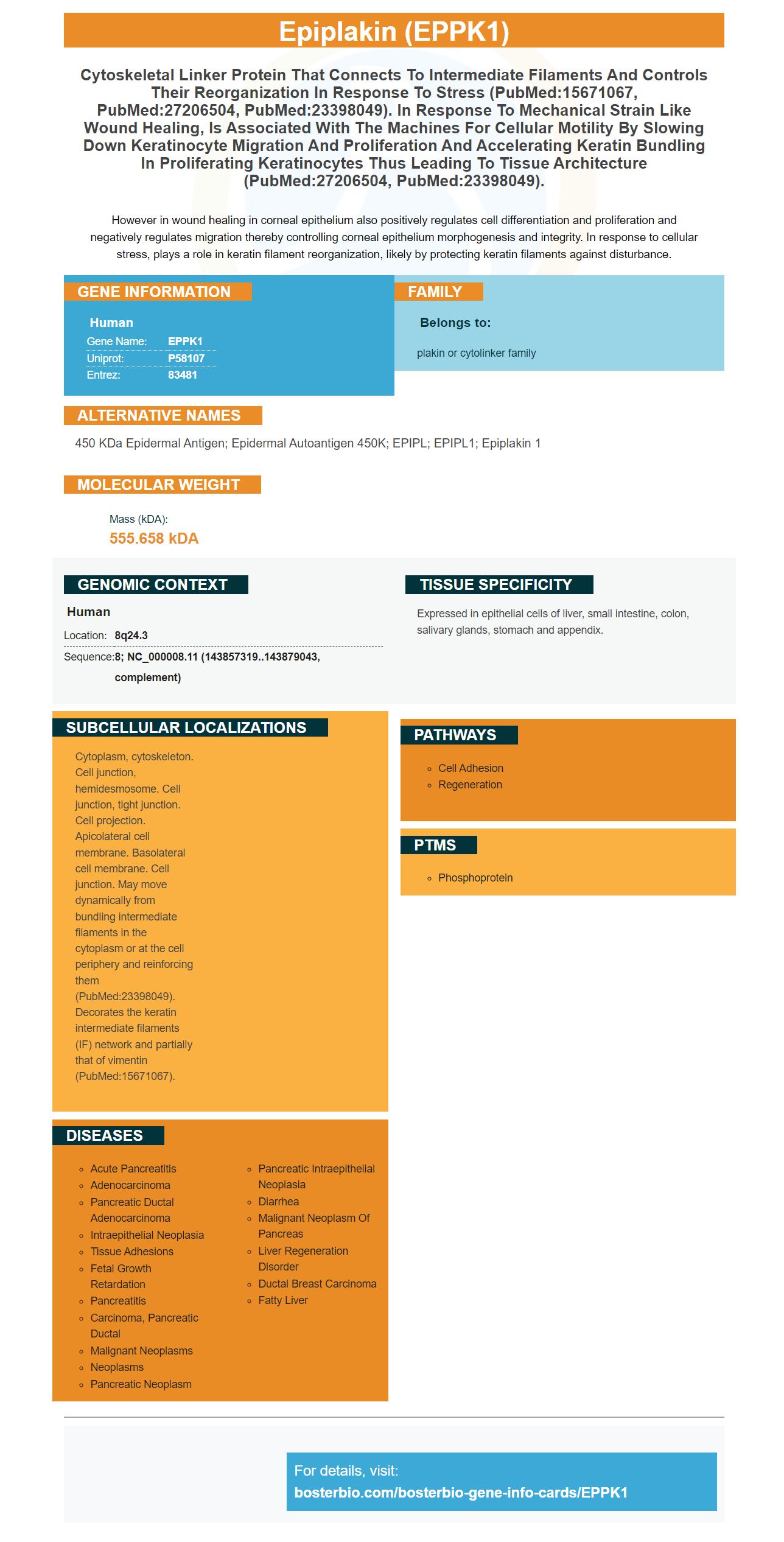
Facts about Epiplakin.
However in wound healing in corneal epithelium also positively regulates cell differentiation and proliferation and negatively regulates migration thereby controlling corneal epithelium morphogenesis and integrity. In response to cellular stress, plays a role in keratin filament reorganization, likely by protecting keratin filaments against disturbance.
| Human | |
|---|---|
| Gene Name: | EPPK1 |
| Uniprot: | P58107 |
| Entrez: | 83481 |
| Belongs to: |
|---|
| plakin or cytolinker family |

450 KDa Epidermal Antigen; Epidermal Autoantigen 450K; EPIPL; EPIPL1; Epiplakin 1
Mass (kDA):
555.658 kDA

| Human | |
|---|---|
| Location: | 8q24.3 |
| Sequence: | 8; NC_000008.11 (143857319..143879043, complement) |
Expressed in epithelial cells of liver, small intestine, colon, salivary glands, stomach and appendix.
Cytoplasm, cytoskeleton. Cell junction, hemidesmosome. Cell junction, tight junction. Cell projection. Apicolateral cell membrane. Basolateral cell membrane. Cell junction. May move dynamically from bundling intermediate filaments in the cytoplasm or at the cell periphery and reinforcing them (PubMed:23398049). Decorates the keratin intermediate filaments (IF) network and partially that of vimentin (PubMed:15671067).



PMID: 11278896 by Fujiwara S., et al. Epiplakin, a novel member of the plakin family originally identified as a 450-kDa human epidermal autoantigen: structure and tissue localization.
PMID: 14708632 by Takeo N., et al. Structure and heterogeneity of the human gene for epiplakin (EPPK1).