This website uses cookies to ensure you get the best experience on our website.


- Table of Contents
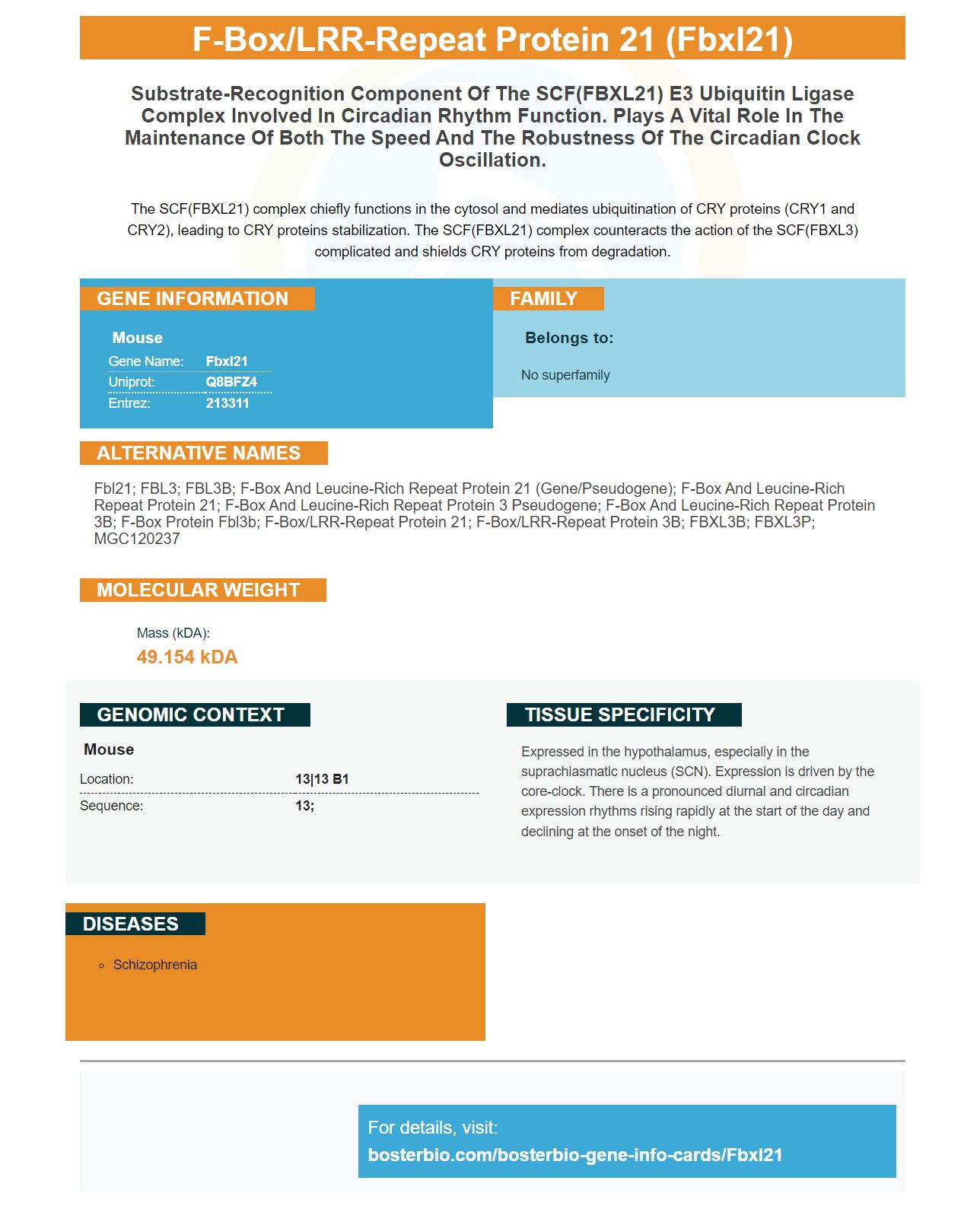
Facts about F-box/LRR-repeat protein 21.
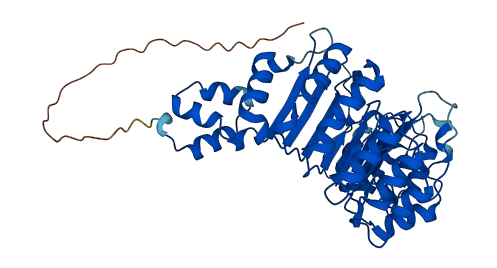
The SCF(FBXL21) complex chiefly functions in the cytosol and mediates ubiquitination of CRY proteins (CRY1 and CRY2), leading to CRY proteins stabilization. The SCF(FBXL21) complex counteracts the action of the SCF(FBXL3) complicated and shields CRY proteins from degradation.
| Mouse | |
|---|---|
| Gene Name: | Fbxl21 |
| Uniprot: | Q8BFZ4 |
| Entrez: | 213311 |
| Belongs to: |
|---|
| No superfamily |

Fbl21; FBL3; FBL3B; F-box and leucine-rich repeat protein 21 (gene/pseudogene); F-box and leucine-rich repeat protein 21; F-box and leucine-rich repeat protein 3 pseudogene; F-box and leucine-rich repeat protein 3B; F-box protein Fbl3b; F-box/LRR-repeat protein 21; F-box/LRR-repeat protein 3B; FBXL3B; FBXL3P; MGC120237
Mass (kDA):
49.154 kDA

| Mouse | |
|---|---|
| Location: | 13|13 B1 |
| Sequence: | 13; |
Expressed in the hypothalamus, especially in the suprachiasmatic nucleus (SCN). Expression is driven by the core-clock. There is a pronounced diurnal and circadian expression rhythms rising rapidly at the start of the day and declining at the onset of the night.


PMID: 18953409 by Dardente H., et al. Implication of the F-Box Protein FBXL21 in circadian pacemaker function in mammals.
PMID: 23452855 by Yoo S.H., et al. Competing E3 ubiquitin ligases govern circadian periodicity by degradation of CRY in nucleus and cytoplasm.