This website uses cookies to ensure you get the best experience on our website.


- Table of Contents
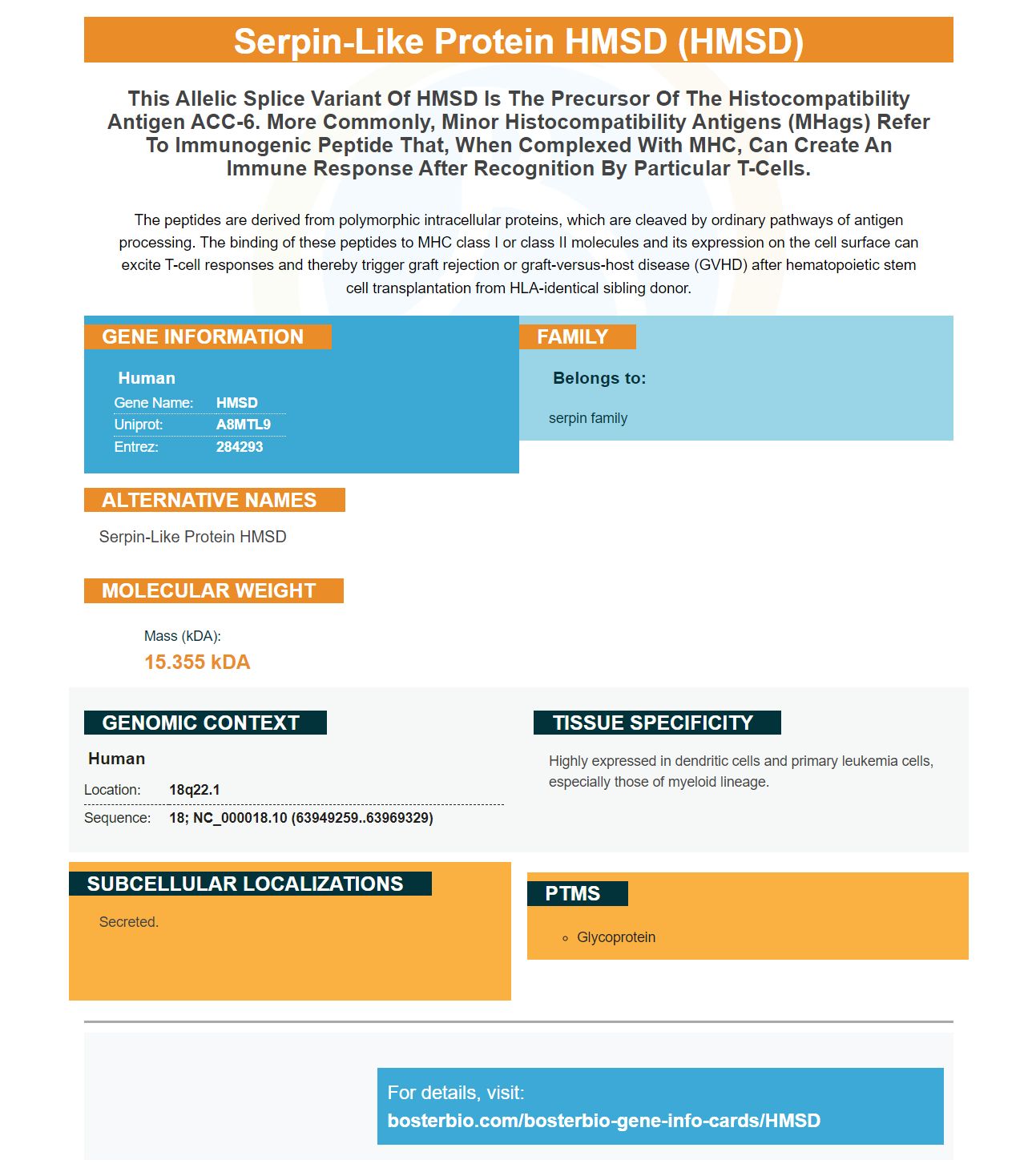
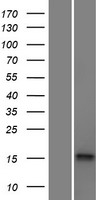
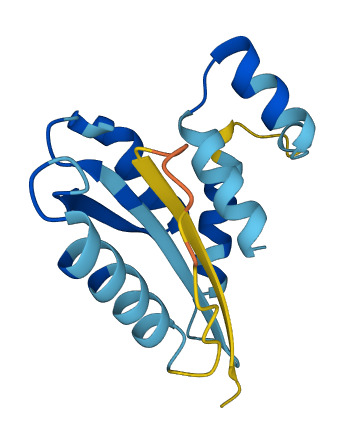
Facts about Serpin-like protein HMSD.
The peptides are derived from polymorphic intracellular proteins, which are cleaved by ordinary pathways of antigen processing. The binding of these peptides to MHC class I or class II molecules and its expression on the cell surface can excite T-cell responses and thereby trigger graft rejection or graft-versus-host disease (GVHD) after hematopoietic stem cell transplantation from HLA-identical sibling donor.
| Human | |
|---|---|
| Gene Name: | HMSD |
| Uniprot: | A8MTL9 |
| Entrez: | 284293 |
| Belongs to: |
|---|
| serpin family |

Serpin-like protein HMSD
Mass (kDA):
15.355 kDA

| Human | |
|---|---|
| Location: | 18q22.1 |
| Sequence: | 18; NC_000018.10 (63949259..63969329) |
Highly expressed in dendritic cells and primary leukemia cells, especially those of myeloid lineage.
Secreted.


PMID: 17409267 by Kawase T., et al. Alternative splicing due to an intronic SNP in HMSD generates a novel minor histocompatibility antigen.
PMID: 8889548 by Bonaldo M.F., et al. Normalization and subtraction: two approaches to facilitate gene discovery.