This website uses cookies to ensure you get the best experience on our website.


- Table of Contents
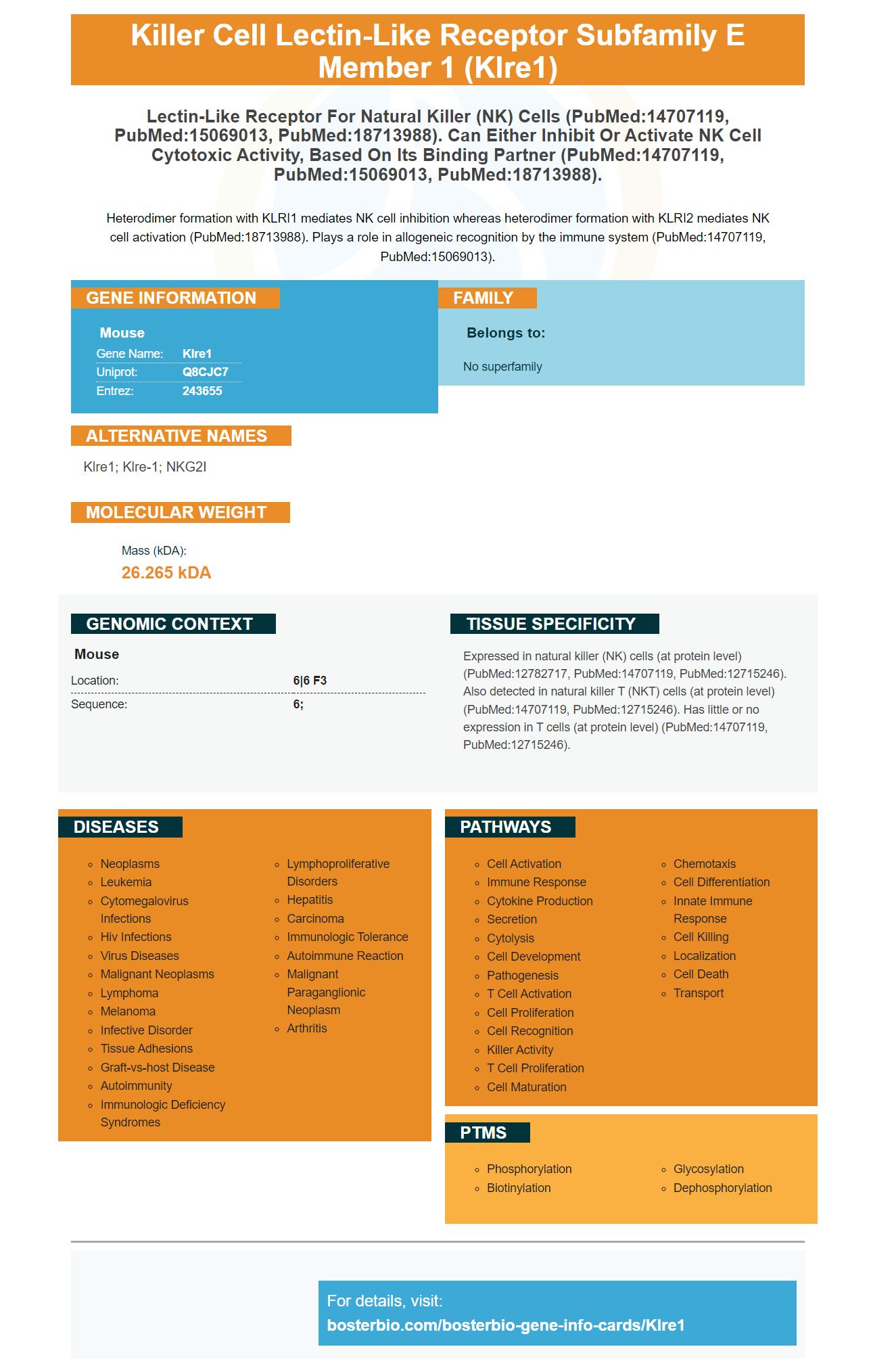
Facts about Killer cell lectin-like receptor subfamily E member 1.
Heterodimer formation with KLRI1 mediates NK cell inhibition whereas heterodimer formation with KLRI2 mediates NK cell activation (PubMed:18713988). Plays a role in allogeneic recognition by the immune system (PubMed:14707119, PubMed:15069013).
| Mouse | |
|---|---|
| Gene Name: | Klre1 |
| Uniprot: | Q8CJC7 |
| Entrez: | 243655 |
| Belongs to: |
|---|
| No superfamily |

Klre1; Klre-1; NKG2I
Mass (kDA):
26.265 kDA

| Mouse | |
|---|---|
| Location: | 6|6 F3 |
| Sequence: | 6; |
Expressed in natural killer (NK) cells (at protein level) (PubMed:12782717, PubMed:14707119, PubMed:12715246). Also detected in natural killer T (NKT) cells (at protein level) (PubMed:14707119, PubMed:12715246). Has little or no expression in T cells (at protein level) (PubMed:14707119, PubMed:12715246).


PMID: 12782717 by Westgaard I.H., et al. The lectin-like receptor KLRE1 inhibits natural killer cell cytotoxicity.
PMID: 14707119 by Koike J., et al. Bone marrow allograft rejection mediated by a novel murine NK receptor, NKG2I.