This website uses cookies to ensure you get the best experience on our website.


- Table of Contents
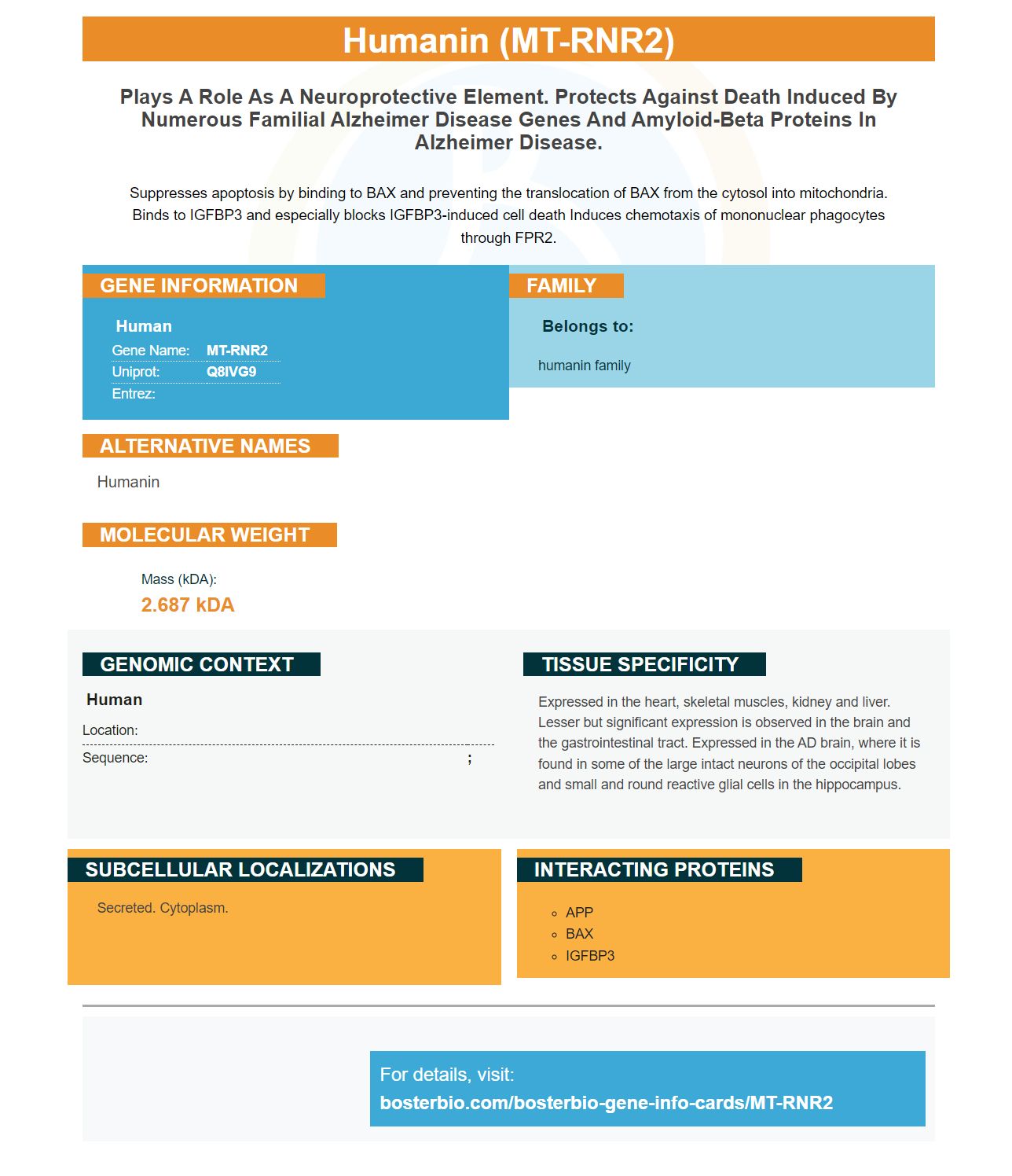
Facts about Humanin.
Suppresses apoptosis by binding to BAX and preventing the translocation of BAX from the cytosol into mitochondria. Binds to IGFBP3 and especially blocks IGFBP3-induced cell death Induces chemotaxis of mononuclear phagocytes through FPR2.
| Human | |
|---|---|
| Gene Name: | MT-RNR2 |
| Uniprot: | Q8IVG9 |
| Entrez: | |
| Belongs to: |
|---|
| humanin family |

Humanin
Mass (kDA):
2.687 kDA

| Human | |
|---|---|
| Location: | |
| Sequence: | ; |
Expressed in the heart, skeletal muscles, kidney and liver. Lesser but significant expression is observed in the brain and the gastrointestinal tract. Expressed in the AD brain, where it is found in some of the large intact neurons of the occipital lobes and small and round reactive glial cells in the hippocampus.
Secreted. Cytoplasm.

PMID: 11371646 by Hashimoto Y., et al. A rescue factor abolishing neuronal cell death by a wide spectrum of familial Alzheimer's disease genes and Abeta.
PMID: 14561895 by Ikonen M., et al. Interaction between the Alzheimer's survival peptide humanin and insulin-like growth factor-binding protein 3 regulates cell survival and apoptosis.