This website uses cookies to ensure you get the best experience on our website.


- Table of Contents
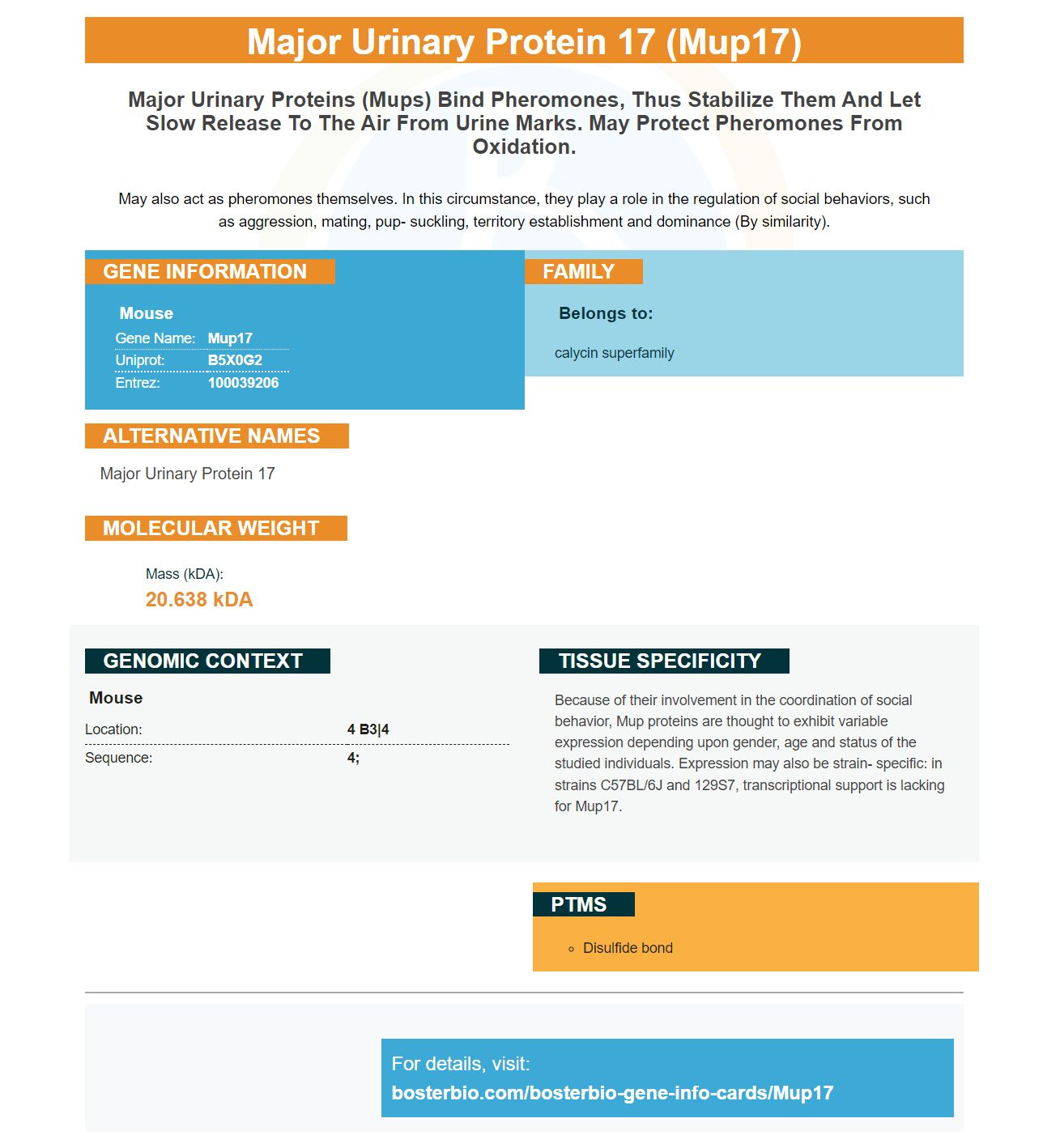
Facts about Major urinary protein 17.
May also act as pheromones themselves. In this circumstance, they play a role in the regulation of social behaviors, such as aggression, mating, pup- suckling, territory establishment and dominance (By similarity).
| Mouse | |
|---|---|
| Gene Name: | Mup17 |
| Uniprot: | B5X0G2 |
| Entrez: | 100039206 |
| Belongs to: |
|---|
| calycin superfamily |

Major urinary protein 17
Mass (kDA):
20.638 kDA
| Mouse | |
|---|---|
| Location: | 4 B3|4 |
| Sequence: | 4; |
Because of their involvement in the coordination of social behavior, Mup proteins are thought to exhibit variable expression depending upon gender, age and status of the studied individuals. Expression may also be strain- specific: in strains C57BL/6J and 129S7, transcriptional support is lacking for Mup17.

PMID: 18815613 by Logan D.W., et al. Species specificity in major urinary proteins by parallel evolution.
PMID: 18507838 by Mudge J.M., et al. Dynamic instability of the major urinary protein gene family revealed by genomic and phenotypic comparisons between C57 and 129 strain mice.