This website uses cookies to ensure you get the best experience on our website.


- Table of Contents


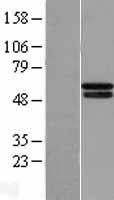
Facts about Transmembrane prolyl 4-hydroxylase.
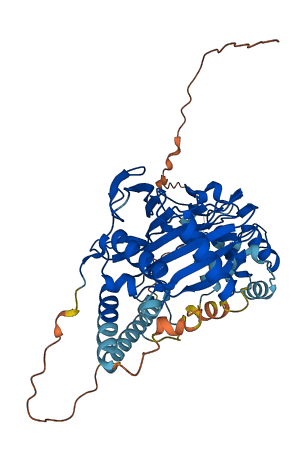
May function as a cellular oxygen sensor and, under normoxic conditions, may target HIF through the hydroxylation for proteasomal degradation via the von Hippel-Lindau ubiquitination complex. .
| Human | |
|---|---|
| Gene Name: | P4HTM |
| Uniprot: | Q9NXG6 |
| Entrez: | 54681 |
| Belongs to: |
|---|
| No superfamily |

EC 1.14.11.-; EGLN4; HIFPH4; HIF-PH4; HIF-prolyl hydroxylase 4; HPH-4; hypoxia-inducible factor prolyl 4-hydroxylase; Hypoxia-inducible factor prolyl hydroxylase 4; P4H with transmembrane domain; P4H-TMFLJ20262; PH4 hypoxia inducible factor prolyl 4 hydroxylase; PH-4; PHD4; proline 4-hydroxylase; prolyl 4-hydroxylase, transmembrane (endoplasmic reticulum); Prolyl hydroxlase domain-containing 4; transmembrane prolyl 4-hydroxylase
Mass (kDA):
56.661 kDA

| Human | |
|---|---|
| Location: | 3p21.31|3p21.3 |
| Sequence: | 3; NC_000003.12 (48989908..49007153) |
Widely expressed with highest levels in adult pancreas, heart, skeletal muscle, brain, placenta, kidney and adrenal gland. Expressed at lower levels in epiphyseal cartilage and in fibroblasts.
Endoplasmic reticulum membrane; Single-pass type II membrane protein.



PMID: 12163023 by Oehme F., et al. Overexpression of PH-4, a novel putative proline 4-hydroxylase, modulates activity of hypoxia-inducible transcription factors.
PMID: 17726031 by Koivunen P., et al. An endoplasmic reticulum transmembrane prolyl 4-hydroxylase is induced by hypoxia and acts on hypoxia-inducible factor alpha.