This website uses cookies to ensure you get the best experience on our website.


- Table of Contents
Designing an IHC experiment for RNF125? The guide has the expected staining pattern, antigen retrieval and fixation, antibodies backed by real IHC images, the tissue controls to run alongside, and protocols taken from published papers.
Open the RNF125 IHC Guide
Facts about E3 ubiquitin-protein ligase RNF125.
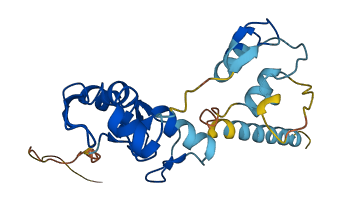
Mediates ubiquitination and subsequent degradation of p53/TP53 (PubMed:25591766). Mediates ubiquitination and subsequent degradation of JAK1 (PubMed:26027934).
| Human | |
|---|---|
| Gene Name: | RNF125 |
| Uniprot: | Q96EQ8 |
| Entrez: | 54941 |

| Belongs to: |
|---|
| No superfamily |

E3 ubiquitin-protein ligase RNF125; EC 6.3.2.-; FLJ20456; MGC21737; ring finger protein 125TRAC1; T-cell RING activation protein 1; T-cell ring protein identified in activation screen; TRAC-1
Mass (kDA):
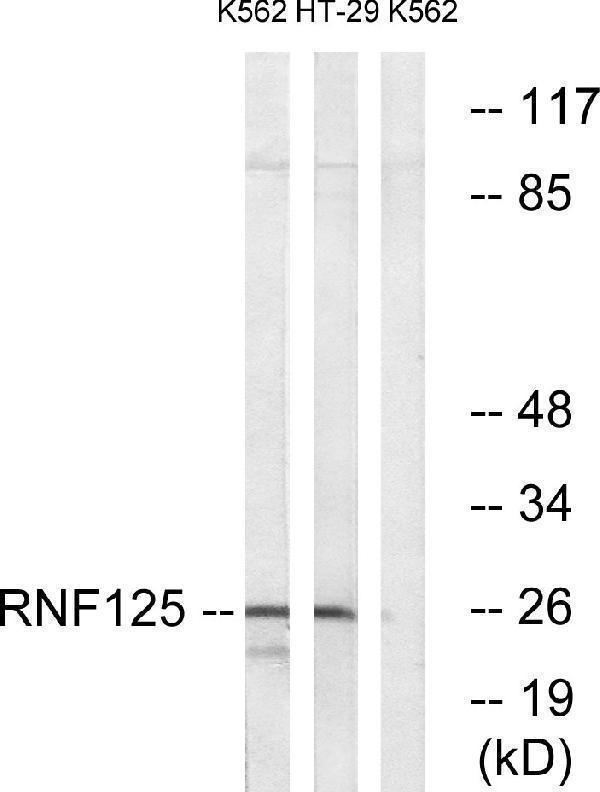
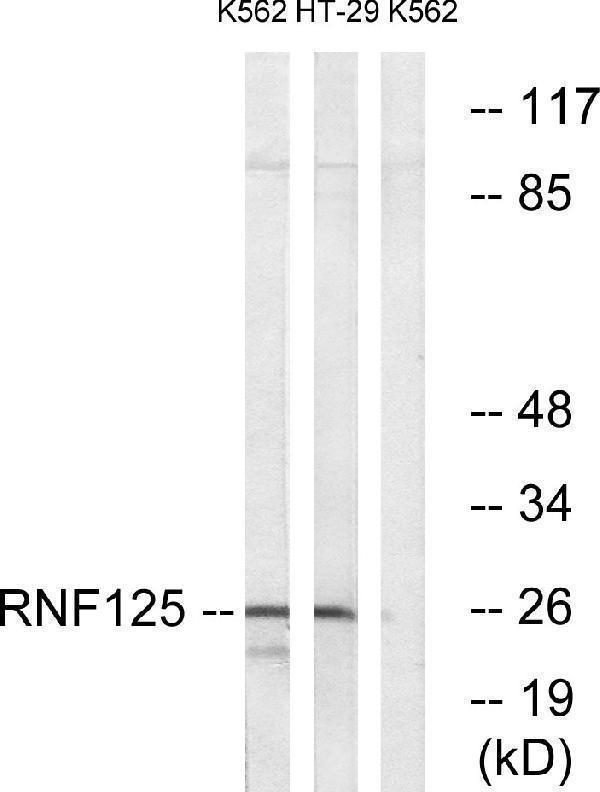
26.454 kDA

| Human | |
|---|---|
| Location: | 18q12.1 |
| Sequence: | 18; NC_000018.10 (32018585..32090756) |
Predominantly expressed in lymphoid tissues, including bone marrow, spleen and thymus. Also weakly expressed in other tissues. Predominant in the CD4(+) and CD8(+) T-cells, suggesting that it is preferentially confined to T-cells.
Golgi apparatus membrane; Lipid-anchor. Shows a reticular staining pattern within the cell and is probably expressed at other intracellular membranes in addition to the Golgi membrane. Not detected at the plasma membrane.






PMID: 12974981 by Chu P., et al. Systematic identification of regulatory proteins critical for T-cell activation.
PMID: 15843525 by Zhao H., et al. A novel E3 ubiquitin ligase TRAC-1 positively regulates T cell activation.