This website uses cookies to ensure you get the best experience on our website.


- Table of Contents
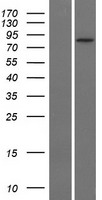
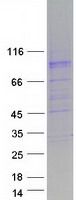
Designing a Western blot for Pendrin? The guide has the expected band size, antibodies backed by real blot images, the controls to run alongside, and protocols taken from published papers.
Open the SLC26A4 Western Blot Guide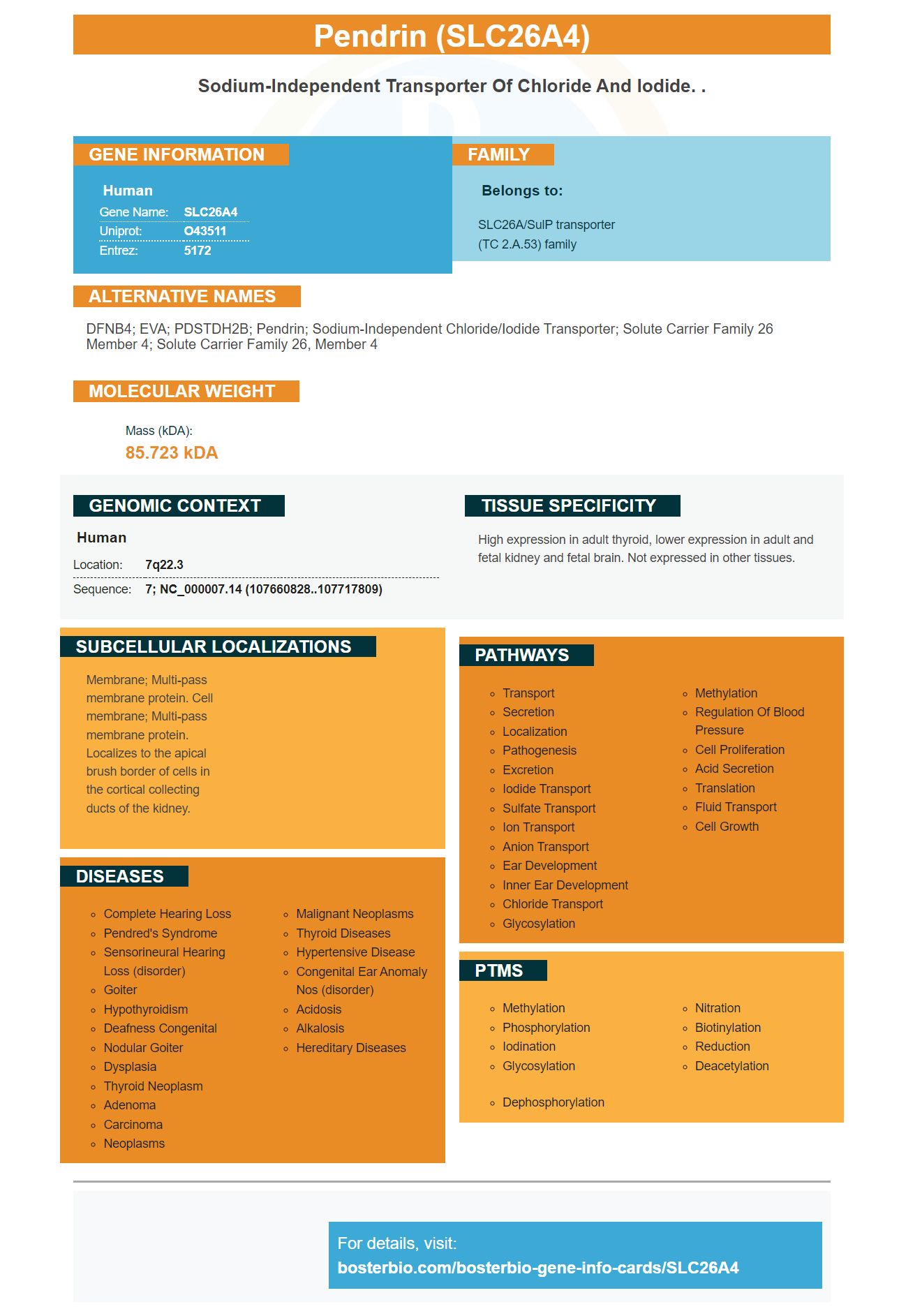
Facts about Pendrin.
| Human | |
|---|---|
| Gene Name: | SLC26A4 |
| Uniprot: | O43511 |
| Entrez: | 5172 |

| Belongs to: |
|---|
| SLC26A/SulP transporter (TC 2.A.53) family |

DFNB4; EVA; PDSTDH2B; pendrin; Sodium-independent chloride/iodide transporter; Solute carrier family 26 member 4; solute carrier family 26, member 4
Mass (kDA):
85.723 kDA

| Human | |
|---|---|
| Location: | 7q22.3 |
| Sequence: | 7; NC_000007.14 (107660828..107717809) |
High expression in adult thyroid, lower expression in adult and fetal kidney and fetal brain. Not expressed in other tissues.
Membrane; Multi-pass membrane protein. Cell membrane; Multi-pass membrane protein. Localizes to the apical brush border of cells in the cortical collecting ducts of the kidney.


PMID: 9398842 by Everett L.A., et al. Pendred syndrome is caused by mutations in a putative sulphate transporter gene (PDS).
PMID: 10192399 by Scott D.A., et al. The Pendred syndrome gene encodes a chloride-iodide transport protein.