This website uses cookies to ensure you get the best experience on our website.


- Table of Contents
Designing an IHC experiment for STOML2? The guide has the expected staining pattern, antigen retrieval and fixation, antibodies backed by real IHC images, the tissue controls to run alongside, and protocols taken from published papers.
Open the STOML2 IHC Guide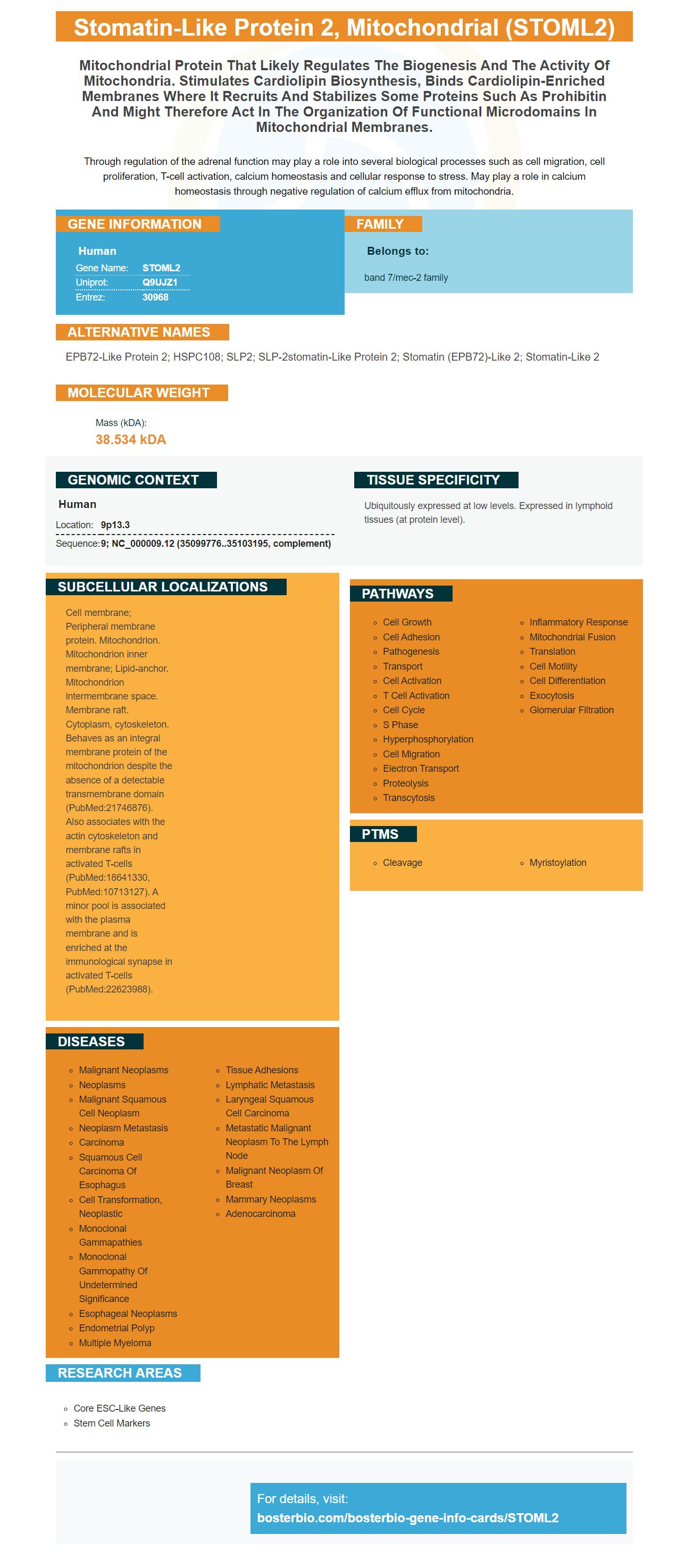


Facts about Stomatin-like protein 2, mitochondrial.
Through regulation of the adrenal function may play a role into several biological processes such as cell migration, cell proliferation, T-cell activation, calcium homeostasis and cellular response to stress. May play a role in calcium homeostasis through negative regulation of calcium efflux from mitochondria.
| Human | |
|---|---|
| Gene Name: | STOML2 |
| Uniprot: | Q9UJZ1 |
| Entrez: | 30968 |

| Belongs to: |
|---|
| band 7/mec-2 family |

EPB72-like protein 2; HSPC108; SLP2; SLP-2stomatin-like protein 2; stomatin (EPB72)-like 2; stomatin-like 2
Mass (kDA):
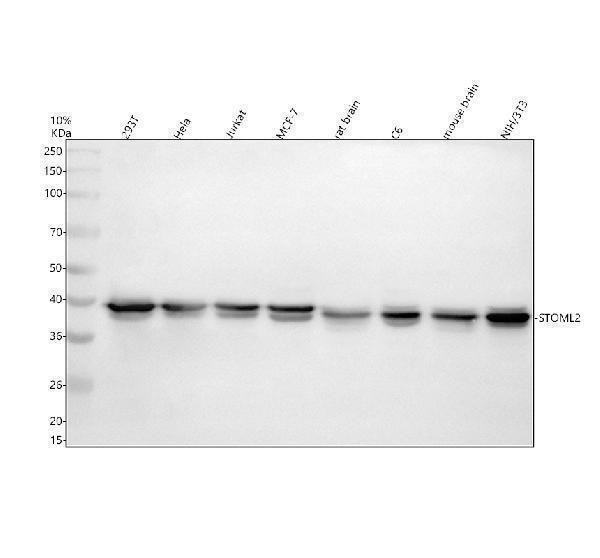
38.534 kDA

| Human | |
|---|---|
| Location: | 9p13.3 |
| Sequence: | 9; NC_000009.12 (35099776..35103195, complement) |
Ubiquitously expressed at low levels. Expressed in lymphoid tissues (at protein level).
Cell membrane; Peripheral membrane protein. Mitochondrion. Mitochondrion inner membrane; Lipid-anchor. Mitochondrion intermembrane space. Membrane raft. Cytoplasm, cytoskeleton. Behaves as an integral membrane protein of the mitochondrion despite the absence of a detectable transmembrane domain (PubMed:21746876). Also associates with the actin cytoskeleton and membrane rafts in activated T-cells (PubMed:18641330, PubMed:10713127). A minor pool is associated with the plasma membrane and is enriched at the immunological synapse in activated T-cells (PubMed:22623988).





PMID: 10713127 by Wang Y., et al. Identification and characterization of human SLP-2, a novel homologue of stomatin (band 7.2b) present in erythrocytes and other tissues.
PMID: 11435687 by Owczarek C.M., et al. A novel member of the stomatin/EPB72/mec-2 family, stomatin-like 2 (STOML2), is ubiquitously expressed and localizes to HSA chromosome 9p13.1.