This website uses cookies to ensure you get the best experience on our website.


- Table of Contents
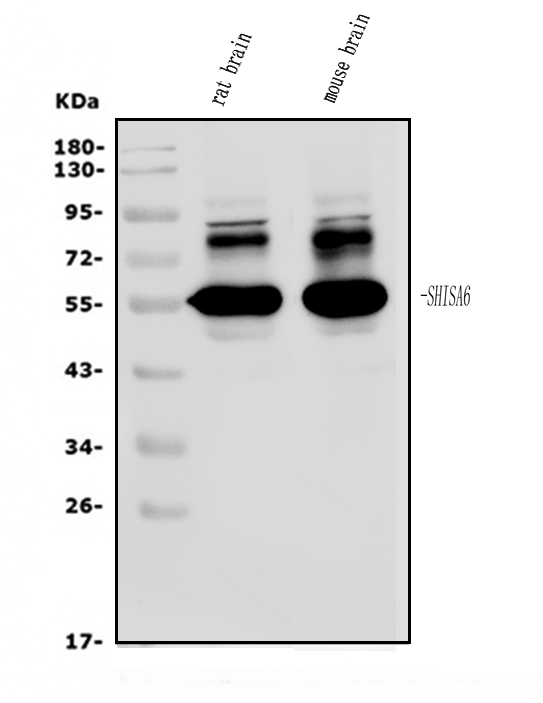
Designing a Western blot for Protein shisa-6? The guide has the expected band size, antibodies backed by real blot images, the controls to run alongside, and protocols taken from published papers.
Open the SHISA6 Western Blot Guide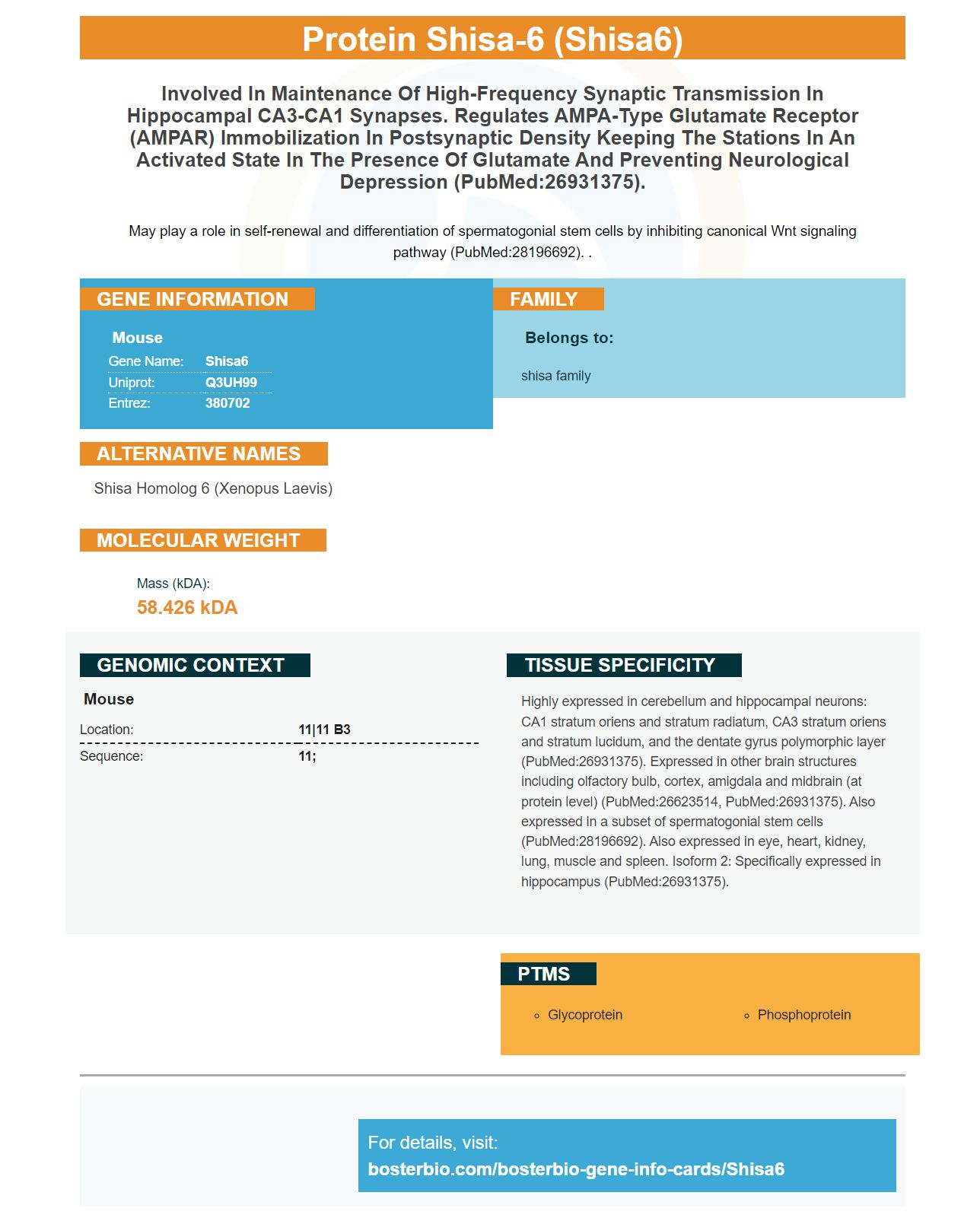
Facts about Protein shisa-6.
May play a role in self-renewal and differentiation of spermatogonial stem cells by inhibiting canonical Wnt signaling pathway (PubMed:28196692). .
| Mouse | |
|---|---|
| Gene Name: | Shisa6 |
| Uniprot: | Q3UH99 |
| Entrez: | 380702 |

| Belongs to: |
|---|
| shisa family |

shisa homolog 6 (Xenopus laevis)
Mass (kDA):
58.426 kDA

| Mouse | |
|---|---|
| Location: | 11|11 B3 |
| Sequence: | 11; |
Highly expressed in cerebellum and hippocampal neurons: CA1 stratum oriens and stratum radiatum, CA3 stratum oriens and stratum lucidum, and the dentate gyrus polymorphic layer (PubMed:26931375). Expressed in other brain structures including olfactory bulb, cortex, amigdala and midbrain (at protein level) (PubMed:26623514, PubMed:26931375). Also expressed in a subset of spermatogonial stem cells (PubMed:28196692). Also expressed in eye, heart, kidney, lung, muscle and spleen. Isoform 2: Specifically expressed in hippocampus (PubMed:26931375).

PMID: 26623514 by Farrow P., et al. Auxiliary subunits of the CKAMP family differentially modulate AMPA receptor properties.
PMID: 26931375 by Klaassen R.V., et al. Shisa6 traps AMPA receptors at postsynaptic sites and prevents their desensitization during synaptic activity.