This website uses cookies to ensure you get the best experience on our website.


- Table of Contents
and ELISA kits, proteins related to Myelodysplastic syndrome.
Myelodysplastic Syndrome (MDS) refers to a group of diverse bone marrow disorders where the marrow does not produce adequate healthy blood cells. MDS is primarily seen in elderly populations but can affect individuals of any age. It arises due to mutations in the blood stem cells which then proliferate into defective cells that have limited functionality. These damaged cells often die earlier than normal cells or are destroyed by the body's immune system, leading to an increased risk of infections, anemia, or bleeding due to insufficient healthy cells. Over time, MDS can escalate into acute myeloid leukemia (AML), intensifying the urgency for effective treatments and interventions. The ongoing research into antibodies related to MDS seeks to unveil novel therapeutic targets and deepen our understanding of the molecular underpinnings of this complex condition, aiming to improve diagnostics, treatments, and outcomes for patients afflicted with this syndrome.
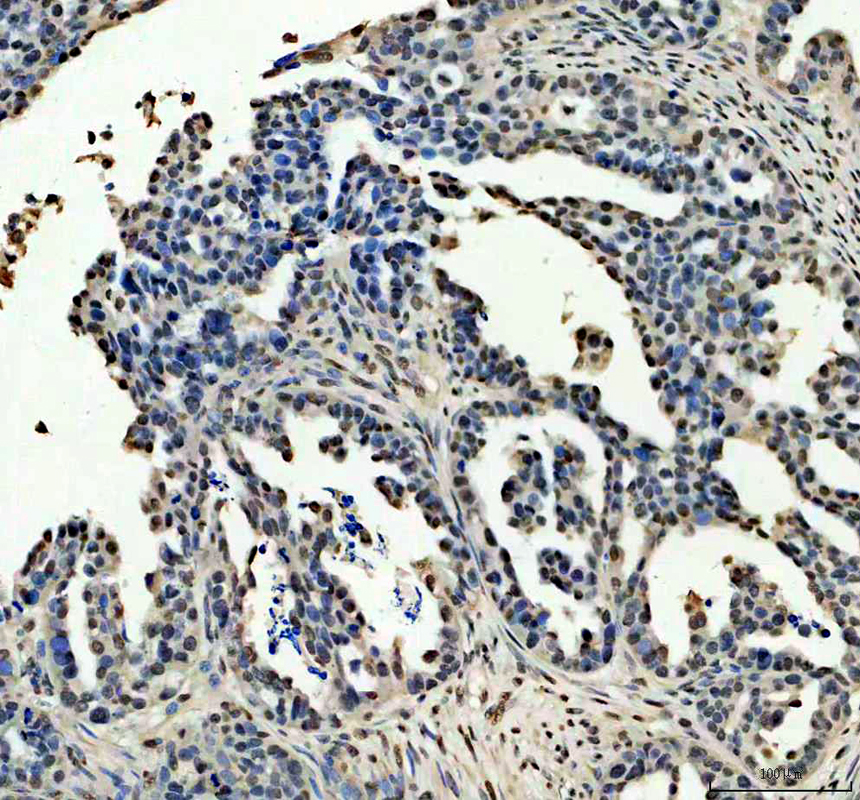
Anti-P53/TP53 Antibody Picoband®, IHC analysis of P53 using anti-P53 antibody (PB9008).
TP53 was detected in a paraffin-embedded section of humn ovarian cancer tissue. Heat mediated antigen retrieval was...

Anti-P53 Tp53 Monoclonal Antibody, IF analysis of p53 using anti-p53 antibody (MA1078).
p53 was detected in immunocytochemical section of A431 cell. Enzyme antigen retrieval was per...

Anti-JAK2 Monoclonal Antibody, IF analysis of JAK2 using anti-JAK2 antibody (M00027) and anti-Beta Tubulin antibody (M01857-3).
JAK2 was detected in immunocytochemical section of A549 cell. E...
| Protein Name | Gene Name | Function |
|---|---|---|
| p53 | TP53 | Regulates cell cycle and is a tumor suppressor widely implicated in cancer. |
| RUNX1 | RUNX1 | Involved in hematopoietic transcription regulation; mutations are associated with dysfunctional hematopoietic differentiation. |
| EZH2 | EZH2 | Part of the polycomb repressive complex 2 (PRC2), crucial for maintaining hematopoietic stem cells; mutations linked to poor prognosis. |
| ASXL1 | ASXL1 | Plays a role in chromatin remodeling; mutations can disrupt the regulation of gene expression. |
| TET2 | TET2 | Involved in DNA methylation processes; defects are common in various myeloid malignancies. |
| SRSF2 | SRSF2 | Serine/arginine-rich splicing factor, mutations affect mRNA splicing of several genes involved in myeloid differentiation. |
| SF3B1 | SF3B1 | Spliceosome complex component; mutations are frequently associated with refractory anemia with ring sideroblasts. |
| U2AF1 | U2AF1 | Splicing factor, important for pre-mRNA splicing; mutations influence RNA splicing. |
| DNMT3A | DNMT3A | DNA methyltransferase, critical for epigenetic regulation; mutations in this gene are common in hematological disorders. |
| NPM1 | NPM1 | Nucleophosmin, mutations generally result in abnormal localization within the cell and are linked with specific types of leukemia. |
| JAK2 | JAK2 | Tyrosine kinase involved in cytokine receptor signaling; abnormalities are critical in myeloproliferative disorders. |
| FLT3 | FLT3 | Class III receptor tyrosine kinase, plays a role in the proliferation of hematopoietic progenitor cells; mutations often lead to poor prognosis. |
| CBL | CBL | E3 ubiquitin-protein ligase involved in cell signaling and protein ubiquitination; mutations can lead to aberrant signal transduction. |
| NRAS | NRAS | GTPase involved in cell division, growth, and differentiation; mutations are implicated in various cancers, including myeloid malignancies. |
| KRAS | KRAS | Plays a key role in several signaling pathways controlling cell growth; mutations lead to gain-of-function impacts. |
| EPO | EPO | Erythropoietin, critical for red blood cell production; its regulation is pivotal in managing anemia in MDS. |
| KIT | KIT | Receptor tyrosine kinase important for stem cell factor binding; anomalies can result in hematopoietic disorders. |
| BCOR | BCOR | Corepressor involved in gene silencing across developmental pathways; frequently mutated in pediatric myeloid malignancies. |
| ABL1 | ABL1 | Tyrosine kinase that is crucial in multiple signaling processes; involved in the Philadelphia chromosome translocation in leukemia. |
Epigenetic alterations are recognized as key mechanisms in the pathogenesis of Myelodysplastic Syndromes (MDS). These modifications do not change the DNA sequence but typically involve changes such as DNA methylation and histone modification, which ultimately affect gene expression. In MDS, abnormal epigenetic modifications can lead to the silencing of tumor suppressor genes or activation of oncogenes, contributing to the ineffective hematopoiesis and increased risk of transformation to acute myeloid leukemia (AML). Researchers are particularly focused on studying the patterns and roles of DNA methylation and demethylation as well as histone modifications in the progression from early to advanced stages of MDS. Understanding these epigenetic landscapes promises new therapeutic targets, with drugs designed to specifically alter epigenetic marks. Current treatments, such as hypomethylating agents, show survival benefits in some patients, highlighting the potential for epigenetic therapy in managing MDS.
Immune dysregulation and inflammation are crucial aspects of Myelodysplastic Syndromes that influence both the disease onset and its progression. Research indicates that MDS is characterized by a complex interplay between the immune system and the bone marrow microenvironment, where inflammatory cytokines play a prominent role in the dysregulation of hematopoietic stem cells. This imbalance can lead to marrow failure and further exacerbate the cytopenias typical in MDS patients. The autoimmune response in certain subsets of MDS can result in increased destruction of bone marrow cells by immune cells, further impairing hematopoiesis. Clinical research has been oriented towards understanding how targeted therapies can modulate this dysregulated immune environment. This includes the use of immunosuppressive therapies and cytokine inhibitors, which have shown promise in reducing marrow inflammation and improving blood counts in certain groups of patients. Greater knowledge of the immune pathways involved can lead to innovative treatment approaches that specifically address the underlying immune dysfunction.