Product Info Summary
| SKU: | A01147 |
|---|---|
| Size: | 100 μg/vial |
| Reactive Species: | Human |
| Host: | Rabbit |
| Application: | ELISA, IHC, WB |
Customers Who Bought This Also Bought
Product info
Product Name
Anti-Angiopoietin-like 4/ANGPTL4 Antibody Picoband®
SKU/Catalog Number
A01147
Size
100 μg/vial
Form
Lyophilized
Description
ANGPTL4 is a secreted angiopoietin-like protein described on-page as hypoxia-inducible in endothelial cells and a target of peroxisome proliferation activators; the page also notes ANGPTL4 contribution to tumor growth and protection from anoikis (detachment-induced cell death). Assay context: validated for WB, IHC, and ELISA in human samples, supporting tissue expression mapping and soluble/lysate confirmation (research use). Often contextualized alongside ECM-remodeling readouts such as MMP9 (invasion/angiogenesis) and other MMP profiling such as MMP3 (often co-measured; putative).
Storage & Handling
Store at -20˚C for one year from date of receipt. After reconstitution, at 4˚C for one month. It can also be aliquotted and stored frozen at -20˚C for six months. Avoid repeated freeze-thaw cycles.
Cite This Product
Anti-Angiopoietin-like 4/ANGPTL4 Antibody Picoband® (Boster Biological Technology, Pleasanton CA, USA, Catalog # A01147)
Host
Rabbit
Contents
Each vial contains 4 mg Trehalose, 0.9 mg NaCl and 0.2 mg Na2HPO4.
Clonality
Polyclonal
Isotype
Rabbit IgG
Immunogen
A synthetic peptide corresponding to a sequence at the C-terminus of human ANGPTL4, different from the related mouse and rat sequences by seven amino acids.
Cross-reactivity
No cross-reactivity with other proteins.
Reactive Species
A01147 is reactive to ANGPTL4 in Human
Observed Molecular Weight
65 kDa
Calculated molecular weight
45.2 kDa
Background of ANGPTL4
Angiopoietin-related protein 4 (Angptl4) is a protein that in humans is encoded by the ANGPTL4 gene. This gene is a member of the angiopoietin/angiopoietin-like gene family and encodes a glycosylated, secreted protein with a fibrinogen C-terminal domain. And this gene is induced under hypoxic conditions in endothelial cells and is the target of peroxisome proliferation activators. By radiation hybrid analysis, Angptl4 gene is mapped to 19p13.3. ANGPTL4 contributed to tumor growth and protected cells from anoikis, a form of programmed cell death induced when contact-dependent cells detach from the surrounding tissue matrix.
Antibody Validation
Boster validates all antibodies on WB, IHC, ICC, Immunofluorescence, and ELISA with known positive control and negative samples to ensure specificity and high affinity, including thorough antibody incubations.
Application & Images
Applications
A01147 is guaranteed for ELISA, IHC, WB Boster Guarantee
Assay Dilutions Recommendation
The recommendations below provide a starting point for assay optimization. The actual working concentration varies and should be decided by the user.
Western blot, 0.1-0.5μg/ml, Human
Immunohistochemistry(Paraffin-embedded Section), 2-5 μg/ml, Human
ELISA, 0.1-0.5μg/ml, -
Positive Control
WB: human placenta tissue, human hepatocellular carcinoma tumor tissue (HCCT)
IHC: human placenta tissue, human spleen tissue
Validation Images & Assay Conditions
Click image to see more details
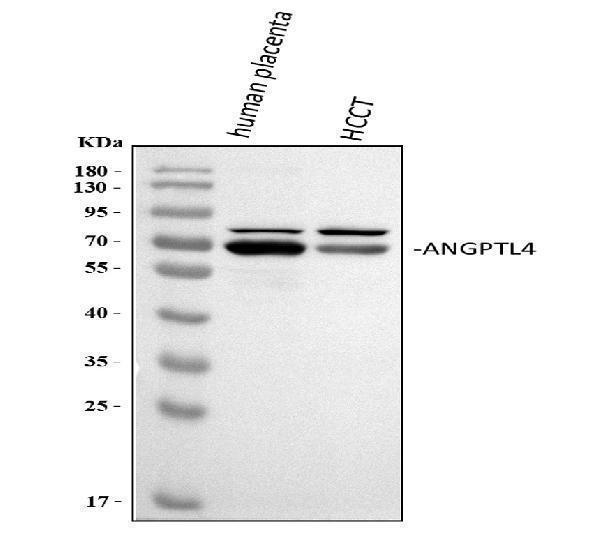
Western blot analysis of ANGPTL4 using anti-ANGPTL4 antibody (A01147).
Electrophoresis was performed on a 5-20% SDS-PAGE gel at 70V (Stacking gel) / 90V (Resolving gel) for 2-3 hours. The sample well of each lane was loaded with 30 ug of sample under reducing conditions.
Lane 1: human placenta tissue lysates,
Lane 2: human hepatocellular carcinoma tumor tissue (HCCT) lysates.
After electrophoresis, proteins were transferred to a nitrocellulose membrane at 150 mA for 50-90 minutes. Blocked the membrane with 5% non-fat milk/TBS for 1.5 hour at RT. The membrane was incubated with rabbit anti-ANGPTL4 antigen affinity purified polyclonal antibody (Catalog # A01147) at 0.5 μg/mL overnight at 4°C, then washed with TBS-0.1%Tween 3 times with 5 minutes each and probed with a goat anti-rabbit IgG-HRP secondary antibody at a dilution of 1:5000 for 1.5 hour at RT. The signal is developed using an Enhanced Chemiluminescent detection (ECL) kit (Catalog # EK1002) with Tanon 5200 system. A specific band was detected for ANGPTL4 at approximately 65 kDa. The expected band size for ANGPTL4 is at 45 kDa.
Click image to see more details
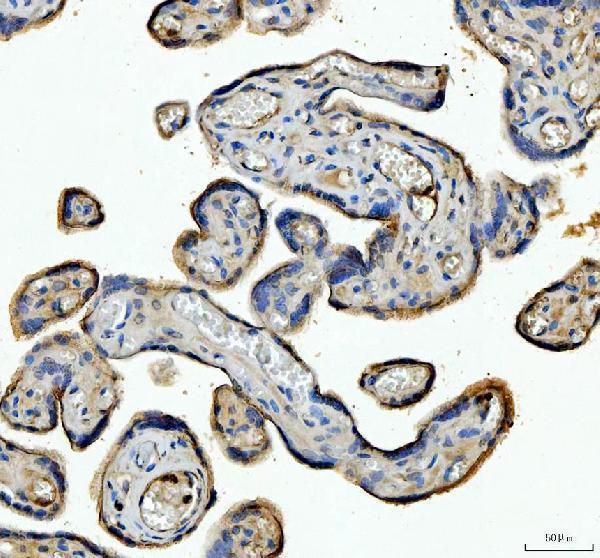
IHC analysis of ANGPTL4 using anti-ANGPTL4 antibody (A01147).
ANGPTL4 was detected in a paraffin-embedded section of human placenta tissue. Heat mediated antigen retrieval was performed in EDTA buffer (pH 8.0, epitope retrieval solution). The tissue section was blocked with 10% goat serum. The tissue section was then incubated with 2 μg/ml rabbit anti-ANGPTL4 Antibody (A01147) overnight at 4°C. Peroxidase Conjugated Goat Anti-rabbit IgG was used as secondary antibody and incubated for 30 minutes at 37°C. The tissue section was developed using HRP Conjugated Rabbit IgG Super Vision Assay Kit (Catalog # SV0002) with DAB as the chromogen.
Click image to see more details
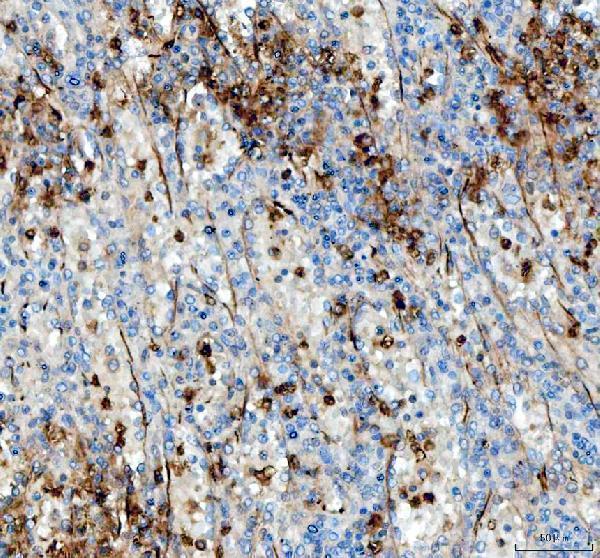
IHC analysis of ANGPTL4 using anti-ANGPTL4 antibody (A01147).
ANGPTL4 was detected in a paraffin-embedded section of human spleen tissue. Heat mediated antigen retrieval was performed in EDTA buffer (pH 8.0, epitope retrieval solution). The tissue section was blocked with 10% goat serum. The tissue section was then incubated with 2 μg/ml rabbit anti-ANGPTL4 Antibody (A01147) overnight at 4°C. Peroxidase Conjugated Goat Anti-rabbit IgG was used as secondary antibody and incubated for 30 minutes at 37°C. The tissue section was developed using HRP Conjugated Rabbit IgG Super Vision Assay Kit (Catalog # SV0002) with DAB as the chromogen.
Specific Publications For Anti-Angiopoietin-like 4/ANGPTL4 Antibody Picoband® (A01147)
Loading publications
Recommended Resources
Here are featured tools and databases that you might find useful.
- Boster's Pathways Library
- Protein Databases
- Bioscience Research Protocol Resources
- Data Processing & Analysis Software
- Photo Editing Software
- Scientific Literature Resources
- Research Paper Management Tools
- Molecular Biology Software
- Primer Design Tools
- Bioinformatics Tools
- Phylogenetic Tree Analysis
Customer Reviews
Have you used Anti-Angiopoietin-like 4/ANGPTL4 Antibody Picoband®?
Share your experimental results or join a short interview to earn up to $1,000 in product credits or other rewards.
0 Reviews For Anti-Angiopoietin-like 4/ANGPTL4 Antibody Picoband®
Customer Q&As
Have a question?
Find answers in Q&As, reviews.
Can't find your answer?
Submit your question
6 Customer Q&As for Anti-Angiopoietin-like 4/ANGPTL4 Antibody Picoband®
Question
I have attached the WB image, lot number and protocol we used for placenta using anti-Angiopoietin-like 4?/ANGPTL4 antibody A01147. Please let me know if you require anything else.
Verified Customer
Verified customer
Asked: 2019-07-18
Answer
Thank you very much for the data. Our lab team are working to resolve this as quickly as possible, and we appreciate your patience and understanding! You have provided everything we needed. Please let me know if there is anything you need in the meantime.
Boster Scientific Support
Answered: 2019-07-18
Question
Will A01147 anti-Angiopoietin-like 4?/ANGPTL4 antibody work on parafin embedded sections? If so, which fixation method do you recommend we use (PFA, paraformaldehyde, other)?
Verified Customer
Verified customer
Asked: 2017-11-01
Answer
You can see on the product datasheet, A01147 anti-Angiopoietin-like 4?/ANGPTL4 antibody as been validated on WB. It is best to use PFA for fixation because it has better tissue penetration ability. PFA needs to be prepared fresh before use. Long term stored PFA turns into formalin, as the PFA molecules congregate and become formalin.
Boster Scientific Support
Answered: 2017-11-01
Question
Will anti-Angiopoietin-like 4?/ANGPTL4 antibody A01147 work for WB with placenta?
S. Carter
Verified customer
Asked: 2017-05-25
Answer
According to the expression profile of placenta, ANGPTL4 is highly expressed in placenta. So, it is likely that anti-Angiopoietin-like 4?/ANGPTL4 antibody A01147 will work for WB with placenta.
Boster Scientific Support
Answered: 2017-05-25
Question
Is a blocking peptide available for product anti-Angiopoietin-like 4?/ANGPTL4 antibody (A01147)?
L. Moore
Verified customer
Asked: 2016-12-21
Answer
We do provide the blocking peptide for product anti-Angiopoietin-like 4?/ANGPTL4 antibody (A01147). If you would like to place an order for it please contact support@bosterbio.com and make a special request.
Boster Scientific Support
Answered: 2016-12-21
Question
I am interested in to test anti-Angiopoietin-like 4?/ANGPTL4 antibody A01147 on human placenta for research purposes, then I may be interested in using anti-Angiopoietin-like 4?/ANGPTL4 antibody A01147 for diagnostic purposes as well. Is the antibody suitable for diagnostic purposes?
J. Zhang
Verified customer
Asked: 2016-10-11
Answer
The products we sell, including anti-Angiopoietin-like 4?/ANGPTL4 antibody A01147, are only intended for research use. They would not be suitable for use in diagnostic work. If you have the means to develop a product into diagnostic use, and are interested in collaborating with us and develop our product into an IVD product, please contact us for more discussions.
Boster Scientific Support
Answered: 2016-10-11
Question
I was wanting to use your anti-Angiopoietin-like 4?/ANGPTL4 antibody for WB for human placenta on frozen tissues, but I want to know if it has been tested for this particular application. Has this antibody been tested and is this antibody a good choice for human placenta identification?
N. Li
Verified customer
Asked: 2014-07-16
Answer
It shows on the product datasheet, A01147 anti-Angiopoietin-like 4?/ANGPTL4 antibody has been validated for ELISA, WB on human tissues. We have an innovator award program that if you test this antibody and show it works in human placenta in IHC-frozen, you can get your next antibody for free.
Boster Scientific Support
Answered: 2014-07-16