recombinant

GAD1 antibody (M02002) performs well in IP, IHC, WB and shows reactivity with Human, Mouse, Pig, Rat.
  • Validated for inter-lot consistency, specificity, and reproducibility
  • Committed to quality since 1993
  • Over 1 Publication
Filter:
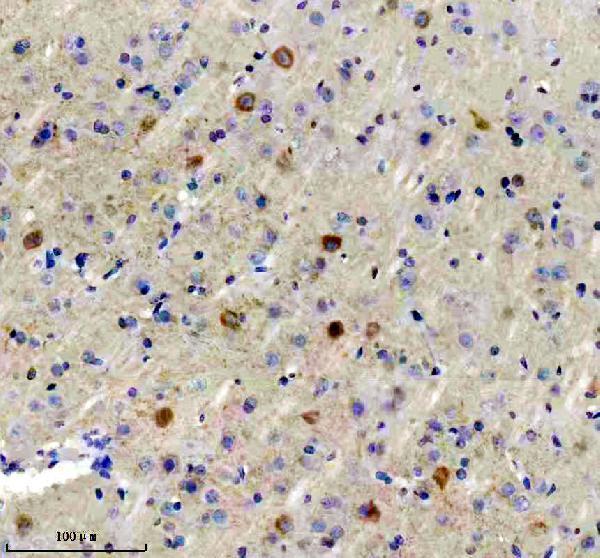
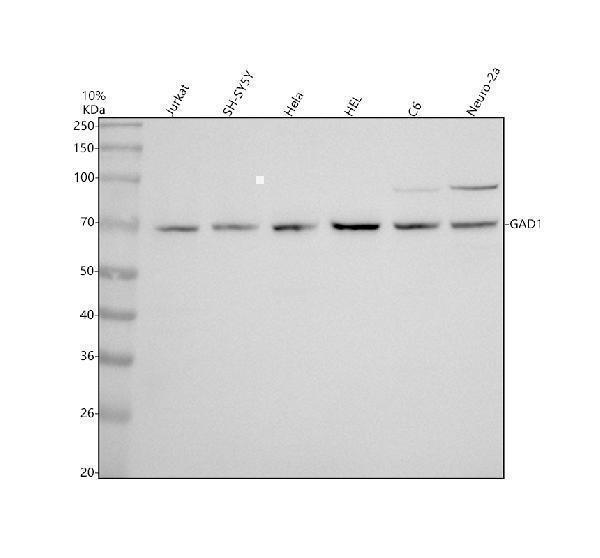
m02002 gad1 primary antibodies ihc testing 1m02002 gad1 primary antibodies wb testing 1

Designing a Western blot for GAD1? The guide covers the expected band size, antibodies backed by real blot images, the controls to run alongside, and protocols taken from published papers.
Open the GAD1 Western Blot Guide

Anti-GAD67 GAD1 Rabbit Monoclonal Antibody

GAD1 antibody

Reactive SpeciesHostApplication
Human, Mouse, Pig, RatRabbitIP, IHC, WB

SKU: M02002

Size: 100 μl

Bundle to save: I do not want free secondary ab
Price:
$370/100 μl

1 in stock in USA, Ships Next Business Day.

Quantity: 1

1
Get A Quote
Guarantee / Product Promise

Tested Applications

GAD1 antibody was positively detected by WB in:

human Jurkat whole cell, human SH-SY5Y whole cell, human Hela whole cell, human HEL whole cell, rat C6 whole cell, mouse Neuro-2a whole cell

Suggested blocking solution with 5% non-fat milk or BSA; (*)Recommended protein loading: 20-40 ug per lane

GAD1 antibody was positively detected by IHC in:

pig brain tissue

Use EDTA pH 8.0 for antigen retrieval; (*) citrate buffer pH 6.0 is an alternative.

Recommend Dilution

Application
Dilution
Species
WB 1:500-2000
IHC 1:50-200
IP 1:20

* It is recommended to optimize the amount of this reagent in each experimental system to achieve the best results.

Reactive Data

Filter:
Boster Guarantee:What is this?
WB
IHC
IF
IP
Human
Tested
Recommend
Rat
Tested
Recommend
Mouse
Tested
Recommend
Pig
Tested
Recommend
Recommend

Product Information

Product Name
Anti-GAD67 GAD1 Rabbit Monoclonal Antibody
View all GAD1 Antibodies
Form
Liquid
Uniprot
Gene ID
Storage & Handling
Store at -20°C for one year. For short term storage and frequent use, store at 4°C for up to one month. Avoid repeated freeze-thaw cycles.
Host
Rabbit
Contents
Rabbit IgG in stabilizing components, phosphate buffered saline, pH 7.4, 150mM NaCl, 0.02% sodium azide and 50% glycerol.
*This antibody is supplied in a stabilized formulation.
Compatibility with conjugation reactions depends on the chemistry of the conjugation method used.
For conjugation methods that are not compatible with the stabilizing components present in this formulation, a carrier-free antibody format is required.
Clonality
Monoclonal
Clone Number
AAGO-7
Isotype
Rabbit IgG
Immunogen
A synthesized peptide derived from human GAD67
Reconstitution
Restore with deionized water (or equivalent) for reconstitution volume of 1.0 mL
Observed Molecular Weight
70 kDa
Calculated Molecular Weight

66.9 kDa

Cite This Product
Anti-GAD67 GAD1 Rabbit Monoclonal Antibody (Boster Biological Technology, Pleasanton CA, USA, Catalog # M02002)

Protocols

Western Blot protocol for GAD1 antibody
Immunohistochemistry (IHC) protocol for GAD1 antibody

Publications

Application:
Excitatory and inhibitory neurons in the hippocampus exhibit molecularly distinct large dense core vesicles
PMID: 27630542

Review

Have you used Anti-GAD67 GAD1 Rabbit Monoclonal Antibody?

Submit a review and receive $370 in product credits, a $185 Amazon gift card, or our carefully curated gift bundles.

Product Promise

We promise Anti-GAD67 GAD1 Rabbit Monoclonal Antibody performs excellently in relevant applications for IP, IHC, WB. If it doesn't perform as promised, we will refund the product. Learn more

In stock
Order Product
M02002
Buy one primary antibody get one 0.5ml HRP or Biotin secondary antibody for free.
*Sample sizes are prepared on demand and will take extra lead time. (cannot be conjugated)
$370.00

Troubleshooting

troubleshooting-box-image

Download troubleshooting handbooks for IHC, Western blot and ELISA for FREE.

Download Free PDFs Now

Boster Guarantee

Guaranteed product quality

Guaranteed product quality

We promise all of our products perform as described in datasheets.

This product is for Research Use Only. Not for use in diagnostic procedures.

Update date: Oct 16, 2026