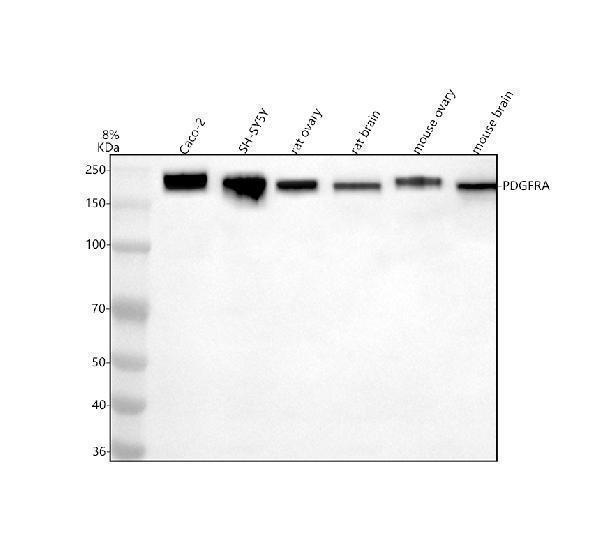
Anti-PDGFR alpha Rabbit Monoclonal Antibody

PDGFRA antibody

Reactive SpeciesHostApplication
Human, Mouse, RatRabbitWB

SKU: M00366

Prefer to Label Your Own Antibody?

Explore our Bundle & Save labeling kits, select your options below to add to cart, and earn 10% back in Boster Credit.

Select a kit to view available options.

Size: 100 μl

Bundle to save: I do not want free secondary ab
Price:
$370/100 μl

Checking availability…

Quantity: 1

1
Get A Quote
Guarantee / Product Promise

Recommend Dilution

Application
Dilution
Species
WB
1:500-2000

* It is recommended to optimize the amount of this reagent in each experimental system to achieve the best results.

Product Information

Product Name
Anti-PDGFR alpha Rabbit Monoclonal Antibody
View all PDGFRA Antibodies
Form
Liquid
Uniprot
Gene ID
Storage & Handling
Store at -20°C for one year. For short term storage and frequent use, store at 4°C for up to one month. Avoid repeated freeze-thaw cycles.
Host
Rabbit
Contents
Rabbit IgG in stabilizing components, phosphate buffered saline, pH 7.4, 150mM NaCl, 0.02% sodium azide and 50% glycerol.
*This antibody is supplied in a stabilized formulation.
Compatibility with conjugation reactions depends on the chemistry of the conjugation method used.
For conjugation methods that are not compatible with the stabilizing components present in this formulation, a carrier-free antibody format is required.
Clonality
Monoclonal
Clone Number
AAOE-16
Isotype
Rabbit IgG
Immunogen
A synthesized peptide derived from human PDGFR alpha
Reconstitution
Restore with deionized water (or equivalent) for reconstitution volume of 1.0 mL
Observed Molecular Weight
180 kDa
Calculated Molecular Weight

122.7 kDa

Background of PDGFRA
PDGFRA(Platelet-derived growth factor receptor, alpha), also called PDGFR2, encodes a cell surface tyrosine kinase receptor for members of the platelet-derived growth factor family. The PDGFA gene is mapped on 4q12. The PDGFRA-FIP1L1 gene is a constitutively activated tyrosine kinase that transforms hematopoietic cells and is a therapeutic target of imatinib. The PDGFRA gene contains 23 exons spanning about 65 kb. Using the human PDGFRA promoter linked to a luciferase reporter, Joosten et al. showed that PAX1 acts as a transcriptional activator of the PDGFRA gene in differentiated human embryonal carcinoma cells. PDGFRA is responsible for mediating cellular contraction of multiple growth factors: TGFB1 and members of the PDGF family. Lei et al. noted that in the rabbit model of the disease, PDGFRA is dramatically more capable of promoting PVR than is the closely related PDGFRB. PDGFRA is a critical receptor required for human CMV infection, and thus a target for novel antiviral therapies.
Cite This Product
Anti-PDGFR alpha Rabbit Monoclonal Antibody (Boster Biological Technology, Pleasanton CA, USA, Catalog # M00366)

Publications

Application:
Species:
Effect of maternal feed restriction in dairy goats at different stages of gestation on skeletal muscle development and energy metabolism of kids at the time of births
Published: 2019-05-11
Journal: ANIMAL REPRODUCTION SCIENCE
Application: WB
Impact Factor: 1.82
Species: Goat
PMID: 31104948

Review

Have you used Anti-PDGFR alpha Rabbit Monoclonal Antibody?

Submit a review and receive $370 in product credits, a $185 Amazon gift card, or our carefully curated gift bundles.

Product Promise

We promise Anti-PDGFR alpha Rabbit Monoclonal Antibody performs excellently in relevant applications for WB. If it doesn't perform as promised, we will refund the product. Learn more

In stock
Order Product
M00366
Buy one primary antibody get one 0.5ml HRP or Biotin secondary antibody for free.
*Sample sizes are prepared on demand and will take extra lead time. (cannot be conjugated)
$370.00

Troubleshooting

troubleshooting-box-image

Download troubleshooting handbooks for IHC, Western blot and ELISA for FREE.

Download Free PDFs Now

Boster Guarantee

Guaranteed product quality

Guaranteed product quality

We promise all of our products perform as described in datasheets.

This product is for Research Use Only. Not for use in diagnostic procedures.

Update date: Nov 5, 2026