This website uses cookies to ensure you get the best experience on our website.


- Table of Contents

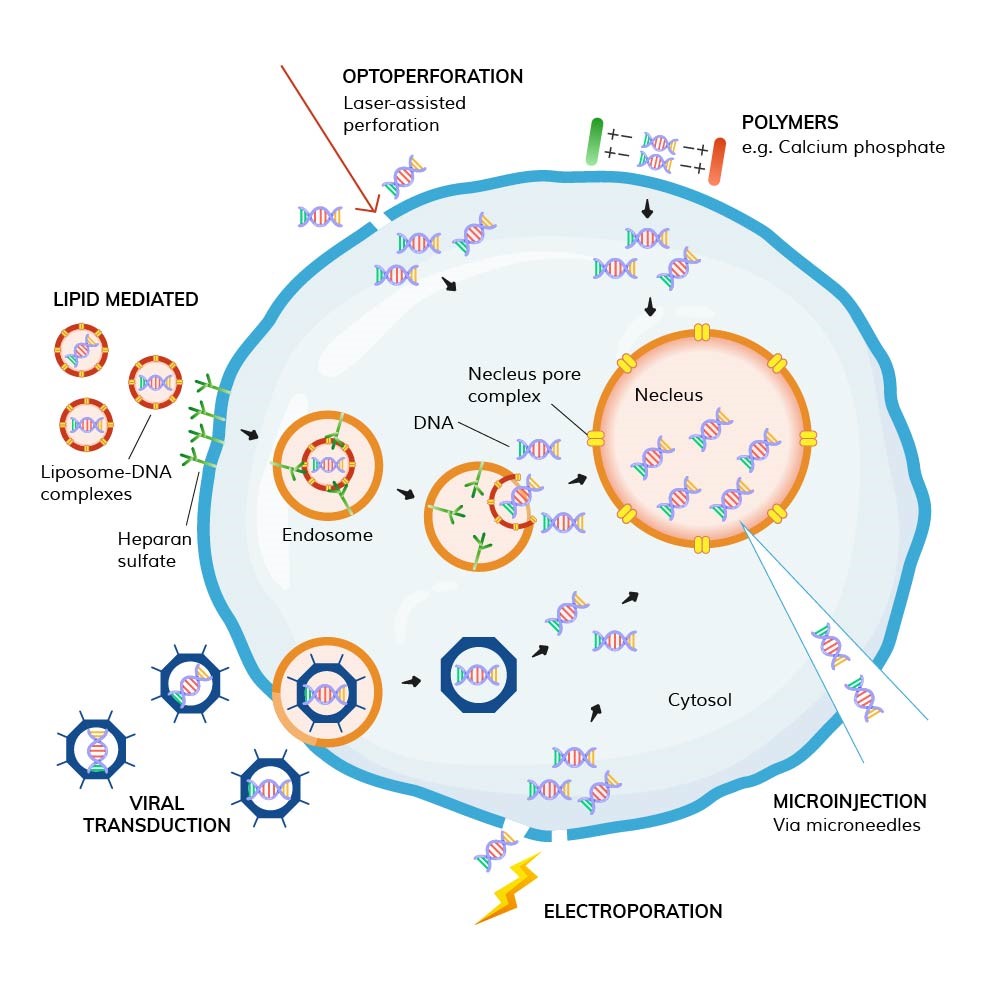
Transfection is the process of introducing exogenous genetic material, such as DNA or RNA, into eukaryotic cells. This exogenous genetic material can be artificially synthesized gene fragments or gene sequences extracted from other organisms. Through transfection, researchers can artificially alter the genetic information inside the cells, enabling the study of gene functions, protein production, gene therapy development, cell signaling pathways, and disease mechanisms, among others.
Principle:
Cells have an inherent barrier function, where the cell membrane prevents external substances from entering the cell, thereby maintaining the stability of the internal environment. The core of transfection technology is to break through this barrier of the cell membrane and successfully deliver exogenous genetic material into the cell.
Classification:
1. Chemical Transfection
Liposome-mediated Transfection: One of the most commonly used chemical transfection methods. Liposomes are tiny vesicles composed of a phospholipid bilayer that can fuse with the cell membrane. The exogenous DNA or RNA is encapsulated inside the liposome, forming a liposome-nucleic acid complex. Cells internalize this complex via endocytosis, and the nucleic acid is released from the liposome into the cytoplasm. Liposome-mediated transfection is relatively simple, has a high transfection efficiency, and is suitable for a variety of cell types. However, it may exhibit some toxicity to certain cells, and transfection efficiency is influenced by factors such as the liposome-nucleic acid ratio and cell density.
Cationic Polymer Transfection: Cationic polymers carry a positive charge, which allows them to bind with negatively charged nucleic acids through electrostatic interactions, forming stable complexes. These complexes can adsorb to the cell surface and enter cells via endocytosis. Compared to liposome transfection, cationic polymer transfection has better cell adaptability and can achieve good results with some difficult-to-transfect cell types, but it may also pose cell toxicity issues.
Calcium Phosphate Precipitation: This method involves mixing exogenous DNA with calcium phosphate, utilizing the cell membrane's ability to adsorb exogenous DNA and the cytoplasm's ability to uptake DNA, enabling the entry of DNA into the cell.
2. Physical Transfection
Electroporation: After mixing the cell suspension with exogenous nucleic acids, the mixture is placed in an electroporation device, where a brief high-voltage pulse is applied. The electric pulse temporarily forms reversible pores in the cell membrane, through which exogenous nucleic acids can enter the cell. Electroporation offers high transfection efficiency, particularly for difficult-to-transfect cells. However, the process can damage cells, affecting their survival and growth.
Microinjection: This technique uses microscopic manipulation to directly insert fine needle into the cell and inject exogenous nucleic acids into the cell. This method allows for precise delivery of genetic material into specific cells, with high transfection efficiency and minimal impact on cells. However, it is technically challenging and has low throughput, making it unsuitable for large-scale transfection experiments.
Gene Gun: This technique uses high-speed particles to deliver exogenous DNA or RNA into target cells, thereby achieving gene introduction.
3. Biological Transfection
Virus-Mediated Transfection: Common viral vectors include retroviruses, lentiviruses, and adenoviruses. These viruses can efficiently infect cells and integrate their genetic material into the host cell's genome (retroviruses and lentiviruses) or express the material transiently in the host cell (adenoviruses). Virus-mediated transfection has the advantage of high transfection efficiency and the ability to infect a wide variety of cell types, making it especially suitable for in vivo gene delivery. However, the preparation of viral vectors is complex and presents potential biosafety risks, such as immune responses caused by viral infection.
Transfection Methods: Transient vs. Stable Transfection
| Project | Transient Transfection | Stable Transfection |
|---|---|---|
| Genetic inheritance | Exogenous genes are not passed to offspring | Exogenous genes are passed to offspring |
| Integration site | Free in the cytoplasm or nucleus | Integrated into the cell genome |
| Screening steps | No need for screening | Requires selective pressure (e.g., antibiotics) |
| Experiment cycle | Quick, usually completed in a few days | Slow, may take weeks to months |
| Cost | Low experiment cost | High experiment cost, but costs lower after producing stable clones |
| Purpose | Quick gene |



C. elegans functions as a model organism due to its simplicity, transparency, and well-characterized biology. Its genome has been fully sequenced, presenting a comprehensive genetic map that aids in studies of gene function and regulation. The worm's short lifecycle and ability to produce large numbers of offspring in a short period are ideal for genetic studies. Additionally, as a transparent organism throughout its life, researchers can observe developmental processes, cell division, and other biological functions in real-time under a microscope. The ease of maintaining and manipulating C. elegans in the laboratory, along with established techniques for gene editing and RNA interference, makes it a powerful tool for studying fundamental biological processes.
In this blog, we discuss a brief history and some key breakthroughs of C. elegans as a model organism. We explain the research advantages and limitations of C. elegans, and describe some research areas where scientists have investigated using C. elegans. You will also find a list of resources...