This website uses cookies to ensure you get the best experience on our website.


- Table of Contents
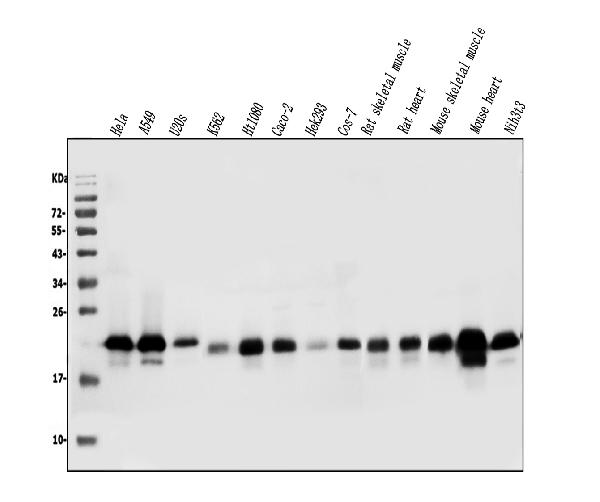
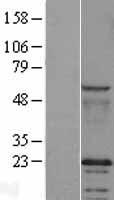
Designing a Western blot for Caveolin-2? The guide has the expected band size, antibodies backed by real blot images, the controls to run alongside, and protocols taken from published papers.
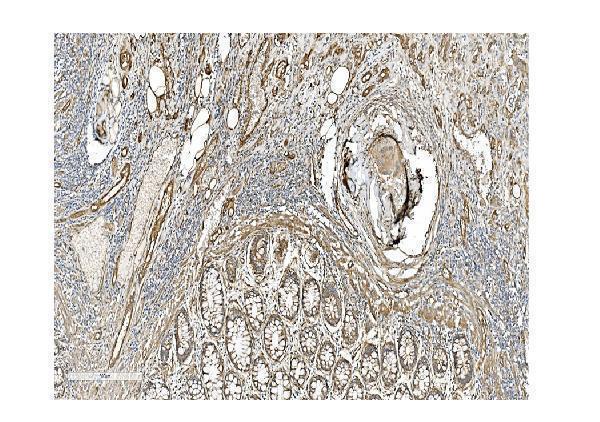
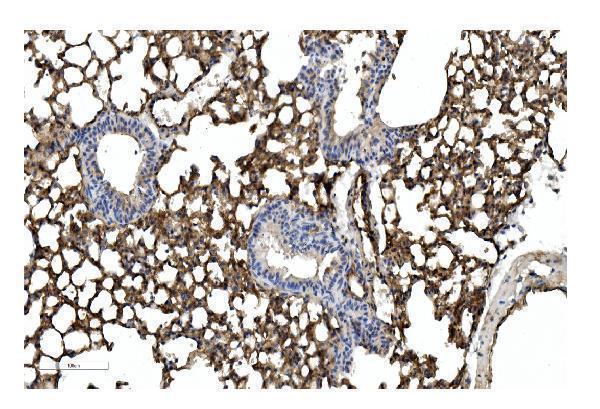
Open the CAV2 Western Blot GuideDesigning an IHC experiment for Caveolin-2? The guide has the expected staining pattern, antigen retrieval and fixation, antibodies backed by real IHC images, the tissue controls to run alongside, and protocols taken from published papers.
Open the CAV2 IHC Guide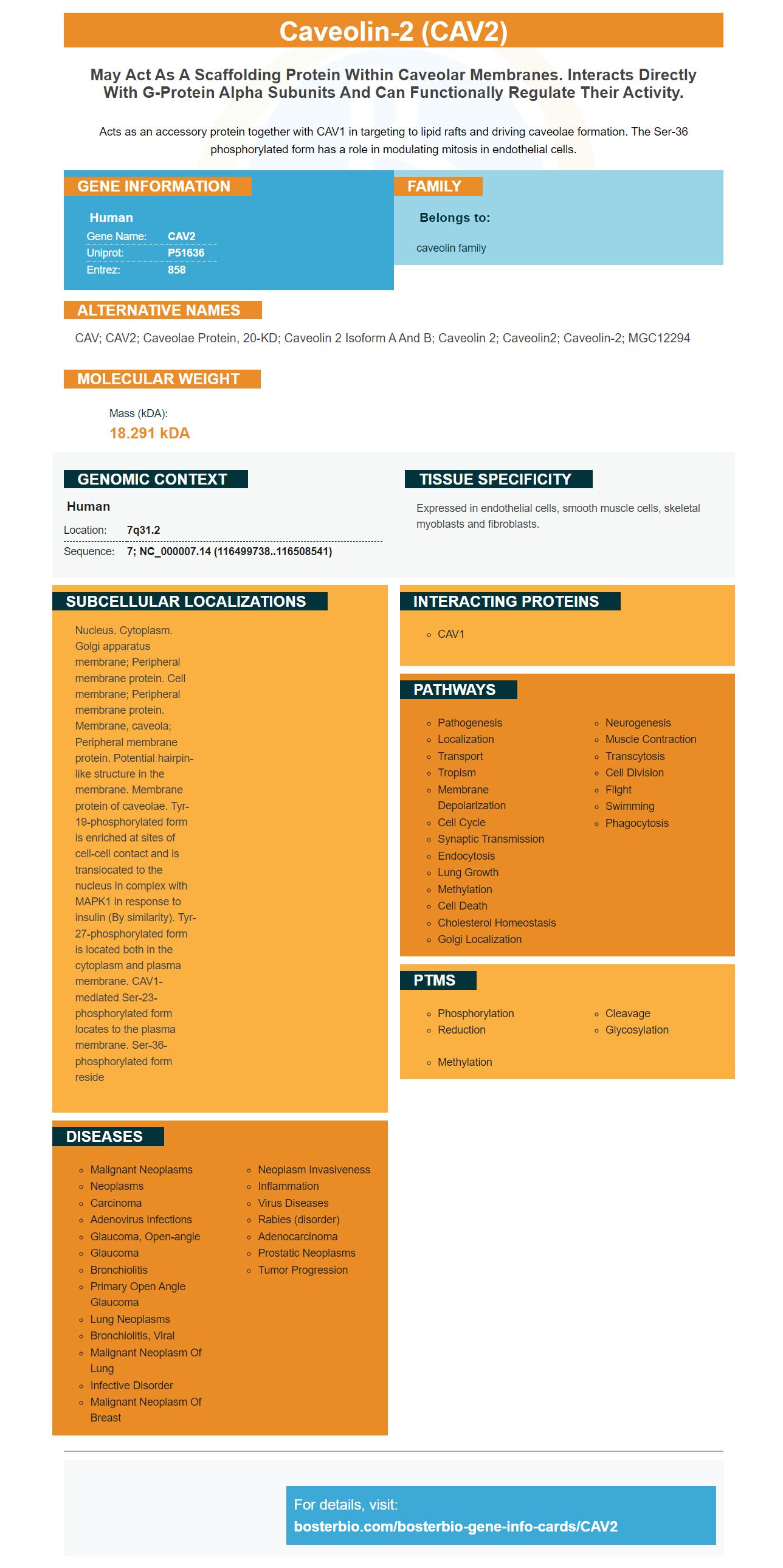
Facts about Caveolin-2.
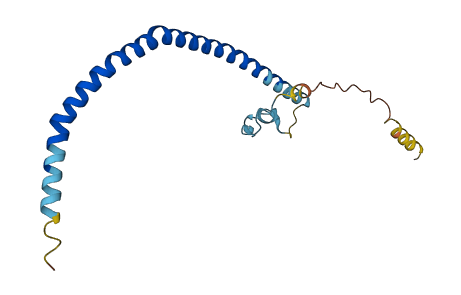
Acts as an accessory protein together with CAV1 in targeting to lipid rafts and driving caveolae formation. The Ser-36 phosphorylated form has a role in modulating mitosis in endothelial cells.
| Human | |
|---|---|
| Gene Name: | CAV2 |
| Uniprot: | P51636 |
| Entrez: | 858 |
| Belongs to: |
|---|
| caveolin family |

CAV; CAV2; caveolae protein, 20-kD; caveolin 2 isoform a and b; caveolin 2; Caveolin2; Caveolin-2; MGC12294
Mass (kDA):
18.291 kDA

| Human | |
|---|---|
| Location: | 7q31.2 |
| Sequence: | 7; NC_000007.14 (116499738..116508541) |
Expressed in endothelial cells, smooth muscle cells, skeletal myoblasts and fibroblasts.
Nucleus. Cytoplasm. Golgi apparatus membrane; Peripheral membrane protein. Cell membrane; Peripheral membrane protein. Membrane, caveola; Peripheral membrane protein. Potential hairpin-like structure in the membrane. Membrane protein of caveolae. Tyr-19-phosphorylated form is enriched at sites of cell-cell contact and is translocated to the nucleus in complex with MAPK1 in response to insulin (By similarity). Tyr-27-phosphorylated form is located both in the cytoplasm and plasma membrane. CAV1-mediated Ser-23-phosphorylated form locates to the plasma membrane. Ser-36-phosphorylated form reside


PMID: 8552590 by Scherer P.E., et al. Identification, sequence, and expression of caveolin-2 defines a caveolin gene family.
PMID: 9361015 by Scherer P.E., et al. Cell-type and tissue-specific expression of caveolin-2. Caveolins 1 and 2 co-localize and form a stable hetero-oligomeric complex in vivo.
*More publications can be found for each product on its corresponding product page