This website uses cookies to ensure you get the best experience on our website.


- Table of Contents
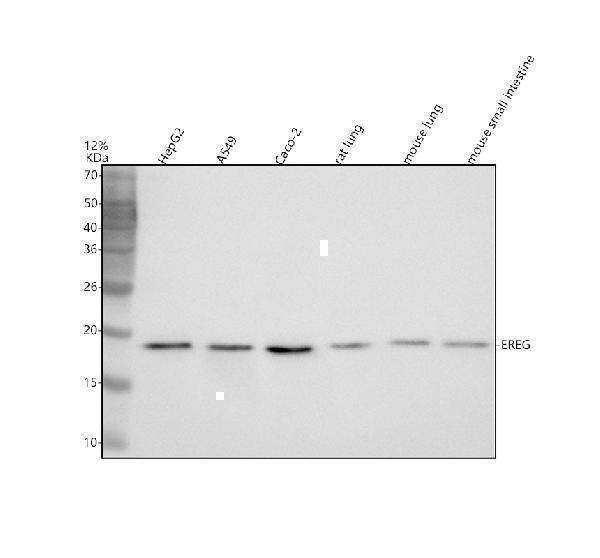
Designing a Western blot for Proepiregulin? The guide has the expected band size, antibodies backed by real blot images, the controls to run alongside, and protocols taken from published papers.
Open the EREG Western Blot Guide
1 Citations


Facts about Proepiregulin.

Ligand of the EGF receptor/EGFR and ERBB4.
Stimulates EGFR and ERBB4 tyrosine phosphorylation (PubMed:9419975).Contributes to inflammation, wound healing, tissue repair, and oocyte maturation by regulating angiogenesis and vascular remodeling and by stimulating cell proliferation (PubMed:24631357). .
| Human | |
|---|---|
| Gene Name: | EREG |
| Uniprot: | O14944 |
| Entrez: | 2069 |

| Belongs to: |
|---|
| No superfamily |

Epiregulin; ER; EREG; proepiregulin
Mass (kDA):
19.044 kDA

| Human | |
|---|---|
| Location: | 4q13.3 |
| Sequence: | 4; NC_000004.12 (74365145..74388749) |
[Epiregulin]: Secreted, extracellular space.; [Proepiregulin]: Cell membrane; Single-pass type I membrane protein.


PMID: 9337852 by Toyoda H., et al. Distribution of mRNA for human epiregulin, a differentially expressed member of the epidermal growth factor family.
PMID: 9419975 by Komurasaki T., et al. Epiregulin binds to epidermal growth factor receptor and ErbB-4 and induces tyrosine phosphorylation of epidermal growth factor receptor, ErbB-2, ErbB-3 and ErbB-4.