This website uses cookies to ensure you get the best experience on our website.


- Table of Contents
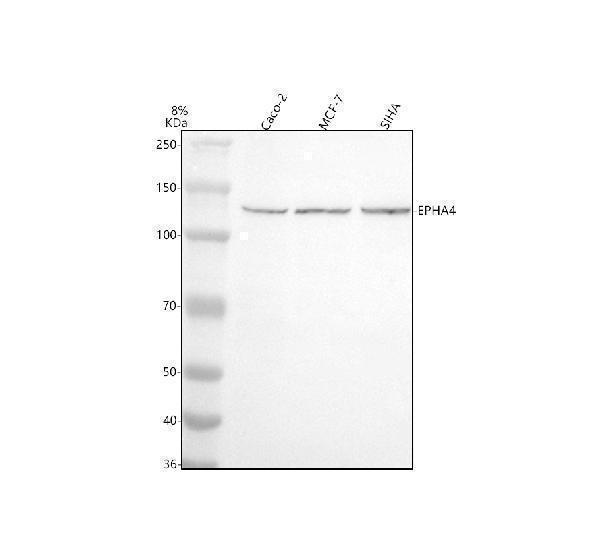
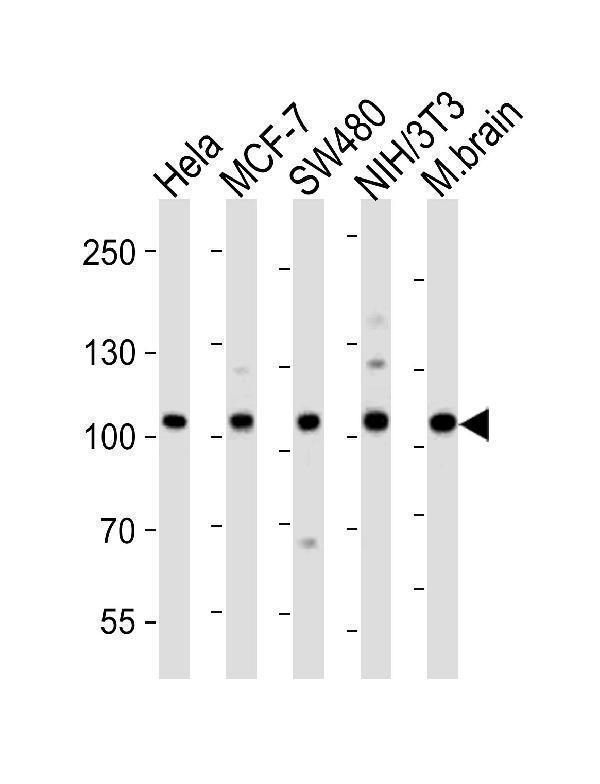
Designing a Western blot for Ephrin type-A receptor 4? The guide has the expected band size, antibodies backed by real blot images, the controls to run alongside, and protocols taken from published papers.
Open the EPHA4 Western Blot GuideDesigning an IHC experiment for Ephrin type-A receptor 4? The guide has the expected staining pattern, antigen retrieval and fixation, antibodies backed by real IHC images, the tissue controls to run alongside, and protocols taken from published papers.
Open the EPHA4 IHC Guide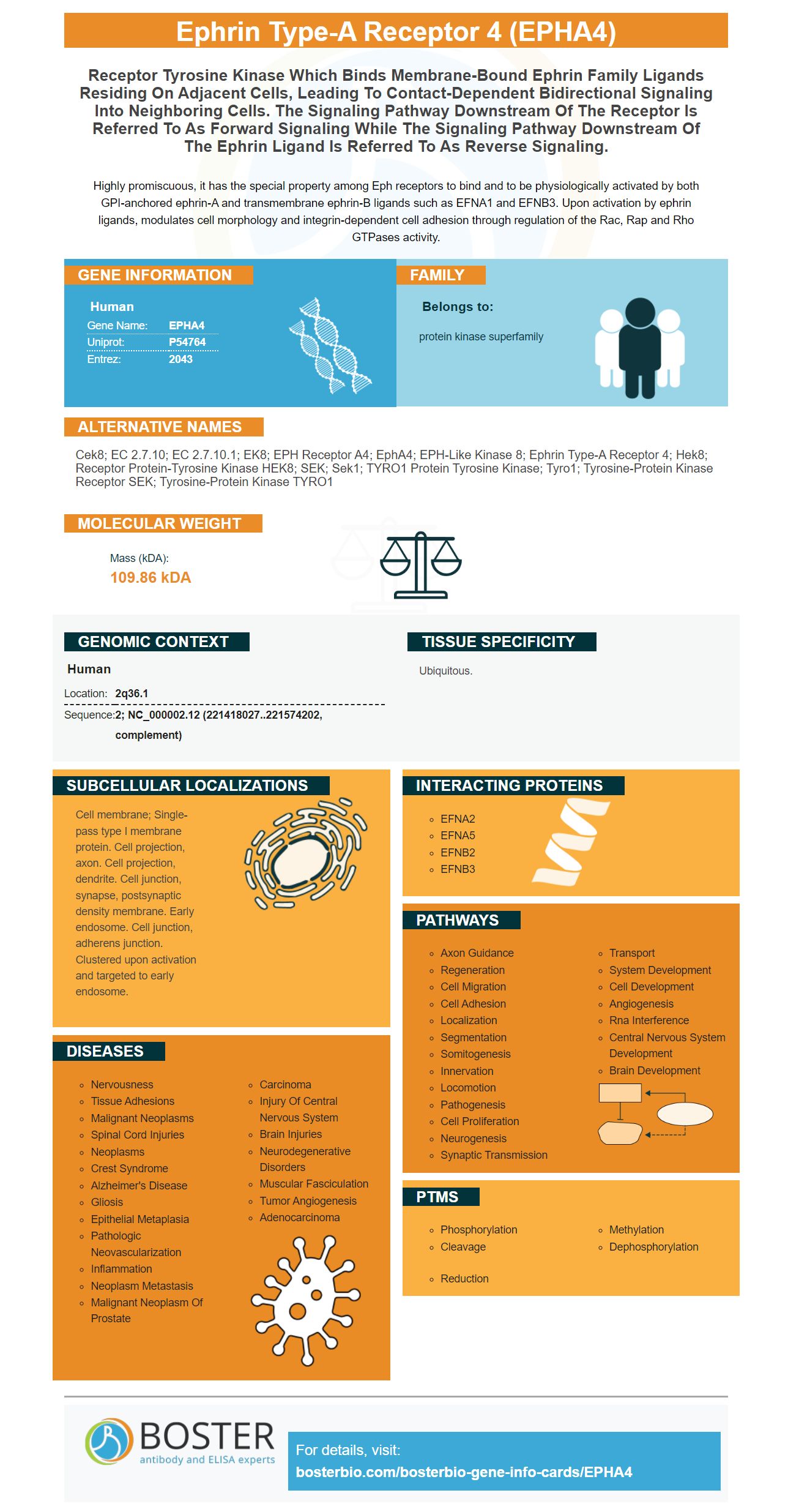
Facts about Ephrin type-A receptor 4.
Highly promiscuous, it has the special property among Eph receptors to bind and to be physiologically activated by both GPI-anchored ephrin-A and transmembrane ephrin-B ligands such as EFNA1 and EFNB3. Upon activation by ephrin ligands, modulates cell morphology and integrin-dependent cell adhesion through regulation of the Rac, Rap and Rho GTPases activity.
| Human | |
|---|---|
| Gene Name: | EPHA4 |
| Uniprot: | P54764 |
| Entrez: | 2043 |

| Belongs to: |
|---|
| protein kinase superfamily |

Cek8; EC 2.7.10; EC 2.7.10.1; EK8; EPH receptor A4; EphA4; EPH-like kinase 8; ephrin type-A receptor 4; Hek8; receptor protein-tyrosine kinase HEK8; SEK; Sek1; TYRO1 protein tyrosine kinase; Tyro1; Tyrosine-protein kinase receptor SEK; Tyrosine-protein kinase TYRO1
Mass (kDA):
109.86 kDA

| Human | |
|---|---|
| Location: | 2q36.1 |
| Sequence: | 2; NC_000002.12 (221418027..221574202, complement) |
Ubiquitous.
Cell membrane; Single-pass type I membrane protein. Cell projection, axon. Cell projection, dendrite. Cell junction, synapse, postsynaptic density membrane. Early endosome. Cell junction, adherens junction. Clustered upon activation and targeted to early endosome.





PMID: 7898931 by Fox G.M., et al. cDNA cloning and tissue distribution of five human EPH-like receptor protein-tyrosine kinases.
PMID: 18094260 by Richter M., et al. The EphA4 receptor regulates neuronal morphology through SPAR- mediated inactivation of Rap GTPases.