This website uses cookies to ensure you get the best experience on our website.


- Table of Contents
Designing an IHC experiment for Fibrillin-1? The guide has the expected staining pattern, antigen retrieval and fixation, antibodies backed by real IHC images, the tissue controls to run alongside, and protocols taken from published papers.
Open the FBN1 IHC Guide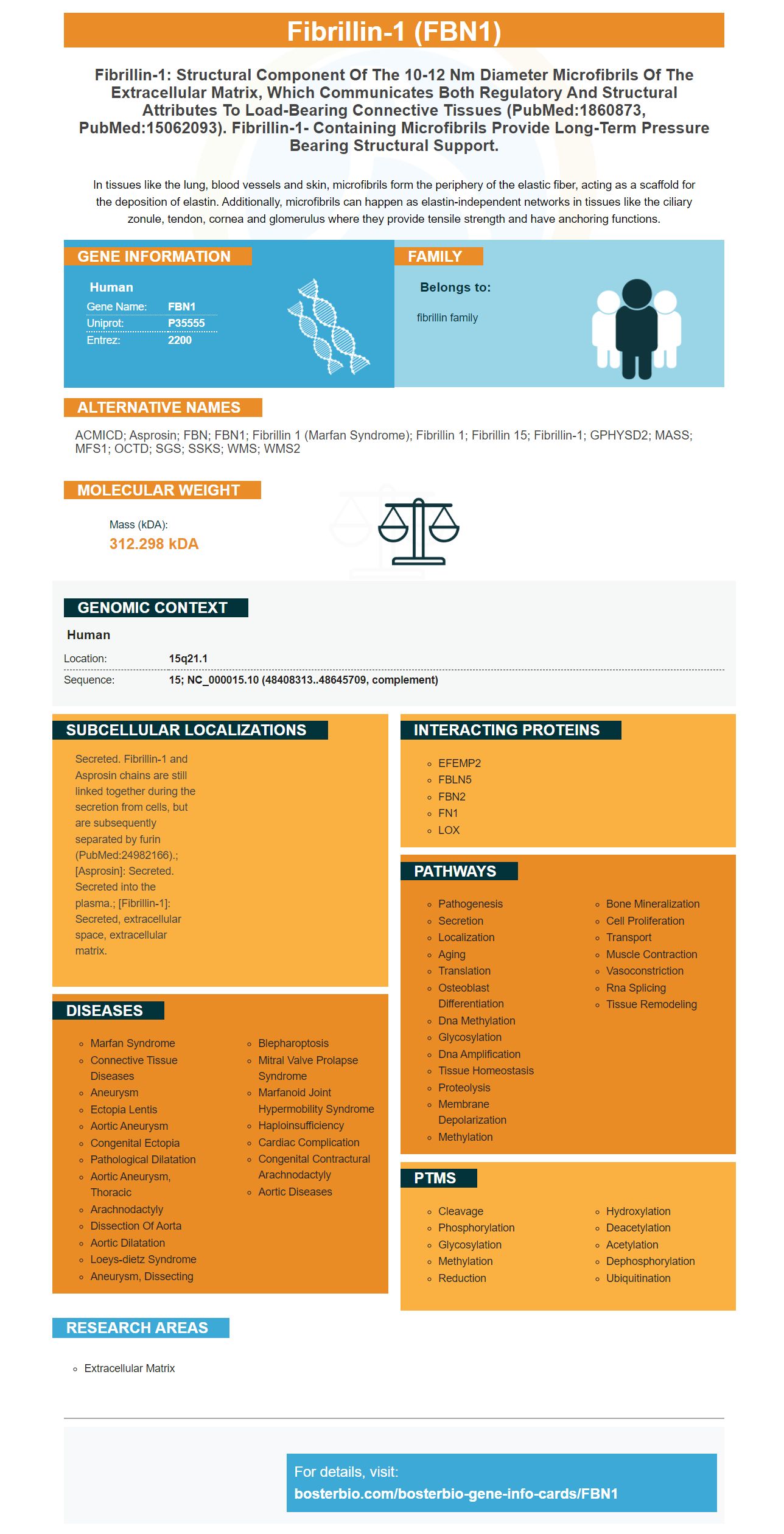
Facts about Fibrillin-1.
In tissues like the lung, blood vessels and skin, microfibrils form the periphery of the elastic fiber, acting as a scaffold for the deposition of elastin. Additionally, microfibrils can happen as elastin-independent networks in tissues like the ciliary zonule, tendon, cornea and glomerulus where they provide tensile strength and have anchoring functions.
| Human | |
|---|---|
| Gene Name: | FBN1 |
| Uniprot: | P35555 |
| Entrez: | 2200 |

| Belongs to: |
|---|
| fibrillin family |

ACMICD; Asprosin; FBN; FBN1; fibrillin 1 (Marfan syndrome); Fibrillin 1; fibrillin 15; fibrillin-1; GPHYSD2; MASS; MFS1; OCTD; SGS; SSKS; WMS; WMS2
Mass (kDA):
312.298 kDA

| Human | |
|---|---|
| Location: | 15q21.1 |
| Sequence: | 15; NC_000015.10 (48408313..48645709, complement) |
Secreted. Fibrillin-1 and Asprosin chains are still linked together during the secretion from cells, but are subsequently separated by furin (PubMed:24982166).; [Asprosin]: Secreted. Secreted into the plasma.; [Fibrillin-1]: Secreted, extracellular space, extracellular matrix.






PMID: 8364578 by Pereira L.V., et al. Genomic organization of the sequence coding for fibrillin, the defective gene product in Marfan syndrome.
PMID: 15221638 by Uyeda T., et al. Three novel mutations of the fibrillin-1 gene and ten single nucleotide polymorphisms of the fibrillin-3 gene in Marfan syndrome patients.