This website uses cookies to ensure you get the best experience on our website.


- Table of Contents
Designing a Western blot for HSPA1B? The guide has the expected band size, antibodies backed by real blot images, the controls to run alongside, and protocols taken from published papers.
Open the HSPA1B Western Blot Guide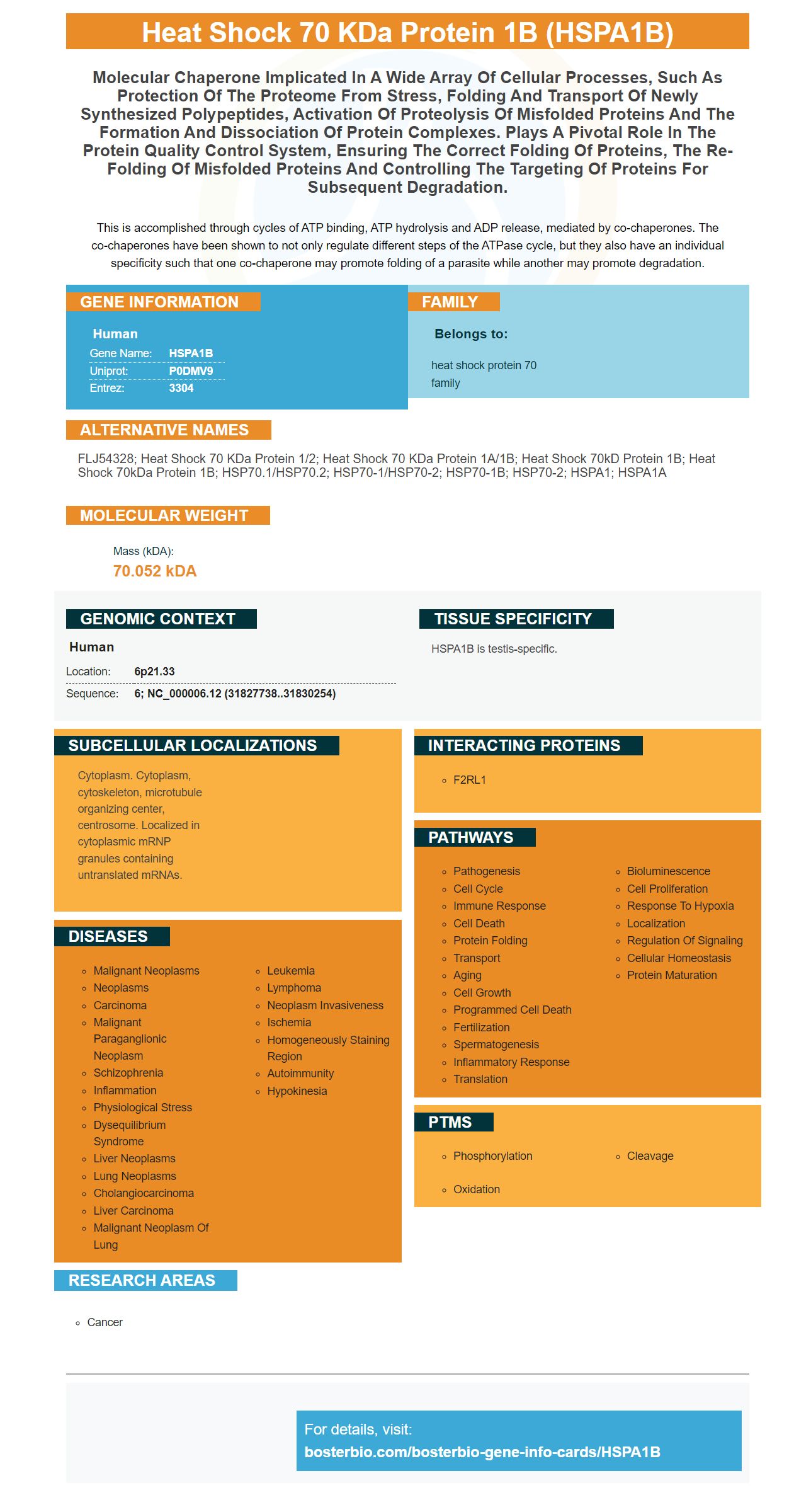
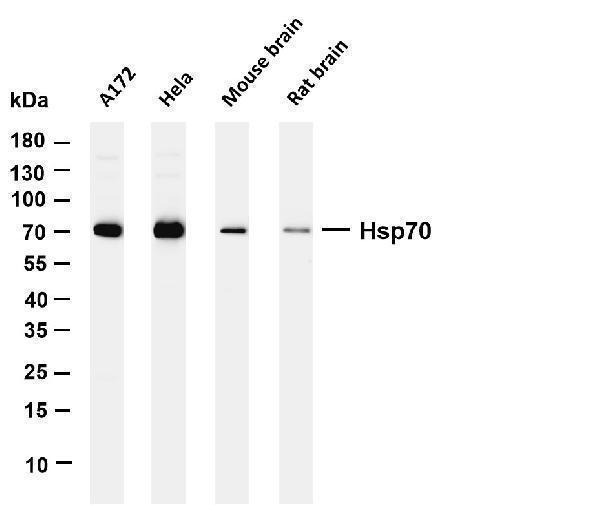
Facts about Heat shock 70 kDa protein 1B.
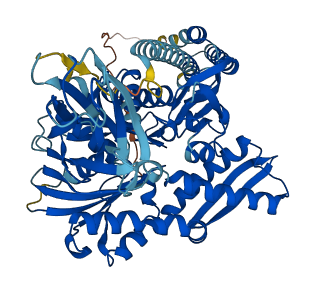
This is accomplished through cycles of ATP binding, ATP hydrolysis and ADP release, mediated by co-chaperones. The co-chaperones have been shown to not only regulate different steps of the ATPase cycle, but they also have an individual specificity such that one co-chaperone may promote folding of a parasite while another may promote degradation.
| Human | |
|---|---|
| Gene Name: | HSPA1B |
| Uniprot: | P0DMV9 |
| Entrez: | 3304 |
| Belongs to: |
|---|
| heat shock protein 70 family |

FLJ54328; Heat shock 70 kDa protein 1/2; heat shock 70 kDa protein 1A/1B; heat shock 70kD protein 1B; heat shock 70kDa protein 1B; HSP70.1/HSP70.2; HSP70-1/HSP70-2; HSP70-1B; HSP70-2; HSPA1; HSPA1A
Mass (kDA):
70.052 kDA

| Human | |
|---|---|
| Location: | 6p21.33 |
| Sequence: | 6; NC_000006.12 (31827738..31830254) |
HSPA1B is testis-specific.
Cytoplasm. Cytoplasm, cytoskeleton, microtubule organizing center, centrosome. Localized in cytoplasmic mRNP granules containing untranslated mRNAs.






PMID: 1700760 by Milner C.M., et al. Structure and expression of the three MHC-linked HSP70 genes.
PMID: 2538825 by Sargent C.A., et al. Human major histocompatibility complex contains genes for the major heat shock protein HSP70.
*More publications can be found for each product on its corresponding product page