This website uses cookies to ensure you get the best experience on our website.


- Table of Contents
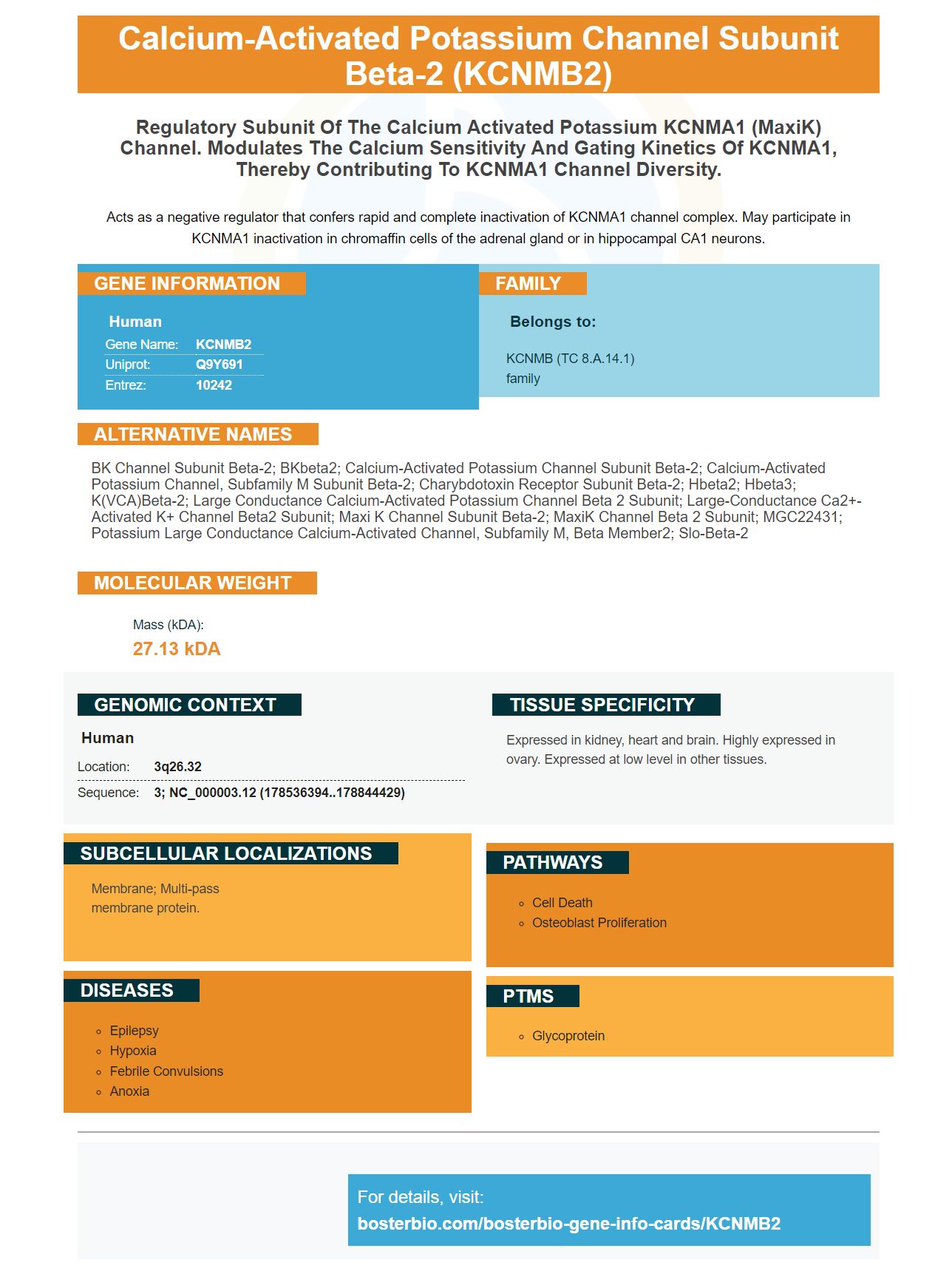
Facts about Calcium-activated potassium channel subunit beta-2.
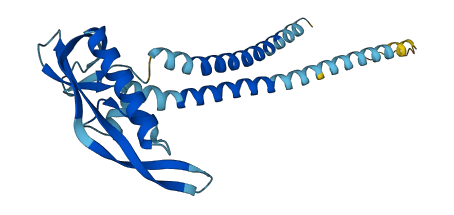
Acts as a negative regulator that confers rapid and complete inactivation of KCNMA1 channel complex. May participate in KCNMA1 inactivation in chromaffin cells of the adrenal gland or in hippocampal CA1 neurons.
| Human | |
|---|---|
| Gene Name: | KCNMB2 |
| Uniprot: | Q9Y691 |
| Entrez: | 10242 |
| Belongs to: |
|---|
| KCNMB (TC 8.A.14.1) family |

BK channel subunit beta-2; BKbeta2; calcium-activated potassium channel subunit beta-2; Calcium-activated potassium channel, subfamily M subunit beta-2; Charybdotoxin receptor subunit beta-2; hbeta2; hbeta3; k(VCA)beta-2; large conductance calcium-activated potassium channel beta 2 subunit; large-conductance Ca2+-activated K+ channel beta2 subunit; Maxi K channel subunit beta-2; MaxiK channel beta 2 subunit; MGC22431; potassium large conductance calcium-activated channel, subfamily M, beta member2; slo-beta-2
Mass (kDA):
27.13 kDA

| Human | |
|---|---|
| Location: | 3q26.32 |
| Sequence: | 3; NC_000003.12 (178536394..178844429) |
Expressed in kidney, heart and brain. Highly expressed in ovary. Expressed at low level in other tissues.
Membrane; Multi-pass membrane protein.


PMID: 10097176 by Wallner M., et al. Molecular basis of fast inactivation in voltage and Ca2+-activated K+ channels: a transmembrane beta-subunit homolog.
PMID: 10692449 by Brenner R., et al. Cloning and functional characterization of novel large conductance calcium-activated potassium channel beta subunits, hKCNMB3 and hKCNMB4.