This website uses cookies to ensure you get the best experience on our website.


- Table of Contents
Designing a Western blot for DNA polymerase eta? The guide has the expected band size, antibodies backed by real blot images, the controls to run alongside, and protocols taken from published papers.
Open the POLH Western Blot Guide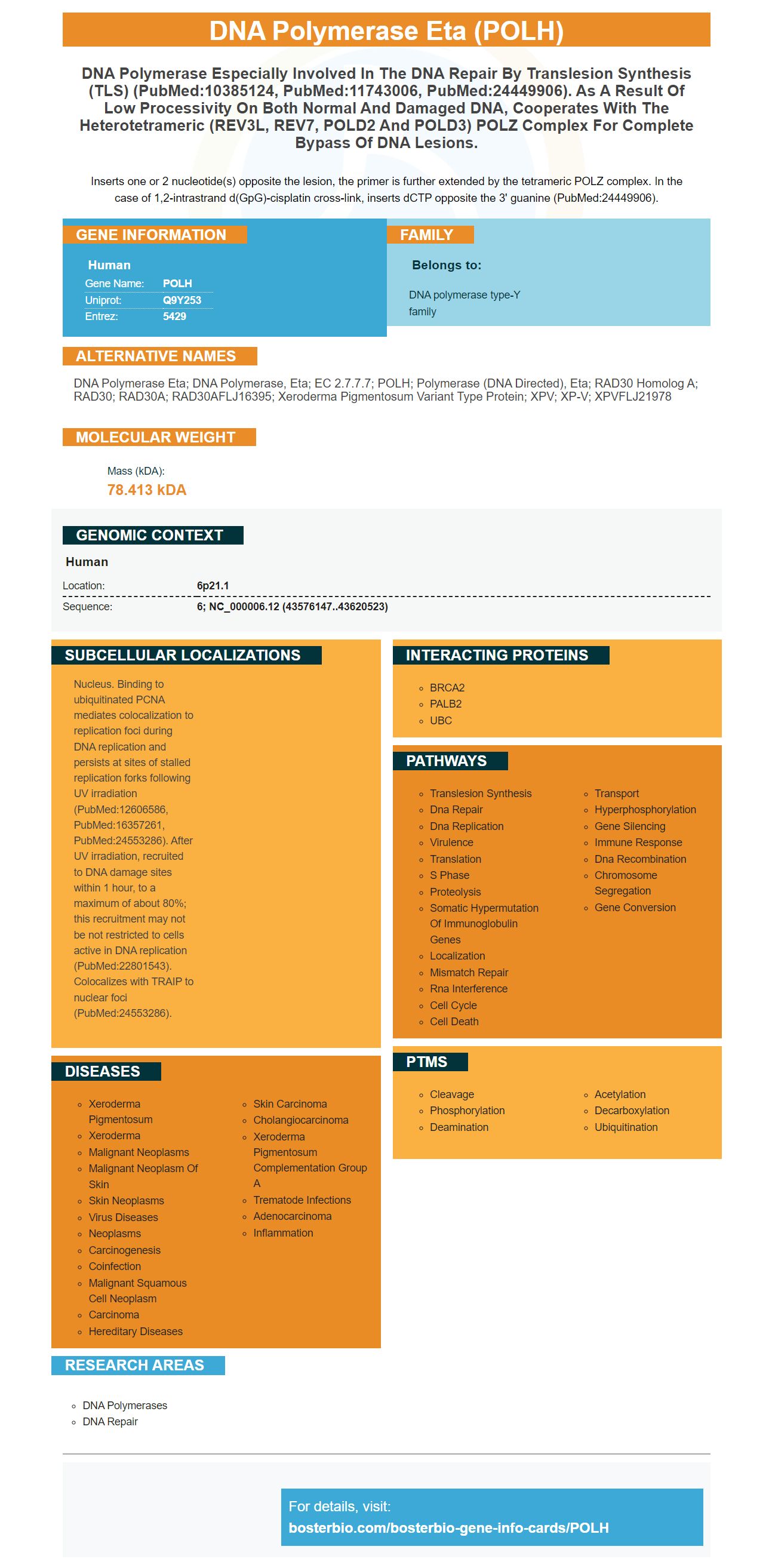
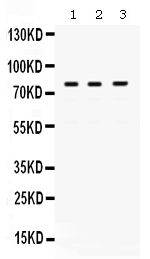

Facts about DNA polymerase eta.
Inserts one or 2 nucleotide(s) opposite the lesion, the primer is further extended by the tetrameric POLZ complex. In the case of 1,2-intrastrand d(GpG)-cisplatin cross-link, inserts dCTP opposite the 3' guanine (PubMed:24449906).
| Human | |
|---|---|
| Gene Name: | POLH |
| Uniprot: | Q9Y253 |
| Entrez: | 5429 |
| Belongs to: |
|---|
| DNA polymerase type-Y family |

DNA polymerase eta; DNA Polymerase, eta; EC 2.7.7.7; POLH; polymerase (DNA directed), eta; RAD30 homolog A; RAD30; RAD30A; RAD30AFLJ16395; Xeroderma pigmentosum variant type protein; XPV; XP-V; XPVFLJ21978
Mass (kDA):
78.413 kDA

| Human | |
|---|---|
| Location: | 6p21.1 |
| Sequence: | 6; NC_000006.12 (43576147..43620523) |
Nucleus. Binding to ubiquitinated PCNA mediates colocalization to replication foci during DNA replication and persists at sites of stalled replication forks following UV irradiation (PubMed:12606586, PubMed:16357261, PubMed:24553286). After UV irradiation, recruited to DNA damage sites within 1 hour, to a maximum of about 80%; this recruitment may not be not restricted to cells active in DNA replication (PubMed:22801543). Colocalizes with TRAIP to nuclear foci (PubMed:24553286).





PMID: 10385124 by Masutani C., et al. The XPV (Xeroderma pigmentosum variant) gene encodes human DNA polymerase eta.
PMID: 10398605 by Johnson R.E., et al. hRAD30 mutations in the variant form of xeroderma pigmentosum.