

Click image to see more details
Product Info Summary
| SKU: | EK1870 |
|---|---|
| Size: | 96 wells/kit, with removable strips. |
| Reactive Species: | Human |
| Application: | ELISA |
| Sample Types: | cell culture supernatants, serum and plasma (heparin, EDTA). |
Product info
Product Name
Human AKR1C4 ELISA Kit PicoKine®
SKU/Catalog Number
EK1870
Size
96 wells/kit, with removable strips.
*Question: How many samples can I assay/run in this kit?
Description
Human AKR1C4 ELISA Kit PicoKine® (96 Tests). Quantitate Human AKR1C4 in cell culture supernatants, serum and plasma (heparin, EDTA). Sensitivity: 10pg/ml. The brand Picokine indicates this is a premium quality ELISA kit. Each Picokine kit delivers precise quantification, high sensitivity, and excellent reproducibility. Only our most reliable and effective kits qualify as Picokine, guaranteeing top-tier results for your assays.
Storage & Handling
Store at 4°C for 6 months, at -20°C for 12 months. Avoid multiple freeze-thaw cycles (Ships with gel ice, can store for up to 3 days in room temperature. Freeze upon receiving.)
Cite This Product
Human AKR1C4 ELISA Kit PicoKine® (Boster Biological Technology, Pleasanton CA, USA, Catalog # EK1870)
Clonality of Antibodies
See Datasheet for details
Standard Protein
Expression system for standard: E.coli; Immunogen sequence: M1-Y323
Sensitivity
<25 pg/ml
Assay Range
156 pg/ml - 10,000 pg/ml
Standard Dilution Instructions

See datasheet of EK1870 for more details
Cross-reactivity
There is no detectable cross-reactivity with other relevant proteins.
Reactive Species
EK1870 is reactive to AKR1C4 in Human samples
Validated Sample Types
cell culture supernatants, serum and plasma (heparin, EDTA).
Application Guarantee
EK1870 is guaranteed for ELISA in Human by Boster Guarantee
See how Boster Bio validate our ELISA kits: ELISA Validation Information
Background of AKR1C4
3α-Hydroxysteroid dehydrogenase (3α-HSD or aldo-keto reductase family 1 member C4) is an enzyme that in humans is encoded by the AKR1C4 gene. It is mapped to 10p15.1. This gene encodes a member of the aldo/keto reductase superfamily, which consists of more than 40 known enzymes and proteins. These enzymes catalyze the conversion of aldehydes and ketones to their corresponding alcohols by utilizing NADH and/or NADPH as cofactors. The enzymes display overlapping but distinct substrate specificity. This enzyme catalyzes the bioreduction of chlordecone, a toxic organochlorine pesticide, to chlordecone alcohol in liver. This gene shares high sequence identity with three other gene members and is clustered with those three genes at chromosome 10p15-p14.
Kit Components
| Catalog Number | Description | Quantity |
|---|---|---|
| EK1870-CAP | Anti-Human AKR1C4 Pre-coated 96-well strip microplate | 1 |
| EK1870-ST | Human AKR1C4 Standard | 2 vials, 10 ng/tube |
| EK1870-DA | Human AKR1C4 Biotinylated antibody (100x) | 100ul |
| AR1103 | Avidin-Biotin-Peroxidase Complex (100x) | 100ul |
| AR1106-1 | Sample Diluent | 30ml |
| AR1106-2 | Antibody Diluent | 12ml |
| AR1106-3 | Avidin-Biotin-Peroxidase Diluent | 12ml |
| AR1104 | Color Developing Reagent (TMB) | 10ml |
| AR1105 | Stop Solution | 10ml |
| AR1106-5 | Wash Buffer (25x) | 20ml |
| PLA-SEA | Adhesive plate sealers | 4 |
*The kit components are not available for individual purchase.
Materials Required But Not Included In Kit
- Microplate Reader capable of reading absorbance at 450nm.
- Incubator.
- Automated plate washer (optional).
- Pipettes and pipette tips capable of precisely dispensing 0.5 µl through 1 ml volumes of aqueous solutions.
- Multichannel pipettes are recommended for large amount of samples.
- Deionized or distilled water.
- 500ml graduated cylinders.
- Test tubes for dilution.
Data Examples, Quality Control Data & Sample Dilution
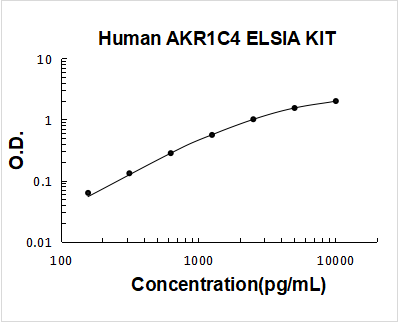
Validation Standard Curve O.D. At 450nm
| Concentration (pg/ml) | 0 | 156 | 312 | 625 | 1250 | 2500 | 5000 | 10000 |
| O.D. | 0.051 | 0.115 | 0.185 | 0.337 | 0.62 | 1.078 | 1.62 | 2.09 |
Data Example Images
Click image to see more details
Human AKR1C4 PicoKine ELISA Kit Standard Curve
Recommended Sample Dilution Ratios
According to our internal validation assays using this ELISA kit, to detect AKR1C4,
| Application | Dilution | Species |
|---|---|---|
| Dilution ratio of 1:1 | concentration in serum and plasma is less than the lowest standard | 156 pg/ml. |
Intra Assay Consistency & Inter Assay Consistency
We measured random samples of Human AKR1C4 ELISA Kit PicoKine® within the same batch/lot to ensure the consistency of the kits' performances. ELISA intra assay consistency is measured using wells from the same plate/assay kit. ELISA inter assay consistency is measured using wells from different plates from the same batch production/lot.
| Intra-Assay Precision | Inter-Assay Precision | |||||
|---|---|---|---|---|---|---|
| Sample | 1 | 2 | 3 | 1 | 2 | 3 |
| n | 16 | 16 | 16 | 24 | 24 | 24 |
| Mean (pg/ml) | 211 | 913 | 4596 | 295 | 1047 | 3034 |
| Standard deviation | 12.74 | 30.49 | 165.92 | 15.93 | 44.18 | 207.22 |
| CV (%) | 6.0% | 3.3% | 3.6% | 5.4% | 4.2% | 6.8% |
Specific Publications For Human AKR1C4 ELISA Kit PicoKine® (EK1870)
Loading publications
Recommended Resources
Here are featured tools and databases that you might find useful.
- Boster's Pathways Library
- Protein Databases
- Bioscience Research Protocol Resources
- Data Processing & Analysis Software
- Photo Editing Software
- Scientific Literature Resources
- Research Paper Management Tools
- Molecular Biology Software
- Primer Design Tools
- Bioinformatics Tools
- Phylogenetic Tree Analysis
Customer Reviews
0 Reviews For Human AKR1C4 ELISA Kit PicoKine®
Customer Q&As
Have a question?
Find answers in Q&As, reviews.
Can't find your answer?
Submit your question
5 Customer Q&As for Human AKR1C4 ELISA Kit PicoKine®
Question
Q: if the enzyme conjugated AKR1C4 antibodies are mixed with the substrate, will that convert the substrate into the enzymatic reaction product? Or the enzyme function is only activated when the antibody is attached with the AKR1C4 antigen?
Verified Customer
Verified customer
Asked: 2020-03-23
Answer
A: The enzyme is always active. Avoid contaminating the substrate with enzyme prior to the incubation otherwise it compromises the assay with false positive signal.
Boster Scientific Support
Answered: 2020-03-23
Question
Q: can you recommend the dilution ratio of serum samples for detection of AKR1C4 in Human serum? I am trying to measure a multiple analytes and it requires 100ul of diluted samples for each well. We have low serum volumes so we like to dilute as much as possible.
Verified Customer
Verified customer
Asked: 2018-12-25
Answer
A: unable to know the physiological or pathological context of your samples we cannot recommend a dilution ratio without performing a pilot test with your samples. Here is how you can perform a pilot study on your own: perform a serial dilution of your samples on the AKR1C4 ELISA kit to make sure you have a linear ascending curve followed by a plateau, which signifies the samples saturating the detection limit of the kit. Then you can pick the dilution ratios from samples in the linear part of the curve as your experimental dilution ratio.
If you are interested in using our ELISA service, you can also send us your sample and we will take care of everything for you. You can check our service details here: bosterbio.com/services/assay-services/elisa-testing-service
Since you mentioned you have limited samples, our cost effective multiplex ELISA service would fit perfectly for your needs, where we can generate dozens of data points using as little as 25ul sample volume. Information on this service is also in the above link.
Boster Scientific Support
Answered: 2018-12-25
Question
Q: Can AKR1C4 ELISA Kits be used with tissue homogenates (or other non-validated sample types)?
H. Chen
Verified customer
Asked: 2017-05-12
Answer
A: Unfortunately, Boster Bio has not routinely validated tissue homogenates as a sample type for ELISA kits. This does not mean that ELISA kits are not valid for other sample types than we have tested: it means further investigation is required. One will need to perform a spike and recovery study to determine if an unvalidated sample type will work with a particular kit. To perform a spike and recovery experiment, one should divide a sample into two aliquots. In one of the aliquots, the user should spike in a known amount of the kit standard. a dilution series is performed comparing the spiked versus the unspiked sample. Generally, samples with expected recovery and linearity between 80-120% are considered acceptable. This method can be used to validate any sample type that has not been evaluated by Boster Bio. for a more detailed spike and recovery protocol, please contact technical support.
Note: acceptable ranges should be determined individually by each laboratory. Additionally, technical support can help determine if a buffer component is not compatible with a given ELISA kit. please check the Citations tab on the product webpage for peer-reviewed papers utilizing a wide range of sample types. We also have an innovator's reward program where if the user validates our ELISA kits in applications or samples previously not validated by Boster Bio or other users, and share such information with us by submit a review, we will reward the user's efforts with a free antibody or ELISA kit from our catalog. Biocompare.com will also give $20 Amazon giftcard as an additional reward, if the review is submitted there as well.
Boster Scientific Support
Answered: 2017-05-12
Question
Q: how many samples can be assayed in a Picokine® ELISA Kit?
Verified Customer
Verified customer
Asked: 2016-12-30
Answer
A: The Picokine® ELISA Kits will generally run a 7-point standard curve, non-specific binding wells, and 39 samples in duplicate. this may depends upon the kit used so please refer to each datasheet for details.
Boster Scientific Support
Answered: 2016-12-30
Question
Q: Are Boster Bio recombinant proteins and antibodies sterile?
Verified Customer
Verified customer
Asked: 2016-01-03
Answer
A: although the vials are bottled using aseptic techniques, heat-treated vials, and sterile stock solutions, they are not considered or guaranteed to be sterile. If sterile material is a must for an experiment, the material can be filtered through a 0.2 micron filter designed for use with biological fluids.
Boster Scientific Support
Answered: 2016-01-03

