Product Info Summary
| SKU: | PB9202 |
|---|---|
| Size: | 100 μg/vial |
| Reactive Species: | Human |
| Host: | Rabbit |
| Application: | IHC, WB |
Customers Who Bought This Also Bought
Product info
Product Name
Anti-GDNF Receptor alpha 1/GFRA1 Antibody Picoband®
SKU/Catalog Number
PB9202
PB0199 is an alternative SKU for this antibody, used in previous lots.
Size
100 μg/vial
Form
Lyophilized
Description
Boster Bio Anti-GDNF Receptor alpha 1/GFRA1 Antibody Picoband® catalog # PB9202. Tested in IHC, WB applications. This antibody reacts with Human. The brand Picoband indicates this is a premium antibody that guarantees superior quality, high affinity, and strong signals with minimal background in Western blot applications. Only our best-performing antibodies are designated as Picoband, ensuring unmatched performance.
Storage & Handling
Store at -20˚C for one year from date of receipt. After reconstitution, at 4˚C for one month. It can also be aliquotted and stored frozen at -20˚C for six months. Avoid repeated freeze-thaw cycles.
Cite This Product
Anti-GDNF Receptor alpha 1/GFRA1 Antibody Picoband® (Boster Biological Technology, Pleasanton CA, USA, Catalog # PB9202)
Host
Rabbit
Contents
Each vial contains antibody formulated with stabilizing components, 0.9 mg NaCl, 0.2 mg Na2HPO4, and 0.05 mg NaN3.
*This antibody is supplied in a stabilized formulation.
Compatibility with conjugation reactions depends on the chemistry of the conjugation method used.
For conjugation methods that are not compatible with the stabilizing components present in this formulation, a carrier-free antibody format is required.
Clonality
Polyclonal
Isotype
Rabbit IgG
Immunogen
E.coli-derived human GFRA1 recombinant protein (Position: D25-Q227). Human GFRA1 shares 97% amino acid (aa) sequence identity with both mouse and rat GFRA1.
Cross-reactivity
No cross-reactivity with other proteins
Reactive Species
PB9202 is reactive to GFRA1 in Human
Observed Molecular Weight
51 kDa
Calculated molecular weight
51.5 kDa
Background of GFRA1
GDNF family receptor alpha-1 (GFRα1), also known as the GDNF receptor or GFRA1, is a protein that in humans is encoded by the GFRA1 gene. It is mapped to chromosome 10q25.3. The protein encoded by this gene is a member of the GDNF receptor family. GFRA1 is released by neuronal cells, Schwann cells, and injured sciatic nerve. It is a glycosylphosphatidylinositol (GPI)-linked cell surface receptor for both GDNF and NTN, and mediates activation of the RET tyrosine kinase receptor. This gene is also a candidate gene for Hirschsprung disease. Soluble GFRA1 mediates robust recruitment of RET to lipid rafts via a mechanism requiring the RET tyrosine kinase.
Antibody Validation
Boster validates all antibodies on WB, IHC, ICC, Immunofluorescence, and ELISA with known positive control and negative samples to ensure specificity and high affinity, including thorough antibody incubations.
Application & Images
Applications
PB9202 is guaranteed for IHC, WB Boster Guarantee
Assay Dilutions Recommendation
The recommendations below provide a starting point for assay optimization. The actual working concentration varies and should be decided by the user.
Immunohistochemistry (Paraffin-embedded Section), 0.5-1μg/ml, Human
Western blot, 0.1-0.5μg/ml, Human
Positive Control
WB: human placenta tissue,
IHC: human lung cancer tissue
Validation Images & Assay Conditions
Click image to see more details
Western blot analysis of GFRA1 using anti-GFRA1 antibody (PB9202).
Electrophoresis was performed on a 5-20% SDS-PAGE gel at 70V (Stacking gel) / 90V (Resolving gel) for 2-3 hours.
Lane 1: recombinant human GFRA1 protein 0.5 ng.
After electrophoresis, proteins were transferred to a nitrocellulose membrane at 150 mA for 50-90 minutes. Blocked the membrane with 5% non-fat milk/TBS for 1.5 hour at RT. The membrane was incubated with rabbit anti-GFRA1 antigen affinity purified polyclonal antibody (Catalog # PB9202) at 0.5 μg/mL overnight at 4°C, then washed with TBS-0.1%Tween 3 times with 5 minutes each and probed with a goat anti-rabbit IgG-HRP secondary antibody at a dilution of 1:5000 for 1.5 hour at RT. The signal is developed using an Enhanced Chemiluminescent detection (ECL) kit (Catalog # EK1002) with Tanon 5200 system. A specific band was detected for GFRA1 at approximately 39 kDa. The expected band size for GFRA1 is at 39 kDa.
Click image to see more details
Western blot analysis of GFRA1 using anti-GFRA1 antibody (PB9202).
Electrophoresis was performed on a 5-20% SDS-PAGE gel at 70V (Stacking gel) / 90V (Resolving gel) for 2-3 hours. The sample well of each lane was loaded with 30 ug of sample under reducing conditions.
Lane 1: human placenta tissue lysates,
After electrophoresis, proteins were transferred to a nitrocellulose membrane at 150 mA for 50-90 minutes. Blocked the membrane with 5% non-fat milk/TBS for 1.5 hour at RT. The membrane was incubated with rabbit anti-GFRA1 antigen affinity purified polyclonal antibody (Catalog # PB9202) at 0.5 μg/mL overnight at 4°C, then washed with TBS-0.1%Tween 3 times with 5 minutes each and probed with a goat anti-rabbit IgG-HRP secondary antibody at a dilution of 1:5000 for 1.5 hour at RT. The signal is developed using an Enhanced Chemiluminescent detection (ECL) kit (Catalog # EK1002) with Tanon 5200 system. A specific band was detected for GFRA1 at approximately 51 kDa. The expected band size for GFRA1 is at 51 kDa.
Click image to see more details
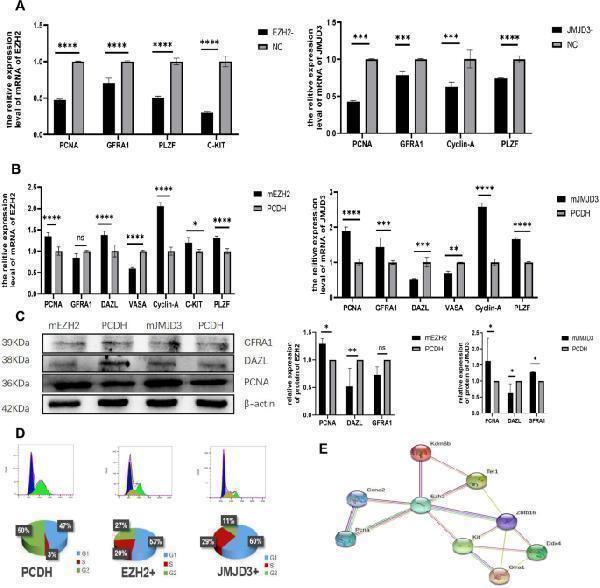
Effects of EZH2 interference or overexpression and JMJD3 interference or overexpression on self-renewal, proliferation and differentiation of spermatogonia. ( A ) The mRNA levels of PCNA, Cyclin-A, GFRA1, PLZF and C-KIT related to spermatogonia self-renewal and proliferation were changed after EZH2 and JMJD3 knockdown. ( B ) The expression of PCNA, cyclin-A, GFRA1, PLZF, C-KIT, DAZL and VASA was detected by qRT-PCR after EZH2 and JMJD3 overexpression. ( C ) The protein expression changes as well as statistical analysis of PCNA, DAZL and GFRA1 after EZH2 and JMJD3 overexpression. The membrane is lysed prior to hybridization with the antibody and the image has been cropped for a more aesthetically pleasing display. The full- length blots can be obtained from Additional file 2: Fig . ( D ) The cell cycle of EZH2 and JMJD3 overexpression cells was detected by flow cytometry. ( E ) Protein interaction network of EZH2, JMJD3 and spermatogonia self-renewal, proliferation and differentiation-related genes
Index in PubMed under a CC BY license. PMID: 38424516
Click image to see more details
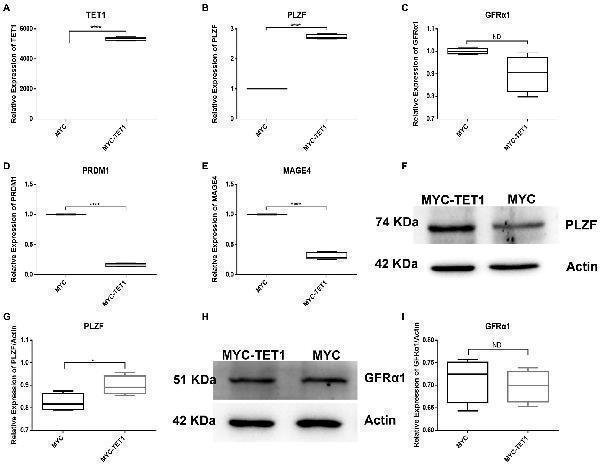
Relative expression of specific genes in spermatogonial cells. (A) The mRNA expression of TET1 in spermatogonial cells was detected by QRT-PCR. (B) The mRNA expression of PLZF in spermatogonial cells was detected by QRT-PCR. (C) The mRNA expression of GFRα1 in spermatogonial cells was detected by QRT-PCR. (D) The mRNA expression of PRDM1 in spermatogonial cells was detected by QRT-PCR. (E) The mRNA expression of MAGE4 in spermatogonial cells was detected by QRT-PCR. (F) The expression of PLZF in TET1 overexpressed cells was detected by Western Blot. (G) Quantification of PLZF protein levels in TET1 overexpressed cells. (H) The expression of GFRα1 in TET1 overexpressed cells was detected by Western Blot. (I) Quantification of GFRα1 protein levels in TET1 overexpressed cells. p < .0001(****), p < .001(***), p < .01(**), p < .05(*).
Index in PubMed under a CC BY license. PMID: 35222097
Click image to see more details
IHC analysis of GFRA1 using anti-GFRA1 antibody (PB9202).
GFRA1 was detected in a paraffin-embedded section of human lung cancer tissue. Heat mediated antigen retrieval was performed in EDTA buffer (pH 8.0, epitope retrieval solution). The tissue section was blocked with 10% goat serum. The tissue section was then incubated with 1 μg/ml rabbit anti-GFRA1 Antibody (PB9202) overnight at 4°C. Biotinylated goat anti-rabbit IgG was used as secondary antibody and incubated for 30 minutes at 37°C. The tissue section was developed using Strepavidin-Biotin-Complex (SABC) (Catalog # SA1022) with DAB as the chromogen.
Specific Publications For Anti-GDNF Receptor alpha 1/GFRA1 Antibody Picoband® (PB9202)
Loading publications
Recommended Resources
Here are featured tools and databases that you might find useful.
- Boster's Pathways Library
- Protein Databases
- Bioscience Research Protocol Resources
- Data Processing & Analysis Software
- Photo Editing Software
- Scientific Literature Resources
- Research Paper Management Tools
- Molecular Biology Software
- Primer Design Tools
- Bioinformatics Tools
- Phylogenetic Tree Analysis
Customer Reviews
Have you used Anti-GDNF Receptor alpha 1/GFRA1 Antibody Picoband®?
Share your experimental results or join a short interview to earn up to $1,000 in product credits or other rewards.
0 Reviews For Anti-GDNF Receptor alpha 1/GFRA1 Antibody Picoband®
Customer Q&As
Have a question?
Find answers in Q&As, reviews.
Can't find your answer?
Submit your question
4 Customer Q&As for Anti-GDNF Receptor alpha 1/GFRA1 Antibody Picoband®
Question
We are currently using anti-GDNF Receptor alpha 1/GFRA1 antibody PB9202 for human tissue, and we are content with the WB results. The species of reactivity given in the datasheet says human. Is it possible that the antibody can work on monkey tissues as well?
Verified Customer
Verified customer
Asked: 2019-09-17
Answer
The anti-GDNF Receptor alpha 1/GFRA1 antibody (PB9202) has not been tested for cross reactivity specifically with monkey tissues, but there is a good chance of cross reactivity. We have an innovator award program that if you test this antibody and show it works in monkey you can get your next antibody for free. Please contact me if I can help you with anything.
Boster Scientific Support
Answered: 2019-09-17
Question
Will PB9202 anti-GDNF Receptor alpha 1/GFRA1 antibody work on parafin embedded sections? If so, which fixation method do you recommend we use (PFA, paraformaldehyde, other)?
Verified Customer
Verified customer
Asked: 2019-06-21
Answer
It shows on the product datasheet, PB9202 anti-GDNF Receptor alpha 1/GFRA1 antibody as been validated on IHC. It is best to use PFA for fixation because it has better tissue penetration ability. PFA needs to be prepared fresh before use. Long term stored PFA turns into formalin, as the PFA molecules congregate and become formalin.
Boster Scientific Support
Answered: 2019-06-21
Question
Do you have a BSA free version of anti-GDNF Receptor alpha 1/GFRA1 antibody PB9202 available?
D. Krishna
Verified customer
Asked: 2019-04-26
Answer
We appreciate your recent telephone inquiry. I can confirm that some lots of this anti-GDNF Receptor alpha 1/GFRA1 antibody PB9202 are BSA free. For now, these lots are available and we can make a BSA free formula for you free of charge. It will take 3 extra days to prepare. If you require this antibody BSA free again in future, please do not hesitate to contact me and I will be pleased to check which lots we have in stock that are BSA free.
Boster Scientific Support
Answered: 2019-04-26
Question
Would anti-GDNF Receptor alpha 1/GFRA1 antibody PB9202 work on primate IHC with substantia nigra?
Verified Customer
Verified customer
Asked: 2017-12-25
Answer
Our lab technicians have not validated anti-GDNF Receptor alpha 1/GFRA1 antibody PB9202 on primate. You can run a BLAST between primate and the immunogen sequence of anti-GDNF Receptor alpha 1/GFRA1 antibody PB9202 to see if they may cross-react. If the sequence homology is close, then you can perform a pilot test. Keep in mind that since we have not validated primate samples, this use of the antibody is not covered by our guarantee. However we have an innovator award program that if you test this antibody and show it works in primate substantia nigra in IHC, you can get your next antibody for free.
Boster Scientific Support
Answered: 2017-12-25