Product Info Summary
| SKU: | PA1062 |
|---|---|
| Size: | 100 μg/vial |
| Reactive Species: | Human, Mouse, Rat |
| Host: | Rabbit |
| Application: | IHC, WB |
Customers Who Bought This Also Bought
Product info
Product Name
Anti-Neurotrophin 3/NTF3 Antibody Picoband®
SKU/Catalog Number
PA1062
BA1293 is an alternative SKU for this antibody, used in previous lots.
Size
100 μg/vial
Form
Lyophilized
Description
NTF3 (neurotrophin-3) is a neurotrophic ligand that activates NTRK3 (TrkC) receptor tyrosine kinase signaling, engaging canonical survival/growth pathways such as PI3K–AKT and MAPK modules downstream of receptor autophosphorylation. Assay context: Human/Mouse/Rat-reactive antibody tested in IHC and WB for tissue localization and lysate confirmation; can be compared with other trophic-factor pathways such as GDNF in neurorepair/neuroinflammation contexts (putative co-panel).
Storage & Handling
Store at -20˚C for one year from date of receipt. After reconstitution, at 4˚C for one month. It can also be aliquotted and stored frozen at -20˚C for six months. Avoid repeated freeze-thaw cycles.
Cite This Product
Anti-Neurotrophin 3/NTF3 Antibody Picoband® (Boster Biological Technology, Pleasanton CA, USA, Catalog # PA1062)
Host
Rabbit
Contents
Each vial contains antibody formulated with stabilizing components, 0.9mg NaCl, 0.2mg Na2HPO4, 0.05mg Thimerosal, 0.05mg NaN3.
*This antibody is supplied in a stabilized formulation.
Compatibility with conjugation reactions depends on the chemistry of the conjugation method used.
For conjugation methods that are not compatible with the stabilizing components present in this formulation, a carrier-free antibody format is required.
Clonality
Polyclonal
Isotype
Rabbit IgG
Immunogen
A synthetic peptide corresponding to a sequence in the middle region of human Neurotrophin 3, identical to the related rat and mouse sequences.
Cross-reactivity
No cross-reactivity with other proteins
Reactive Species
PA1062 is reactive to NTF3 in Human, Mouse, Rat
Observed Molecular Weight
47 kDa
Calculated molecular weight
29.4 kDa
Background of NTF3
Neurotrophin-3 is a member of a family of neurotrophic factors, that is closely related to both nerve growth factor and brain derived neurotrophic factor. These proteins are involved in the maintenance of the adult nervous system and affect development of neurons in the embryo when it is expressed in human placenta. NT3 deficient mice generated by gene targeting display severe movement defects of the limbs.
Antibody Validation
Boster validates all antibodies on WB, IHC, ICC, Immunofluorescence, and ELISA with known positive control and negative samples to ensure specificity and high affinity, including thorough antibody incubations.
Application & Images
Applications
PA1062 is guaranteed for IHC, WB Boster Guarantee
Assay Dilutions Recommendation
The recommendations below provide a starting point for assay optimization. The actual working concentration varies and should be decided by the user.
Immunohistochemistry (Paraffin-embedded Section), 0.5-1μg/ml, Rat, Human, Mouse
Western blot, 0.1-0.5μg/ml, Human, Mouse, Rat
Positive Control
WB: Rat Brain Tissue, Rat Brain Tissue, MCF-7 Cell, HELA Cell
IHC: Rat Brain Tissue
Validation Images & Assay Conditions
Click image to see more details
Anti-Neurotrophin 3 antibody, PA1062, Western blotting
Lane 1: Rat Brain Tissue Lysate
Lane 2: Rat Brain Tissue Lysate
Lane 3: MCF-7 Cell Lysate
Lane 4: HELA Cell Lysate
Click image to see more details
Anti-Neurotrophin 3 antibody, PA1062, IHC(P)
IHC(P): Rat Brain Tissue
Click image to see more details
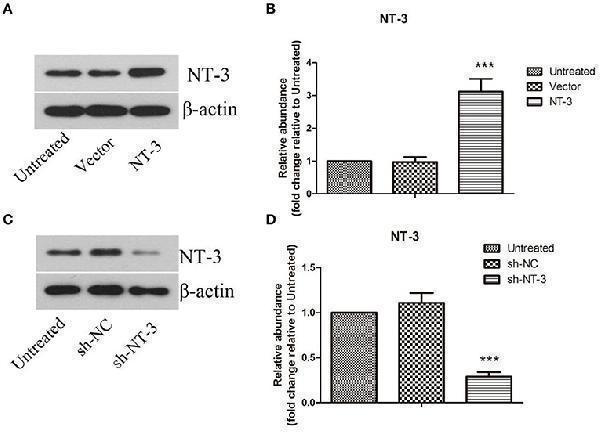
Lentivirus-mediated overexpression or interference of NT-3 in BMSCs. (A,C) The protein level of NT-3 in BMSCs transfected by lentivirus was detected by western blot assay. β-actin was used as a loading control. (B,D) The densitometric analysis results were shown. The data were expressed as means ± SD ( n = 3). The results displayed were obtained from at least three independent experiments. *** P < 0.001, versus the vector group or sh-NC group.
Index in PubMed under a CC BY license. PMID: 33642999
Click image to see more details
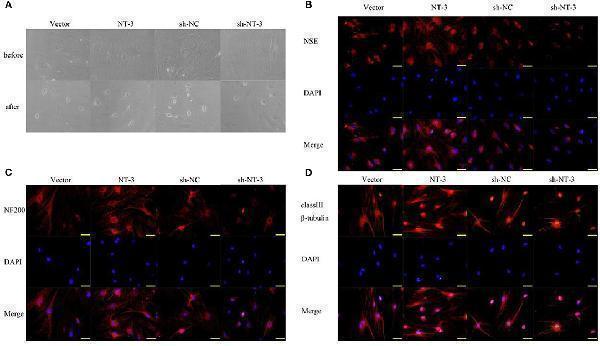
Effect of NT-3 on the differentiation of BMSCs into neurons. (A) The morphology changes of BMSCs before and after neuronal differentiation induction were observed under the microscope. (B–D) The expressions of NSE, NF-200, and class III β-tubulin were assessed by immunofluorescence staining. Scale bars represent 50 μm. The results displayed were obtained from at least three independent experiments.
Index in PubMed under a CC BY license. PMID: 33642999
Click image to see more details
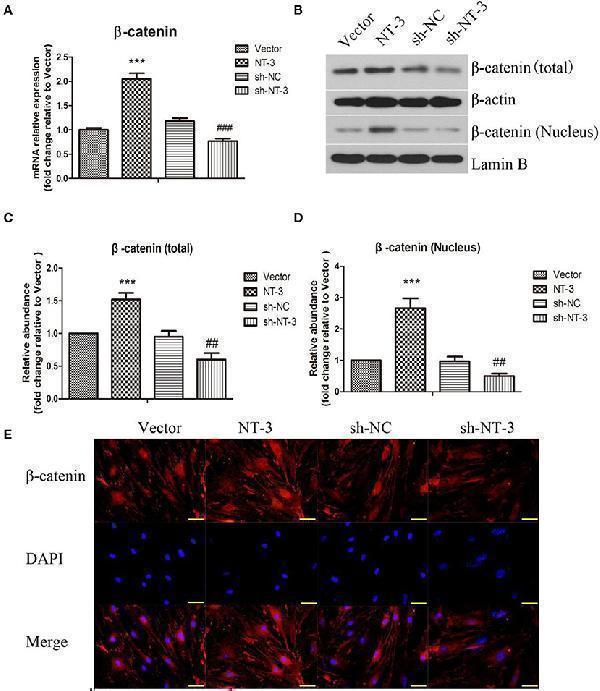
Effect of NT-3 on Wnt/β-catenin signaling pathway in BMSCs. (A) The mRNA expression of NT-3 in BMSCs was assessed by qPCR. (B) The levels of total and nuclear β-catenin in BMSCs were determined by western blot assay. β-actin and Lamin B were used as loading controls. (C,D) The densitometric analysis results were shown. (E) The expression of β-catenin in BMSCs was detected by immunofluorescence staining. Scale bars represent 50 μm. The data were expressed as means ± SD ( n = 3). The results displayed were obtained from at least three independent experiments. *** P < 0.001, vs. the vector group. ## P < 0.01; ### P < 0.001, vs. the sh-NC group.
Index in PubMed under a CC BY license. PMID: 33642999
Click image to see more details
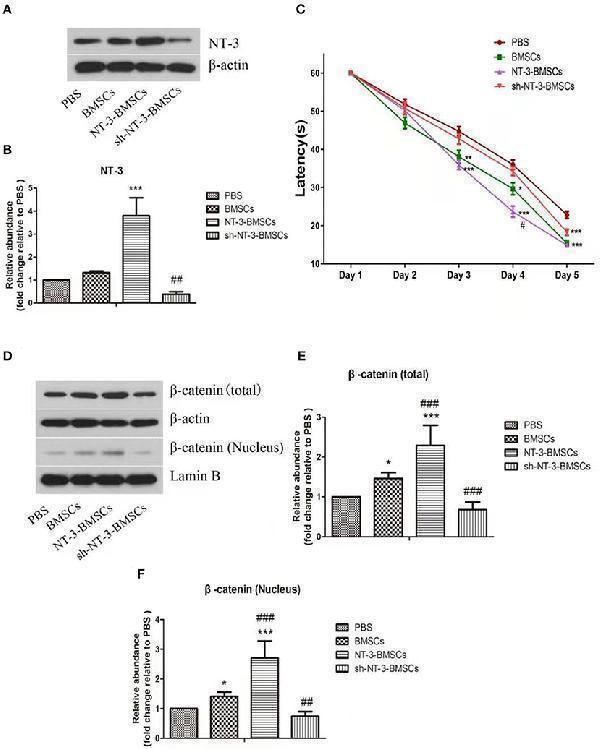
Effect of NT-3 genetic modified BMSCs transplantation on the cognitive function and Wnt/β-catenin pathway in rats with AD. (A) The protein levels of NT-3 in brain tissues were assessed by western blot assay. β-actin was used as a loading control. (B) The densitometric analysis results were shown. (C) The cognitive function of the AD rats were determined by MWM. The mean escape latency of each group was shown. (D) The levels of total and nuclear β-catenin in brain tissues were determined by western blot assay. β-actin and Lamin B were used as loading controls. (E,F) The densitometric analysis results were shown. The data were expressed as means ± SD ( n = 4). The results displayed were obtained from at least three independent experiments. * P < 0.05, ** P < 0.01; *** P < 0.001, vs. the PBS group. # P < 0.05; ## P < 0.01; ### P < 0.001, vs. the BMSCs group.
Index in PubMed under a CC BY license. PMID: 33642999
Click image to see more details
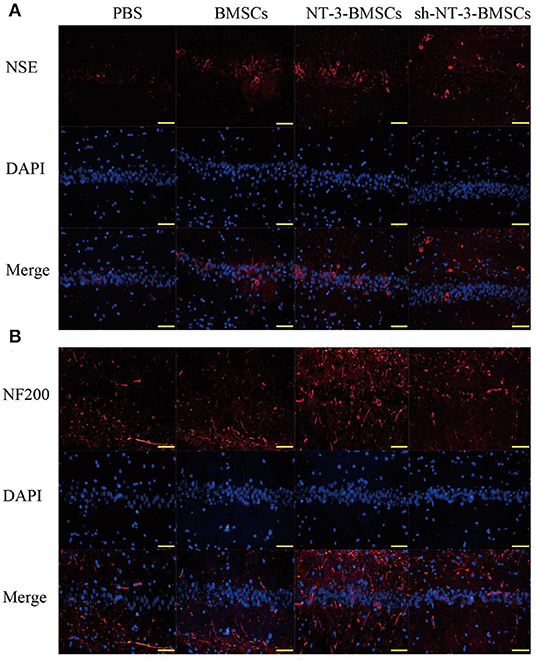
Effect of NT-3 genetic modified BMSCs transplantation on neurogenesis in brain tissues. The expressions of NSE (A) and NF-200 (B) in the brain tissues were determined by immunofluorescence staining. Scale bars represent 50 μm. The results displayed were obtained from at least three independent experiments.
Index in PubMed under a CC BY license. PMID: 33642999
Specific Publications For Anti-Neurotrophin 3/NTF3 Antibody Picoband® (PA1062)
Loading publications
Recommended Resources
Here are featured tools and databases that you might find useful.
- Boster's Pathways Library
- Protein Databases
- Bioscience Research Protocol Resources
- Data Processing & Analysis Software
- Photo Editing Software
- Scientific Literature Resources
- Research Paper Management Tools
- Molecular Biology Software
- Primer Design Tools
- Bioinformatics Tools
- Phylogenetic Tree Analysis
Customer Reviews
Have you used Anti-Neurotrophin 3/NTF3 Antibody Picoband®?
Share your experimental results or join a short interview to earn up to $1,000 in product credits or other rewards.
0 Reviews For Anti-Neurotrophin 3/NTF3 Antibody Picoband®
Customer Q&As
Have a question?
Find answers in Q&As, reviews.
Can't find your answer?
Submit your question