Product Info Summary
| SKU: | A00016-3 |
|---|---|
| Size: | 100μl |
| Reactive Species: | Human, Mouse, Rat |
| Host: | Mouse |
| Application: | ELISA, IF, IHC, WB |
Customers Who Bought This Also Bought
Product info
Product Name
Anti-p16 CDKN2A Monoclonal Antibody
SKU/Catalog Number
A00016-3
Size
100μl
Form
Liquid
Description
Boster Bio Anti-p16 CDKN2A Monoclonal Antibody catalog # A00016-3. Tested in WB, IHC, IF, ELISA applications. This antibody reacts with Human, Mouse, Rat.
Storage & Handling
Store at -20°C for one year. For short term storage and frequent use, store at 4°C for up to one month. Avoid repeated freeze-thaw cycles.
Cite This Product
Anti-p16 CDKN2A Monoclonal Antibody (Boster Biological Technology, Pleasanton CA, USA, Catalog # A00016-3)
Host
Mouse
Contents
Ascitic fluid containing 0.03% sodium azide, 0.5% stabilizing protein, 50% glycerol
*This antibody is supplied in a stabilized formulation.
Compatibility with conjugation reactions depends on the chemistry of the conjugation method used.
For conjugation methods that are not compatible with the stabilizing components present in this formulation, a carrier-free antibody format is required.
Clonality
Monoclonal
Clone Number
1E12E1
Isotype
IgG1
Immunogen
Purified recombinant fragment of p16 expressed in E. Coli.
Reactive Species
A00016-3 is reactive to CDKN2A in Human, Mouse, Rat
Observed Molecular Weight
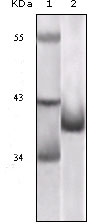
39 kDa
Calculated molecular weight
13.9 kDa
Antibody Validation
Boster validates all antibodies on WB, IHC, ICC, Immunofluorescence, and ELISA with known positive control and negative samples to ensure specificity and high affinity, including thorough antibody incubations.
Application & Images
Applications
A00016-3 is guaranteed for ELISA, IF, IHC, WB Boster Guarantee
Assay Dilutions Recommendation
The recommendations below provide a starting point for assay optimization. The actual working concentration varies and should be decided by the user.
WB 1:500-1:2000
IHC 1:200-1:1000
ELISA 1:10000
IF 1:50-200
Validation Images & Assay Conditions
Click image to see more details
Western blot analysis using p16 monoclonal antibody against truncated p16 recombinant protein.
Click image to see more details
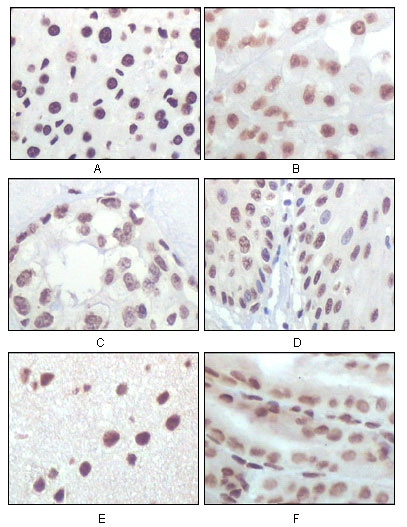
Immunohistochemistry analysis of paraffin-embedded rat liver tissue (A) , human brain tumor (B) , breast cancer (C) , esophageal epithelium tissue (D) , mouse brain tissue (E) and stomach tisue (F) , showing nuclear localization with DAB staining using p16 Mon
Click image to see more details
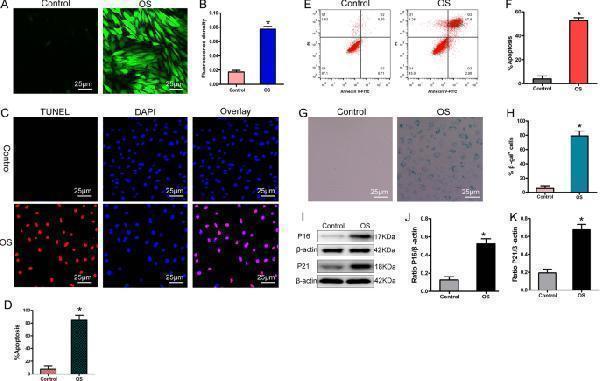
Accumulation of damaged mitochondria led to stress-induced apoptosis and senescence. a , b 2′,7′-Dichlorofluorescin diacetate (DCFH-DA) detection of reactive oxygen species (ROS; n = 4). c , d TUNEL–DAPI detection of deoxyribonucleic acid (DNA) damage and apoptosis ( n = 4). e , f Annexin V–FITC and propidium iodide (PI) detection of apoptosis ( n = 4). g , h Detection of β-gal activity by β-gal staining ( n = 4). i – k Western blot analysis of P16 and P21 expression ( n = 3). In ( b ), ( d ), ( f ), ( h ), and ( j – k ), data are presented as means ± SD. Statistical significances were calculated by Student’s t test. Data were compared with the control group: * P < 0.05. H 2 O 2 was used to simulate OS; L-DMEM was used as control. TUNEL = terminal deoxynucleotidyl transferase deoxyuridine-5′-triphosphate nick end labeling; DAPI = 4′,6-diamidino-2-phenylindole; FITC = fluorescein isothiocyanate; P16 = protein 16; P21 = protein 21; β-gal = β-galactosidase.
Index in PubMed under a CC BY license. PMID: 31959744
Specific Publications For Anti-p16 CDKN2A Monoclonal Antibody (A00016-3)
Loading publications
Recommended Resources
Here are featured tools and databases that you might find useful.
- Boster's Pathways Library
- Protein Databases
- Bioscience Research Protocol Resources
- Data Processing & Analysis Software
- Photo Editing Software
- Scientific Literature Resources
- Research Paper Management Tools
- Molecular Biology Software
- Primer Design Tools
- Bioinformatics Tools
- Phylogenetic Tree Analysis
Customer Reviews
Have you used Anti-p16 CDKN2A Monoclonal Antibody?
Share your experimental results or join a short interview to earn up to $1,000 in product credits or other rewards.
0 Reviews For Anti-p16 CDKN2A Monoclonal Antibody
Customer Q&As
Have a question?
Find answers in Q&As, reviews.
Can't find your answer?
Submit your question
12 Customer Q&As for Anti-p16 CDKN2A Monoclonal Antibody
Question
My question regards to test anti-p16 Monoclonal antibody A00016-3 on rat adenohypophysis for research purposes, then I may be interested in using anti-p16 Monoclonal antibody A00016-3 for diagnostic purposes as well. Is the antibody suitable for diagnostic purposes?
Verified Customer
Verified customer
Asked: 2020-05-08
Answer
The products we sell, including anti-p16 Monoclonal antibody A00016-3, are only intended for research use. They would not be suitable for use in diagnostic work. If you have the means to develop a product into diagnostic use, and are interested in collaborating with us and develop our product into an IVD product, please contact us for more discussions.
Boster Scientific Support
Answered: 2020-05-08
Question
Is there a BSA free version of anti-p16 Monoclonal antibody A00016-3 available?
Verified Customer
Verified customer
Asked: 2020-04-09
Answer
We appreciate your recent telephone inquiry. I can confirm that some lots of this anti-p16 Monoclonal antibody A00016-3 are BSA free. For now, these lots are available and we can make a BSA free formula for you free of charge. It will take 3 extra days to prepare. If you require this antibody BSA free again in future, please do not hesitate to contact me and I will be pleased to check which lots we have in stock that are BSA free.
Boster Scientific Support
Answered: 2020-04-09
Question
Does A00016-3 anti-p16 Monoclonal antibody work on parafin embedded sections? If so, which fixation method do you recommend we use (PFA, paraformaldehyde, other)?
Verified Customer
Verified customer
Asked: 2020-04-02
Answer
As indicated on the product datasheet, A00016-3 anti-p16 Monoclonal antibody as been tested on IHC. It is best to use PFA for fixation because it has better tissue penetration ability. PFA needs to be prepared fresh before use. Long term stored PFA turns into formalin, as the PFA molecules congregate and become formalin.
Boster Scientific Support
Answered: 2020-04-02
Question
Will anti-p16 Monoclonal antibody A00016-3 work for IHC with adenohypophysis?
Verified Customer
Verified customer
Asked: 2020-01-03
Answer
According to the expression profile of adenohypophysis, CDKN2A is highly expressed in adenohypophysis. So, it is likely that anti-p16 Monoclonal antibody A00016-3 will work for IHC with adenohypophysis.
Boster Scientific Support
Answered: 2020-01-03
Question
I see that the anti-p16 Monoclonal antibody A00016-3 works with IHC, what is the protocol used to produce the result images on the product page?
M. Mangal
Verified customer
Asked: 2019-12-09
Answer
You can find protocols for IHC on the "support/technical resources" section of our navigation menu. If you have any further questions, please send an email to support@bosterbio.com
Boster Scientific Support
Answered: 2019-12-09
Question
Is this A00016-3 anti-p16 Monoclonal antibody reactive to the isotypes of CDKN2A?
Verified Customer
Verified customer
Asked: 2019-08-30
Answer
The immunogen of A00016-3 anti-p16 Monoclonal antibody is Purified recombinant fragment of p16 expressed in E. Coli. Could you tell me which isotype you are interested in so I can help see if the immunogen is part of this isotype?
Boster Scientific Support
Answered: 2019-08-30
Question
Is a blocking peptide available for product anti-p16 Monoclonal antibody (A00016-3)?
Verified Customer
Verified customer
Asked: 2019-06-24
Answer
We do provide the blocking peptide for product anti-p16 Monoclonal antibody (A00016-3). If you would like to place an order for it please contact support@bosterbio.com and make a special request.
Boster Scientific Support
Answered: 2019-06-24
Question
My question regarding product A00016-3, anti-p16 Monoclonal antibody . I was wondering if it would be possible to conjugate this antibody with biotin. I would need it to be without BSA or sodium azide. I am planning on using a buffer exchange of sodium azide with PBS only. Would there be problems for me to conjugate the antibody and store it in -20 degrees in small aliquots?
Verified Customer
Verified customer
Asked: 2019-05-28
Answer
We do not advise storing this antibody with PBS buffer only in -20 degrees. If you want to store it in -20 degrees it is best to add some cryoprotectant like glycerol. If you want carrier free A00016-3 anti-p16 Monoclonal antibody , we can provide it to you in a special formula with trehalose and/or glycerol. These molecules will not interfere with conjugation chemistry and provide a good level of protection for the antibody from degradation. Please be sure to specify this in your purchase order.
Boster Scientific Support
Answered: 2019-05-28
Question
See below the WB image, lot number and protocol we used for adenohypophysis using anti-p16 Monoclonal antibody A00016-3. Please let me know if you require anything else.
Verified Customer
Verified customer
Asked: 2019-05-14
Answer
Thank you very much for the data. Our lab team are working to resolve this as quickly as possible, and we appreciate your patience and understanding! You have provided everything we needed. Please let me know if there is anything you need in the meantime.
Boster Scientific Support
Answered: 2019-05-14
Question
I was wanting to use your anti-p16 Monoclonal antibody for IHC for rat adenohypophysis on frozen tissues, but I want to know if it has been tested for this particular application. Has this antibody been tested and is this antibody a good choice for rat adenohypophysis identification?
Verified Customer
Verified customer
Asked: 2018-03-26
Answer
You can see on the product datasheet, A00016-3 anti-p16 Monoclonal antibody has been validated for IHC, WB on human, mouse, rat tissues. We have an innovator award program that if you test this antibody and show it works in rat adenohypophysis in IHC-frozen, you can get your next antibody for free.
Boster Scientific Support
Answered: 2018-03-26
Question
We are currently using anti-p16 Monoclonal antibody A00016-3 for rat tissue, and we are well pleased with the IHC results. The species of reactivity given in the datasheet says human, mouse, rat. Is it possible that the antibody can work on primate tissues as well?
T. Johnson
Verified customer
Asked: 2018-02-09
Answer
The anti-p16 Monoclonal antibody (A00016-3) has not been tested for cross reactivity specifically with primate tissues, though there is a good chance of cross reactivity. We have an innovator award program that if you test this antibody and show it works in primate you can get your next antibody for free. Please contact me if I can help you with anything.
Boster Scientific Support
Answered: 2018-02-09
Question
We appreciate helping with my inquiry over the phone. Here are the WB image, lot number and protocol we used for adenohypophysis using anti-p16 Monoclonal antibody A00016-3. Let me know if you need anything else.
D. Taylor
Verified customer
Asked: 2013-11-22
Answer
We appreciate the data. You have provided everything we needed. Our lab team are working to resolve your inquiry as quickly as possible, and we appreciate your patience and understanding! Please let me know if there is anything you need in the meantime.
Boster Scientific Support
Answered: 2013-11-22