This website uses cookies to ensure you get the best experience on our website.


- Table of Contents
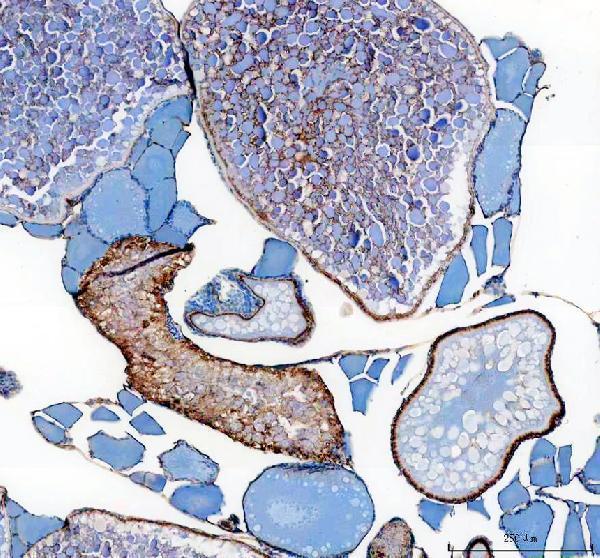
Designing an IHC experiment for GDF9? The guide has the expected staining pattern, antigen retrieval and fixation, antibodies backed by real IHC images, the tissue controls to run alongside, and protocols taken from published papers.
Open the GDF9 IHC Guide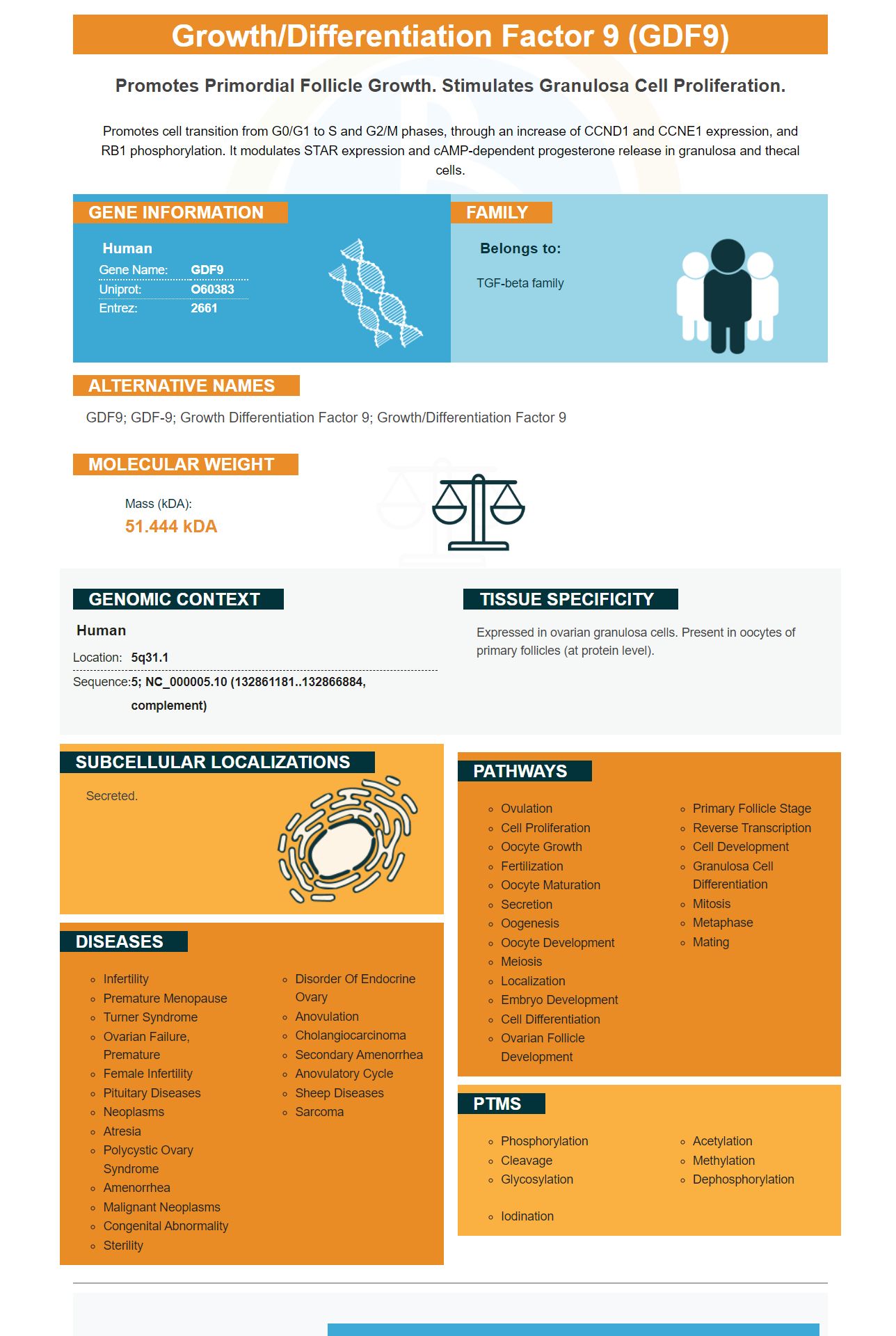
4 Citations
1 Citations
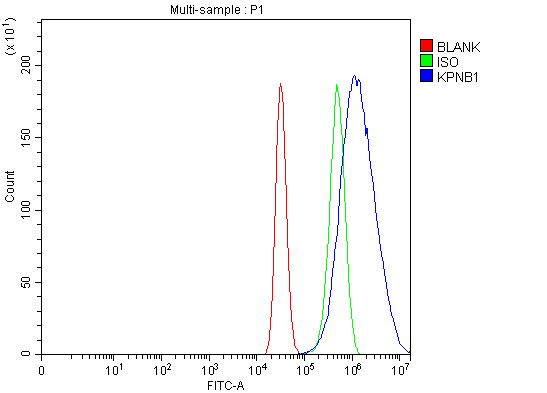
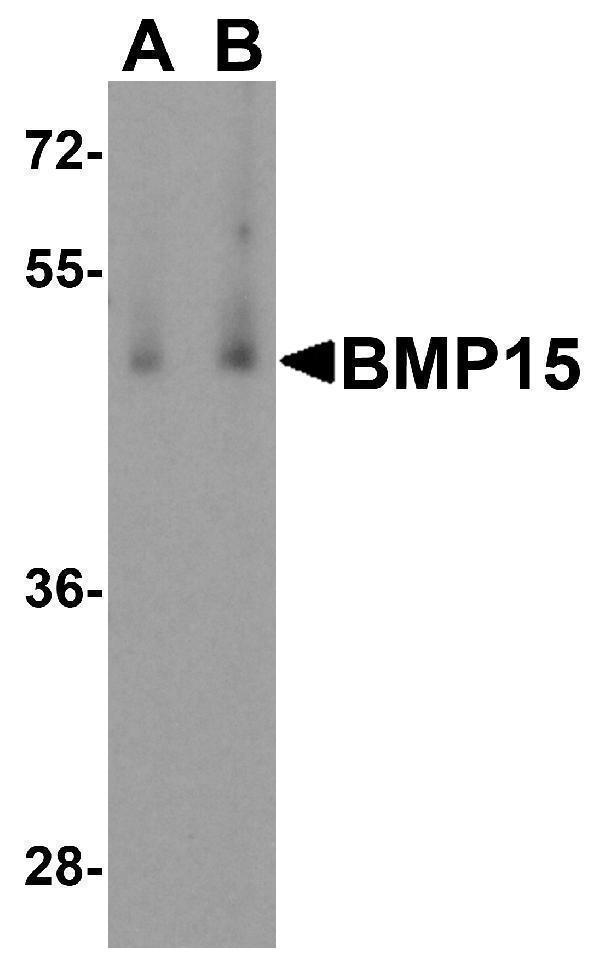
Facts about Growth/differentiation factor 9.
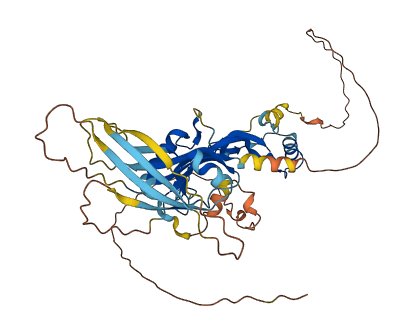
Promotes cell transition from G0/G1 to S and G2/M phases, through an increase of CCND1 and CCNE1 expression, and RB1 phosphorylation. It modulates STAR expression and cAMP-dependent progesterone release in granulosa and thecal cells.
| Human | |
|---|---|
| Gene Name: | GDF9 |
| Uniprot: | O60383 |
| Entrez: | 2661 |

| Belongs to: |
|---|
| TGF-beta family |

GDF9; GDF-9; growth differentiation factor 9; growth/differentiation factor 9
Mass (kDA):
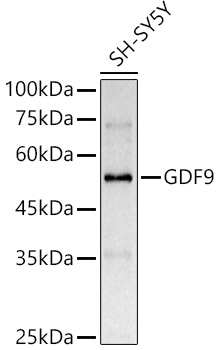
51.444 kDA

| Human | |
|---|---|
| Location: | 5q31.1 |
| Sequence: | 5; NC_000005.10 (132861181..132866884, complement) |
Expressed in ovarian granulosa cells. Present in oocytes of primary follicles (at protein level).
Secreted.




PMID: 10443672 by Aaltonen J., et al. Human growth differentiation factor 9 (GDF-9) and its novel homolog GDF-9B are expressed in oocytes during early folliculogenesis.
PMID: 12050262 by Yamamoto N., et al. Growth differentiation factor-9 inhibits 3'5'-adenosine monophosphate-stimulated steroidogenesis in human granulosa and theca cells.
*More publications can be found for each product on its corresponding product page