This website uses cookies to ensure you get the best experience on our website.


- Table of Contents
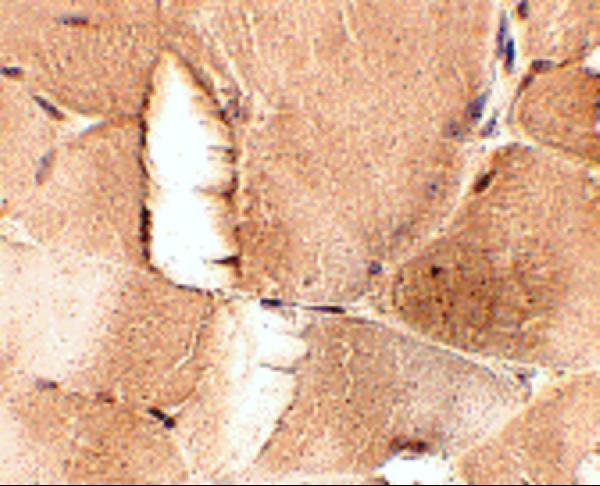
Designing an IHC experiment for Junctophilin-1? The guide has the expected staining pattern, antigen retrieval and fixation, antibodies backed by real IHC images, the tissue controls to run alongside, and protocols taken from published papers.
Open the JPH1 IHC Guide
Facts about Junctophilin-1.

JPH1 contributes to the building of the skeletal muscle triad by linking the t-tubule (transverse-tubule) and SR (sarcoplasmic reticulum) membranes. .
| Human | |
|---|---|
| Gene Name: | JPH1 |
| Uniprot: | Q9HDC5 |
| Entrez: | 56704 |

| Belongs to: |
|---|
| junctophilin family |

DKFZp762L0313; JP-1junctophilin type1; JP1junctophilin-1; junctophilin 1; Junctophilin type 1; mitsugumin72
Mass (kDA):
71.686 kDA

| Human | |
|---|---|
| Location: | 8q21.11 |
| Sequence: | 8; NC_000008.11 (74234700..74321540, complement) |
Abundantly expressed in skeletal muscle. Very low levels in heart.
Cell membrane; Peripheral membrane protein. Endoplasmic reticulum membrane; Single-pass type IV membrane protein. Sarcoplasmic reticulum membrane; Single-pass type IV membrane protein. Localized predominantly on the plasma membrane. The transmembrane domain is anchored in endoplasmic/sarcoplasmic reticulum membrane, while the N-terminal part associates with the plasma membrane. In skeletal muscle cells, it is predominantly localized at the junction of the A and I bands (By similarity).


PMID: 10891348 by Nishi M., et al. Characterization of human junctophilin subtype genes.