This website uses cookies to ensure you get the best experience on our website.


- Table of Contents
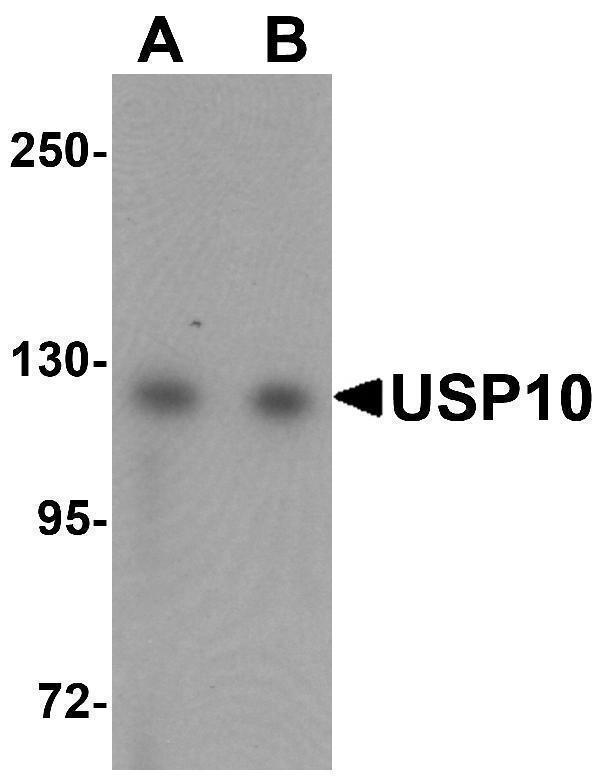
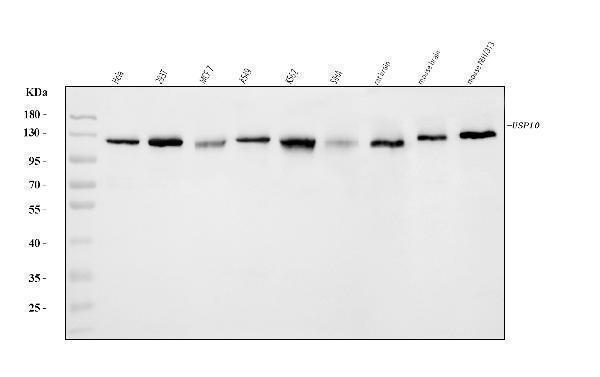
Designing a Western blot for USP10? The guide has the expected band size, antibodies backed by real blot images, the controls to run alongside, and protocols taken from published papers.
Open the USP10 Western Blot Guide
Facts about Ubiquitin carboxyl-terminal hydrolase 10.

Following DNA damage, translocates into the nucleus and deubiquitinates p53/TP53, leading to modulate the p53/TP53-dependent DNA damage response. Component of a regulatory loop which controls autophagy and p53/TP53 amounts: mediates deubiquitination of BECN1, a key regulator of autophagy, leading to stabilize the PIK3C3/VPS34- containing complexes.
| Human | |
|---|---|
| Gene Name: | USP10 |
| Uniprot: | Q14694 |
| Entrez: | 9100 |

| Belongs to: |
|---|
| peptidase C19 family |

Deubiquitinating enzyme 10; EC 3.4.19.12; KIAA0190MGC2621; ubiquitin carboxyl-terminal hydrolase 10; ubiquitin specific peptidase 10; ubiquitin specific protease 10; ubiquitin thioesterase 10; Ubiquitin Thiolesterase 10; Ubiquitin-specific-processing protease 10; UBPO; Uchrp; USP10
Mass (kDA):
87.134 kDA

| Human | |
|---|---|
| Location: | 16q24.1 |
| Sequence: | 16; NC_000016.10 (84699977..84779922) |
Widely expressed.
Cytoplasm. Nucleus. Early endosome. Cytoplasmic in normal conditions (PubMed:20096447). After DNA damage, translocates to the nucleus following phosphorylation by ATM (PubMed:20096447).




PMID: 11439350 by Soncini C., et al. Ras-GAP SH3 domain binding protein (G3BP) is a modulator of USP10, a novel human ubiquitin specific protease.
PMID: 17693683 by Tang L.-Y., et al. Quantitative phosphoproteome profiling of Wnt3a-mediated signaling network: indicating the involvement of ribonucleoside-diphosphate reductase M2 subunit phosphorylation at residue serine 20 in canonical Wnt signal transduction.