This website uses cookies to ensure you get the best experience on our website.


- Table of Contents
and ELISA kits, proteins related to Ankylosing Spondylitis.
Ankylosing Spondylitis (AS) is a chronic, inflammatory autoimmune disease that primarily affects the spine and sacroiliac joints, leading to pain, stiffness, and reduced flexibility. Over time, AS can cause the vertebrae to fuse, resulting in a hunched posture and limited mobility. This condition not only impacts physical health but also affects emotional well-being, as individuals may experience fatigue and decreased quality of life. While the exact cause of Ankylosing Spondylitis remains unclear, genetic and environmental factors are believed to play significant roles. Recent advancements in research have focused on developing targeted antibodies that aim to modulate the immune system, reduce inflammation, and slow disease progression. These innovative therapies offer hope for more effective management and improved outcomes for those living with AS.

Anti-TNF alpha Antibody Picoband®, Figure 2. IHC analysis of TNF alpha using anti-TNF alpha antibody (PA1079).
TNF alpha was detected in a paraffin-embedded section of human B lympho...
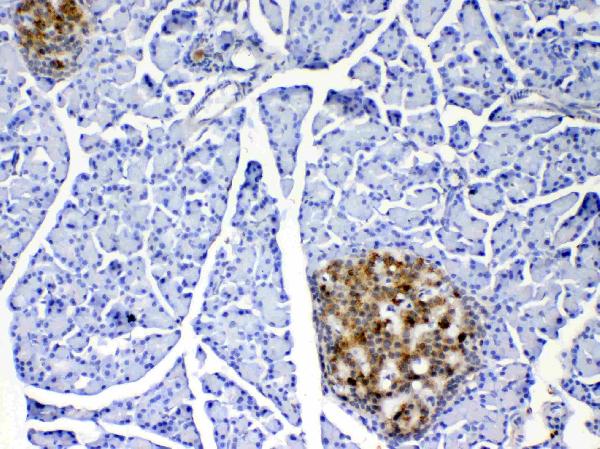
Anti-IL17/Il17a Antibody Picoband®, Figure 2. IF analysis of IL17 Alpha//Il17a using anti-IL17 Alpha/IL17a antibody (A00421-2).
IL17 Alpha/IL17 was detected in immunocytoc...
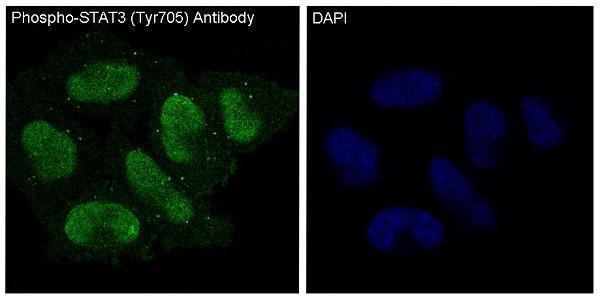
Anti-Phospho-STAT3 (Y705) Rabbit Monoclonal Antibody, Immunofluorescent analysis of HeLa cells treated with IFN-alpha, using Phospho-STAT3 (Y705) Antibody....
| Protein Name | Gene Name | Function |
|---|---|---|
| HLA-B27 | HLA-B | Major histocompatibility complex class I molecule involved in immune system regulation. |
| TNF-alpha | TNF | Pro-inflammatory cytokine playing a key role in systemic inflammation. |
| IL-17A | IL17A | Pro-inflammatory cytokine involved in autoimmune responses. |
| IL-23R | IL23R | Receptor for interleukin-23, important in the differentiation of Th17 cells. |
| ERAP1 | ERAP1 | Enzyme involved in antigen processing and presentation. |
| IL-1β | IL1B | Pro-inflammatory cytokine involved in immune and inflammatory responses. |
| IL-6 | IL6 | Cytokine involved in inflammation and maturation of B cells. |
| STAT3 | STAT3 | Transcription factor mediating cytokine signaling and inflammation. |
| IL-12B | IL12B | Subunit of interleukins 12 and 23, involved in T cell differentiation. |
| IL-18 | IL18 | Pro-inflammatory cytokine that enhances the activity of NK cells and T cells. |
| RANKL | TNFSF11 | Regulates osteoclast differentiation and bone remodeling. |
| CD74 | CD74 | Involved in antigen presentation and immune response regulation. |
| CCR6 | CCR6 | Chemokine receptor involved in the migration of immune cells. |
| RUNX3 | RUNX3 | Transcription factor involved in T cell differentiation and immune response. |
| PTGER4 | PTGER4 | Prostaglandin E receptor involved in inflammatory responses. |
| SLC22A5 | SLC22A5 | Organic cation transporter implicated in immune cell function. |
| B3GALT4 | B3GALT4 | Enzyme involved in glycosylation processes affecting immune function. |
| CARD9 | CARD9 | Adaptor protein involved in innate immune signaling pathways. |
| CD40 | CD40 | Costimulatory protein essential for B cell activation and immune responses. |
| KIR3DL2 | KIR3DL2 | Killer cell immunoglobulin-like receptor involved in natural killer cell regulation. |
Ankylosing Spondylitis (AS) has a strong genetic component, with the HLA-B27 gene being the most significant risk factor identified to date. Approximately 90-95% of individuals with AS test positive for HLA-B27, highlighting its critical role in disease susceptibility. The presence of HLA-B27 is believed to influence the immune system's ability to differentiate between self and non-self, potentially leading to chronic inflammation characteristic of AS. Research in this area focuses on understanding the mechanisms by which HLA-B27 contributes to the pathogenesis of AS, including its role in antigen presentation and the misfolding of proteins that may trigger inflammatory responses. Additionally, studies are exploring other genetic markers and their interactions with HLA-B27 to provide a more comprehensive understanding of the hereditary aspects of AS. Insights gained from genetic research are pivotal in developing targeted therapies and personalized treatment plans, aiming to improve disease management and patient outcomes.
The study of inflammatory pathways and cytokine signaling is central to understanding the pathophysiology of Ankylosing Spondylitis. Key cytokines such as Tumor Necrosis Factor-alpha (TNF-α) and Interleukins IL-17 and IL-23 play crucial roles in mediating inflammation and promoting the chronic immune responses seen in AS. Research in this area investigates how these cytokines interact within the immune system to drive the inflammatory processes that lead to joint damage and spinal fusion characteristic of AS. Therapeutic interventions targeting these cytokines, including biologic agents like TNF inhibitors and IL-17 blockers, have been developed based on insights from cytokine research. Ongoing studies aim to elucidate the precise pathways and feedback mechanisms involved, which may reveal novel targets for intervention and improve existing treatment strategies. Understanding the intricacies of inflammatory signaling not only aids in the development of more effective treatments but also enhances the ability to predict disease progression and tailor interventions to individual patient profiles.