This website uses cookies to ensure you get the best experience on our website.


- Table of Contents
and ELISA kits, proteins related to Lung Cancer.
Lung cancer remains one of the most prevalent and deadly cancers worldwide, accounting for a significant number of diagnoses and fatalities each year. It primarily originates in the cells lining the airways, with two main types: non-small cell lung cancer (NSCLC) and small cell lung cancer (SCLC). Despite advancements in detection and treatment, the prognosis for lung cancer patients can be challenging, underscoring the urgent need for innovative therapies. Antibody-based research has emerged as a promising frontier, offering targeted approaches that can specifically identify and attack cancer cells while minimizing harm to healthy tissues. By harnessing the power of antibodies, scientists are developing more effective treatments aimed at improving survival rates and enhancing the quality of life for those affected by lung cancer. Our commitment to advancing antibody research continues to drive breakthroughs in the fight against this formidable disease.
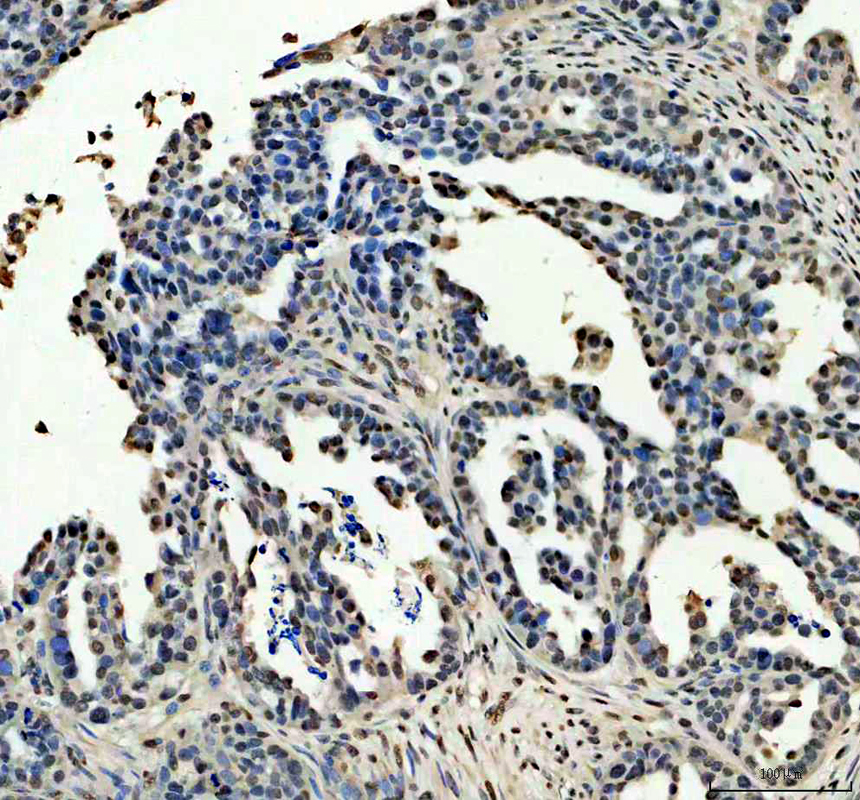
Anti-P53/TP53 Antibody Picoband®, Figure 4. IHC analysis of TP53 using anti-TP53 antibody (PB9008).
TP53 was detected in a paraffin-embedded section of humn ovarian cancer tissue. Heat mediated antigen retrieval was...

Anti-P53 Tp53 Monoclonal Antibody, Figure 3. IF analysis of p53 using anti-p53 antibody (MA1078).
p53 was detected in immunocytochemical section of A431 cell. Enzyme antigen retrieva...

Anti-beta Catenin/CTNNB1 Antibody Picoband®, Figure 9. IF analysis of CTNNB1 using anti-CTNNB1 antibody (A00004).
CTNNB1 was detected in a paraffin-embedded section...
| Protein Name | Gene Name | Function |
|---|---|---|
| Epidermal Growth Factor Receptor | EGFR | Promotes cell proliferation and survival through signaling pathways |
| Anaplastic Lymphoma Kinase | ALK | Involved in cell growth and differentiation; fusion genes drive oncogenesis |
| ROS Proto-Oncogene 1 | ROS1 | Encodes a receptor tyrosine kinase involved in cell signaling and growth |
| Kirsten Rat Sarcoma Viral Oncogene Homolog | KRAS | Regulates cell division, differentiation, and apoptosis |
| B-Raf Proto-Oncogene | BRAF | Serine/threonine kinase involved in the MAPK/ERK signaling pathway |
| MET Proto-Oncogene | MET | Encodes a receptor tyrosine kinase involved in cell growth and angiogenesis |
| RET Proto-Oncogene | RET | Encodes a receptor tyrosine kinase involved in cell proliferation and differentiation |
| Human Epidermal Growth Factor Receptor 2 | ERBB2 | Promotes cell growth and differentiation; target for certain therapies |
| Neurotrophic Receptor Tyrosine Kinase 1 | NTRK1 | Involved in nerve growth and survival; fusions drive oncogenesis |
| Tumor Protein p53 | TP53 | Regulates the cell cycle and functions as a tumor suppressor |
| Phosphatidylinositol-4,5-Bisphosphate 3-Kinase Catalytic Subunit Alpha | PIK3CA | Involved in the PI3K/AKT signaling pathway affecting growth and survival |
| Discoidin Domain Receptor Tyrosine Kinase 2 | DDR2 | Involved in cell adhesion, growth, and extracellular matrix remodeling |
| Serine/Threonine Kinase 11 | STK11 | Regulates cell metabolism, growth, and apoptosis as a tumor suppressor |
| Kelch Like ECH Associated Protein 1 | KEAP1 | Regulates oxidative stress response and acts as a tumor suppressor |
| Fibroblast Growth Factor Receptor 1 | FGFR1 | Involved in cell growth, differentiation, and angiogenesis |
| Cyclin Dependent Kinase Inhibitor 2A | CDKN2A | Regulates the cell cycle by inhibiting CDK4/6 |
| SWI/SNF-Related, Matrix Associated, Actin Dependent Regulator of Chromatin, Subfamily A, Member 4 | SMARCA4 | Chromatin remodeler involved in gene expression and DNA repair |
| Retinoblastoma Protein | RB1 | Regulates the cell cycle and acts as a tumor suppressor |
| Catenin Beta 1 | CTNNB1 | Involved in cell adhesion and Wnt signaling pathway |
Precision medicine has revolutionized the approach to lung cancer treatment by tailoring therapies based on the genetic and molecular profile of an individual’s tumor. This sub-area focuses on identifying specific genetic mutations, such as EGFR, ALK, ROS1, and BRAF, which drive the growth and progression of lung cancer. By understanding these molecular alterations, clinicians can select targeted therapies that specifically inhibit the abnormal proteins produced by these mutations, leading to more effective and less toxic treatments compared to conventional chemotherapy. Additionally, ongoing research in this area aims to discover new genetic markers and develop novel inhibitors, enhancing the ability to personalize treatment plans for patients. This approach not only improves response rates and survival outcomes but also helps in overcoming resistance mechanisms that often arise with standard treatments. Precision medicine encompasses the integration of genomic data with clinical information to enable predictive modeling and the development of individualized therapeutic strategies, marking a significant advancement in the management of lung cancer.
Immunotherapy has emerged as a groundbreaking sub-field in lung cancer research, harnessing the body’s immune system to recognize and eliminate cancer cells. Central to this approach are immune checkpoint inhibitors, such as PD-1/PD-L1 and CTLA-4 antibodies, which block inhibitory pathways that prevent T-cells from effectively attacking tumor cells. These therapies have demonstrated significant improvements in survival rates for patients with non-small cell lung cancer (NSCLC) and are increasingly being integrated into first-line treatment protocols. Beyond checkpoint inhibitors, other immunotherapeutic strategies, including CAR-T cell therapy and cancer vaccines, are under investigation to enhance the immune response against lung cancer. Research in this area also focuses on understanding the tumor microenvironment and identifying biomarkers that predict response to immunotherapy, thereby optimizing patient selection and treatment efficacy. Immunotherapy offers the potential for durable responses and even long-term remission in some patients, representing a paradigm shift in the treatment landscape of lung cancer and providing hope for improved patient outcomes.