This website uses cookies to ensure you get the best experience on our website.


- Table of Contents
and ELISA kits, proteins related to Cholangiocarcinoma.
Cholangiocarcinoma, also known as bile duct cancer, is a rare and often aggressive form of cancer that originates in the bile ducts. These ducts are narrow tubes that transport bile, a fluid produced by the liver to aid in digestion. The disease is characterized by its silent progression, often remaining undetected until advanced stages, making it particularly challenging to treat effectively. Research into cholangiocarcinoma is vital as it aims to uncover the molecular and genetic underpinnings of the disease, improving diagnostic methods, and developing targeted therapies. Antibodies play a crucial role in this research by helping to identify specific antigens related to the cancer, thus paving the way for innovative therapeutic strategies. This focus on understanding the cellular mechanisms and immune profiles specific to cholangiocarcinoma promises new hope for treatments, with the ultimate goal of improving survival rates and quality of life for those affected.

Anti-VEGF/VEGFA Antibody Picoband®, YJD affected the VEGF/VEGFR-2/FAK pathway in vivo. ( A – B ) Germ cell markers MVH and Oct4 were detected by IF. ( C ) The expression of VEGF, VEGFR-2, and...
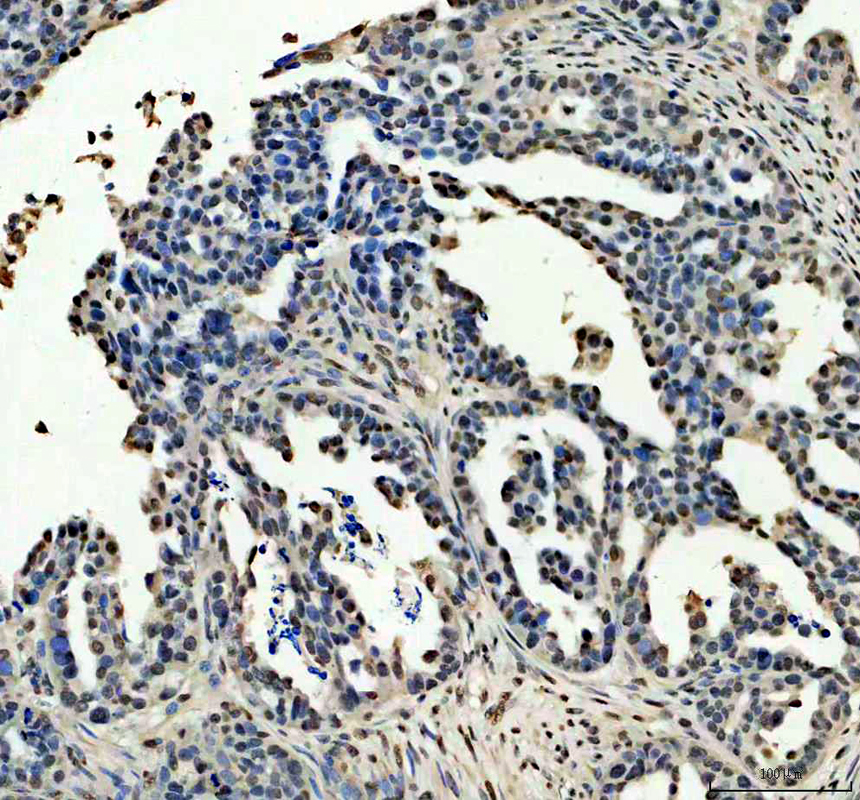
Anti-P53/TP53 Antibody Picoband®, IHC analysis of P53 using anti-P53 antibody (PB9008).
TP53 was detected in a paraffin-embedded section of humn ovarian cancer tissue. Heat mediated antigen retrieval was...

Anti-P53 Tp53 Monoclonal Antibody, IF analysis of p53 using anti-p53 antibody (MA1078).
p53 was detected in immunocytochemical section of A431 cell. Enzyme antigen retrieval was per...
| Protein Name | Gene Name | Function |
|---|---|---|
| FGFR2 | FGFR2 | Fibroblast growth factor receptor, involved in proliferation and survival; common mutations in cholangiocarcinoma indicate drug targets. |
| IDH1 | IDH1 | Isocitrate dehydrogenase 1, mutation affects cellular metabolism and epigenetic regulation. |
| KRAS | KRAS | Oncogene involved in signaling pathways regulating cell division, often mutated in cancer. |
| p53 | TP53 | Tumor suppressor protein, involved in DNA repair, cell cycle arrest, and apoptosis; frequently mutated in cancers. |
| BAP1 | BAP1 | BRCA1 associated protein, involved in chromatin dynamics and DNA repair. |
| BRCA2 | BRCA2 | Breast cancer type 2 susceptibility protein, important in DNA repair; mutations associated with high risk of several cancers. |
| ALK | ALK | Anaplastic lymphoma kinase, involved in cell growth; translocations/mutations can be oncogenic. |
| CDKN2A | CDKN2A | Cyclin-dependent kinase inhibitor 2A, regulates cell cycle and is a tumor suppressor; deletions and mutations are common in cancers. |
| NTRK1 | NTRK1 | Neurotrophic receptor tyrosine kinase 1, involved in nervous system development and potentially oncogenic when fused. |
| MSH2 | MSH2 | MutS homolog 2, involved in DNA mismatch repair; mutations lead to microsatellite instability and increase cancer risk. |
| PIK3CA | PIK3CA | Phosphatidylinositol-4,5-bisphosphate 3-kinase catalytic subunit alpha isoform, involved in signaling pathways controlling cell growth. |
| SMAD4 | SMAD4 | SMAD family member 4, mediates signal transduction by TGF-beta; mutations associated with various cancers. |
| HER2 | ERBB2 | Human Epidermal growth factor Receptor 2, involved in cell growth and differentiation; overexpression linked to several cancers. |
| EGFR | EGFR | Epidermal growth factor receptor, involved in cell growth and division; mutations and amplifications can be targeted by drugs. |
| PTEN | PTEN | Phosphatase and tensin homolog, a tumor suppressor negatively regulating the PI3K/AKT signaling pathway. |
| MET | MET | MET proto-oncogene, receptor tyrosine kinase involved in cell growth and survival. |
| MLH1 | MLH1 | MutL homolog 1, involved in DNA mismatch repair; mutations lead to high cancer risk due to microsatellite instability. |
| ARID1A | ARID1A | AT-rich interactive domain-containing protein 1A, involved in chromatin remodeling; frequently mutated in various cancers. |
| VEGF | VEGFA | Vascular endothelial growth factor, key regulator of angiogenesis; often targeted in cancer therapy. |
| PD-L1 | CD274 | Programmed death-ligand 1, involved in immune evasion of tumors; a target in immunotherapy treatments. |
Understanding the molecular pathogenesis of Cholangiocarcinoma (CCA) is crucial for developing targeted therapies and diagnostic tools. This subfield focuses on identifying the genetic and epigenetic changes that lead to the transformation of normal cholangiocytes into cancerous cells. Recent research has revealed a complex landscape of genetic mutations, including those in genes like KRAS, BRAF, and TP53, and abnormalities in pathways such as EGFR, VEGF, and PI3K/AKT/mTOR, which are pivotal in cell proliferation, survival, and angiogenesis. Moreover, the role of chronic inflammation and biliary diseases in altering DNA methylation and histone modification patterns has also been a focus. Insights gained from this area not only help in discerning the molecular underpinnings of CCA but also assist in stratifying patients for personalized therapy, which is crucial given the heterogeneity and generally poor prognosis of the disease.
Immunotherapy represents a groundbreaking shift in the treatment of various cancers, including Cholangiocarcinoma. This subfield explores the potential of harnessing the patient's immune system to fight cancer, focusing on the development and efficacy of immune checkpoint inhibitors, vaccines, and adoptive cell transfer therapy. Despite the traditionally limited response of CCA to conventional chemotherapies, emerging data suggest that certain subsets of patients may benefit significantly from immunotherapeutic approaches. For example, the presence of microsatellite instability (MSI) and mutations in IDH1/2 in some CCA patients might render them more responsive to these therapies. Research in this area also delves into the tumor microenvironment of CCA, which typically exhibits an immunosuppressive milieu that may inhibit effective anti-tumor immune responses. By understanding and modulating this environment, researchers aim to enhance the efficacy of immunotherapy in treating Cholangiocarcinoma.