This website uses cookies to ensure you get the best experience on our website.


- Table of Contents
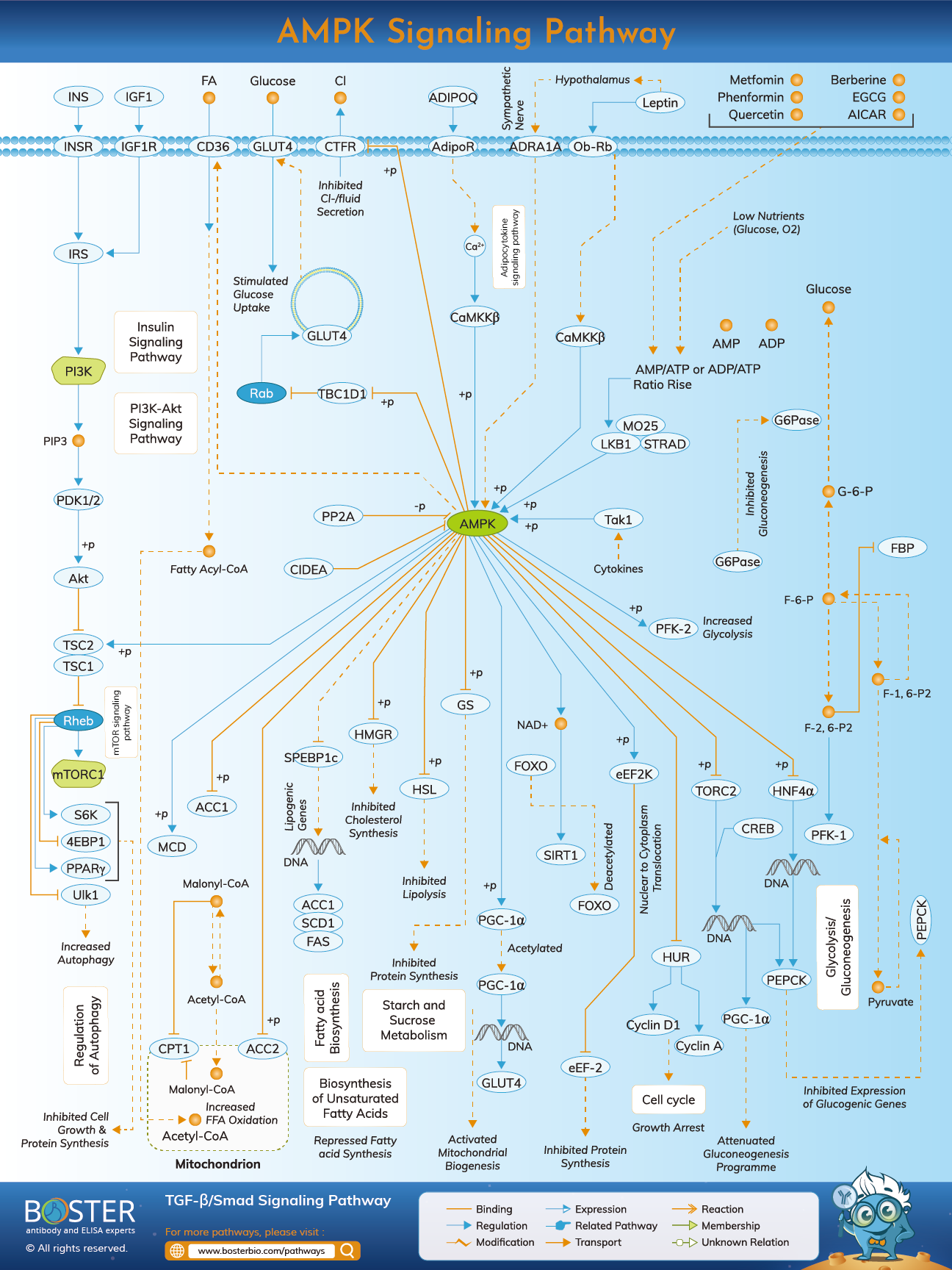
Interactive map for energy sensing, metabolism, autophagy and cell growth
Explore pathway targetsInteractive pathway map — select a highlighted node
Select a target to open its Boster gene card or a verified product/search result.
| Target | Role in pathway | Boster antibody route | Status |
|---|---|---|---|
| PRKAA1 (AMPKα1) | Central energy-sensing kinase | A00994-3 | Exact SKU |
| PIK3CA (PI3K) | Growth and insulin input | PB9314 | Exact SKU |
| MTOR | Anabolic growth and autophagy brake | A00003-2 | Exact SKU |
| RPS6KB1 (S6K) | Protein synthesis output | A01475-2 | Exact SKU |
| EIF4EBP1 (4E-BP1) | Translation control | A00968-1 | Exact SKU |
| SIRT1 | Mitochondrial and stress adaptation | A00018-1 | Exact SKU |
| FOXO1 | Catabolic transcription program | View live matches | Needs product selection |
| AKT1 | Opposing growth signal | View live matches | Needs product selection |
AMP-activated protein kinase coordinates cellular energy supply with demand. Rising AMP or ADP promotes AMPK activation through upstream kinases including LKB1 and CaMKKβ. Active AMPK suppresses energy-intensive biosynthesis while promoting glucose uptake, fatty-acid oxidation, mitochondrial adaptation and autophagy.
AMPK responds to a falling ATP state and redirects metabolism toward ATP production.
AMPK restrains mTORC1 through TSC2 and RAPTOR-linked control.
ACC, HMGCR, GLUT4, FOXO and PGC-1α connect the signal to lipid, glucose and mitochondrial programs.
Scale-test note: the native map contains many biochemical labels that are not direct gene symbols. The overlay highlights high-confidence gene-mappable nodes only.
AMPK intersects with insulin/PI3K–AKT signaling, mTOR-regulated translation, autophagy, lipid synthesis, gluconeogenesis and sirtuin-dependent mitochondrial control. This makes paired readouts more informative than a single AMPK measurement.
Supports glucose uptake and fuel oxidation during energetic stress.
Constrains lipogenesis and gluconeogenic programs.
Integrates hormonal and nutrient inputs relevant to feeding behavior.
Phosphorylated AMPKα together with a downstream substrate such as phospho-ACC provides stronger evidence than total AMPK alone.
AMPK and growth-factor signaling converge on mTORC1, so the paired readout reveals whether the metabolic checkpoint reaches anabolic output.