This website uses cookies to ensure you get the best experience on our website.


- Table of Contents
Following protein transfer, it is important to block the unreacted sites on the membrane using inert proteins and/or nonionic detergent to reduce levels of nonspecific protein binding during the assay. Including well-prepared blocking buffers can greatly improve the signal-to-noise ratio and help stabilize assay conditions. For labs aiming to reduce background and streamline results, using a professionally managed Western Blotting Service can help standardize the process and improve consistency across experiments. A clear understanding of the western blot principle helps ensure each step, including blocking, is performed correctly for optimal results. Blocking buffers should block all unreacted sites without disrupting target protein-membrane interactions or affect epitope availability. For researchers seeking a streamlined approach to minimize nonspecific binding and optimize blocking conditions, our In-Cell Western Blot Service provides a high-throughput alternative with reduced background interference. Additional considerations such as PVDF membranes, Phosphate-Buffered Saline, and compatibility with specific Blocking reagent formulations can also influence blocking efficiency.
There are three factors to consider when choosing an appropriate blocking agent for your specific protocol (click here for more western blot blocking optimization tips):
Some antibodies are sensitive to components found in common blocking agents. For instance, biotin-conjugated antibodies may show high background when used with nonfat dry milk, which naturally contains biotin. Similarly, phospho-specific antibodies may perform poorly with milk due to endogenous phosphatases. Always consult the antibody datasheet for recommended blocking agents and test alternatives like Bovine serum albumin (BSA), casein, or other protein-based blocker formulations when needed.
Ensuring that the primary antibody and secondary antibody are compatible with your selected blocking solution is essential for optimal binding.
Blocking agents should preserve the structure and accessibility of the protein’s epitopes. Certain proteins—particularly those with post-translational modifications—may be masked or degraded if incompatible blocking agents are used. For example, phosphorylated proteins may be affected by milk-derived phosphatases, leading to weak or missing bands.
Selecting a blocking agent that maintains target stability supports clear detection of your protein expression and prevents loss of your target protein of interest during gel electrophoresis or subsequent steps.
The type of detection system—chemiluminescent, fluorescent, or colorimetric—can influence which blocking agent is most suitable. Some preservatives (e.g. sodium azide) can inhibit enzyme activity in HRP-based detection, while PBS-based buffers may interfere with alkaline phosphatase systems. If your workflow uses chemiluminescent detection, ensure the blocking system is compatible with HRP activity. When working with AP-linked antibodies, avoid PBS-based buffers and use TBS or appropriate Phosphate-Buffered Saline alternatives. Selecting a blocking agent and buffer system that aligns with your detection chemistry helps maintain clarity and strengthens your signal-to-noise ratio.
For a more detailed breakdown of each step and best practices, explore our western blot optimization guide.
The most typical blocking solutions are nonfat dry milk, casein, gelatin, or Tween-20 in TBS and/or PBS buffers. Here are some advantages and disadvantages of some common blocking agents:
We advise reviewing the data sheet for any recommended blocking agents because antibodies can be very sensitive to the blocking agents used.
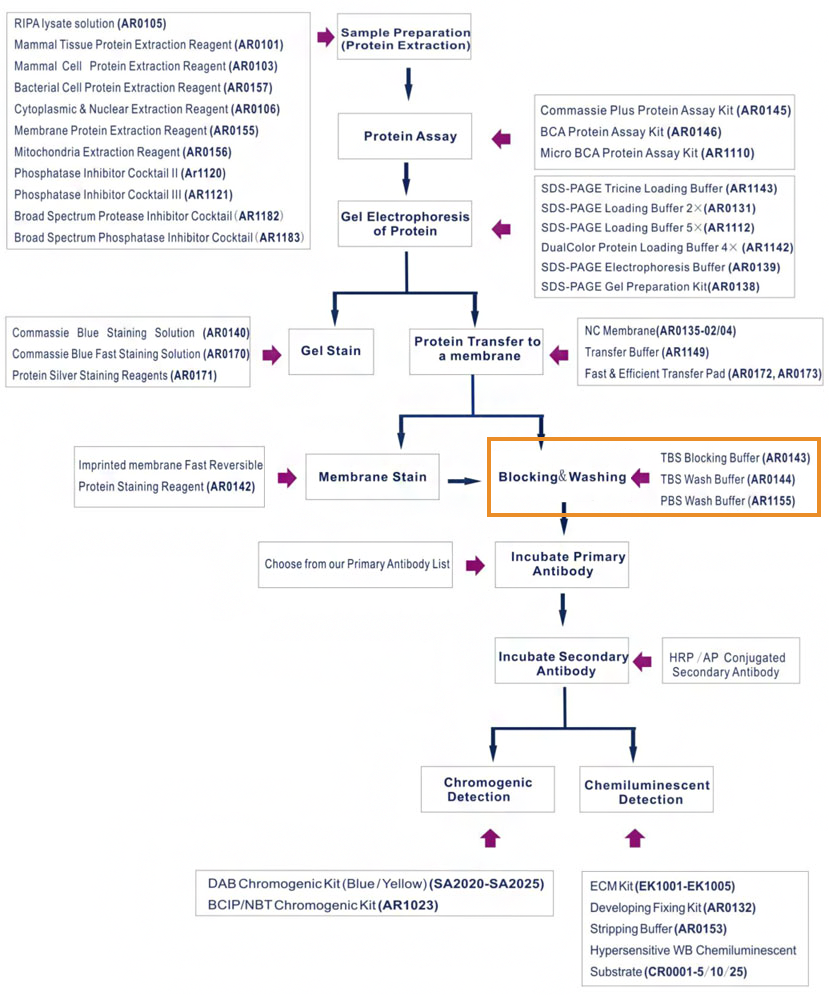
Here is a summary workflow for a typical WB experimental protocol along with necessary reagents for each step. Comprehensive western blot sample preparation is an essential part of this workflow, as it directly influences the reliability and clarity of the downstream results. Click on the flowchart image to shop WB Reagents & Kits, 20.17% off for a limited time!
Many different factors in the blocking step may need troubleshooting during western blotting... For more troubleshooting and optimization tips, visit our western blot troubleshooting resource:
More WB Resources*Note to educators: you are permitted to share BosterBio's resources and PDFs on your class websites and lab websites. Please make sure to cite or link to the origin.

Featured Western Blotting Products
Promotion for Western Blotting Reagents happening now! Shop for Western Blot Reagents and Protein Analysis Kits here: Shop for Savings!